What is a survey plan?
A survey plan is what you write before anyone writes a question. It records the decision the survey serves, who should answer, how many answers you need, each question with the reason it is there, and how the results will be read. Most weak surveys fail at this stage: they ask too much, of the wrong people, with no idea what to do with the answers.
This template holds the plan in six blocks. The example is for Earshot, a made-up podcast app that wants to choose the features of a paid tier called Earshot Plus, launching in Q4.
The goal and the audience
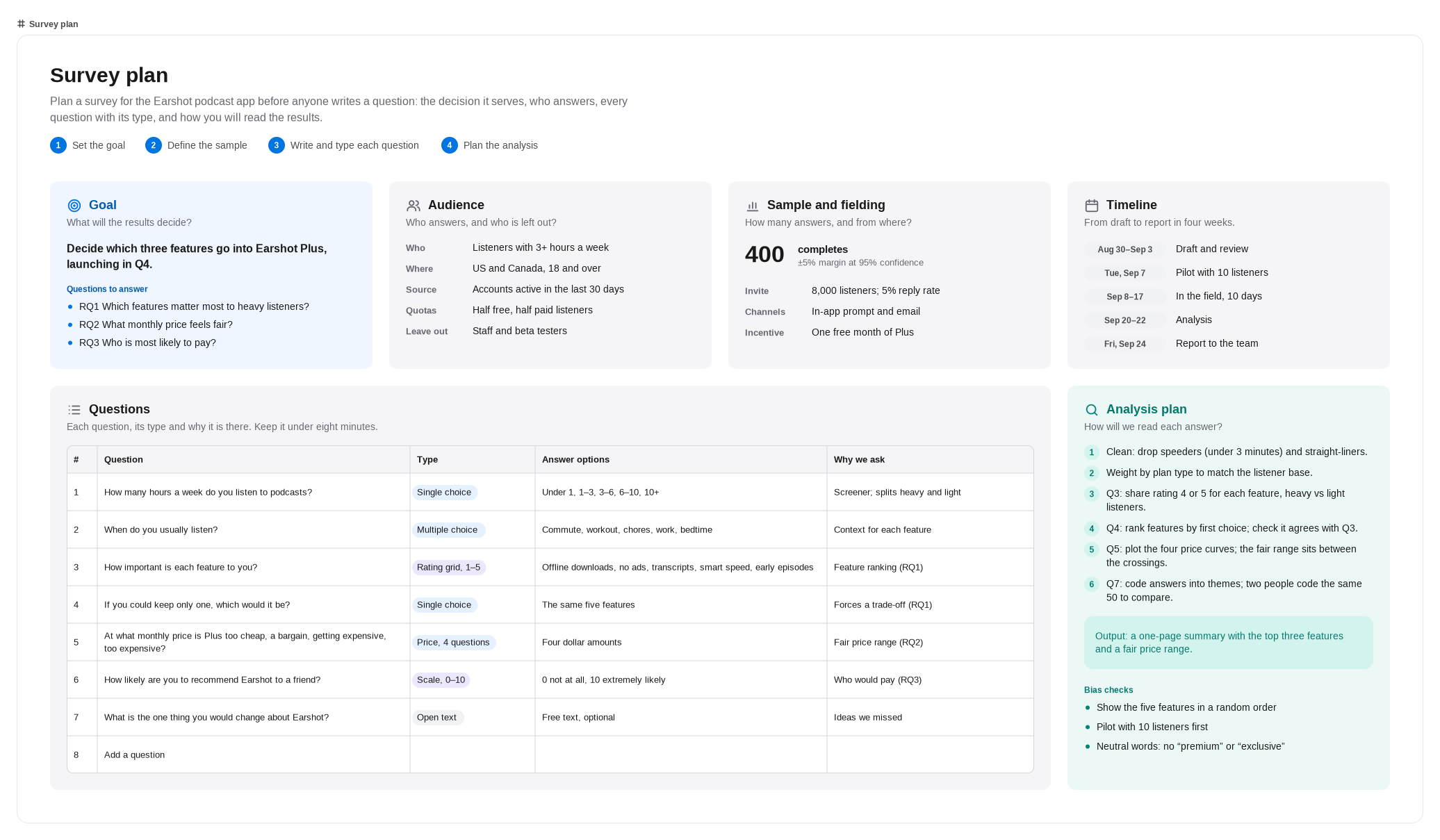
The Goal block answers “What will the results decide?” in one line: decide which three features go into Earshot Plus. Under it are three questions to answer, coded RQ1 to RQ3: which features matter most to heavy listeners, what monthly price feels fair, and who is most likely to pay. Those codes return later in the table.
The Audience block asks who answers and who is left out. It has five lines: who (listeners with 3+ hours a week), where (US and Canada, 18 and over), source (accounts active in the last 30 days), quotas (half free, half paid listeners) and who to leave out (staff and beta testers).
Sample size and timeline
Sample and fielding leads with a number: 400 completes, which gives a ±5% margin at 95% confidence. The lines under it show how to get there. Invite 8,000 listeners at a 5% reply rate, through an in-app prompt and email, with one free month of Plus as the incentive. Writing down the reply rate you expect tells you how many invitations to send.
The Timeline runs four weeks from draft to report. It includes a step many teams skip: a pilot with 10 listeners on Tuesday, September 7, the day before the survey goes into the field for 10 days. Analysis takes three days, and the report reaches the team on Friday, September 24.
Every question, its type and its reason
The large table is the questionnaire itself. Each row has a number, the question, its type, the answer options and a column called Why we ask. The example has seven questions and the instruction to keep the survey under eight minutes.
The types vary on purpose. Question 1, hours listened a week, is a single choice and works as a screener that splits heavy and light listeners. Question 2 is multiple choice. Question 6, how likely are you to recommend Earshot to a friend, is a scale from 0 to 10. Question 7 is open text and optional: “What is the one thing you would change about Earshot?” The last row, “Add a question”, is blank.
If a question has no reason, cut it
Read the right-hand column of the middle rows. Question 3 is a rating grid from 1 to 5 over five features: offline downloads, no ads, transcripts, smart speed and early episodes. Its reason is “Feature ranking (RQ1)”. Question 4 asks which single feature people would keep, and its reason is “Forces a trade-off (RQ1)”, because in a grid people tend to rate everything as important.
Question 5 asks at what monthly price Plus is too cheap, a bargain, getting expensive and too expensive. Those four questions feed “Fair price range (RQ2)”. Every row points back to a research question or says plainly what it is for. A question that cannot fill this column only makes the survey longer.
Plan the analysis before you field
The Analysis plan lists six steps in the order you will do them. First clean the data: drop speeders, who finish in under 3 minutes, and straight-liners. Then weight by plan type to match the listener base. The next steps name a question each. For Q5, plot the four price curves; the fair range sits between the crossings. For Q7, code answers into themes, with two people coding the same 50 to compare.
A box states the output: a one-page summary with the top three features and a fair price range. Three bias checks close the block, including showing the five features in a random order and avoiding words such as “premium”.
How to use the survey plan template
- Open it as a new board. The podcast survey remains in your copy as a worked reference.
- Set the goal. Write the decision and two or three research questions. Stop here if nobody will act on the result.
- Define the sample. Fill the audience lines, choose the number of completes and work back to the invitations you need.
- Write and type each question. Fill one table row per question and tie its last column to a research question.
- Plan the analysis. Write one step per question, then put your pilot and field dates on the timeline.
When a survey plan helps, and when another method fits
Use it when you need numbers from many people: ranking features, testing a price, measuring how common a problem is. Share the board with whoever will act on the result, so they can comment before the survey goes out.
A survey measures what you already know to ask. To discover problems you have not thought of, talk to people with an interview guide. When the survey is one method among several, place it in a research plan. Once a recommend-score question like question 6 has answers, read them with an NPS analysis.
Questions about the Survey plan template
How many questions should a survey have?
As few as answer your research questions. The example has seven and aims for under eight minutes. Completion drops as surveys get longer, so test the length in the pilot and cut any question whose “Why we ask” is weak.
How many responses do I need?
It depends on the precision you want. About 400 completes give a margin of roughly 5 points either way at 95% confidence, which is the figure on the board. If you plan to compare subgroups, each subgroup needs enough answers of its own.
Why run a pilot first?
A pilot with about ten people shows which questions are misread, which options are missing and how long the survey really takes. Fixing these before launch is cheap. After launch, a change means the early and late answers can no longer be compared.
Does the template send the survey?
No. It is a planning board. You build and send the questionnaire in a survey tool of your choice, then use the board to keep the goal, the question list and the analysis steps in front of the team.