What is a theory of change?
A theory of change is a program’s argument for why its work will lead to the result it wants. It sets out a chain: what goes in, what you do, what that produces, what changes for people, and the long-term change at the end. It also states the assumptions that must hold for each link to carry weight.
Funders ask for one, and teams that write one tend to find the weak link in their plan before the money is spent. This template draws the chain as five columns over a band of assumptions. The example is Read Up, an after-school reading program.
Five columns, read left to right
Each column has an arrow-shaped header and a plain-language subtitle that tells you what belongs there:
- Inputs. What we put in.
- Activities. What we do.
- Outputs. What we produce, counted.
- Outcomes. What changes for people.
- Impact. The long-term change.
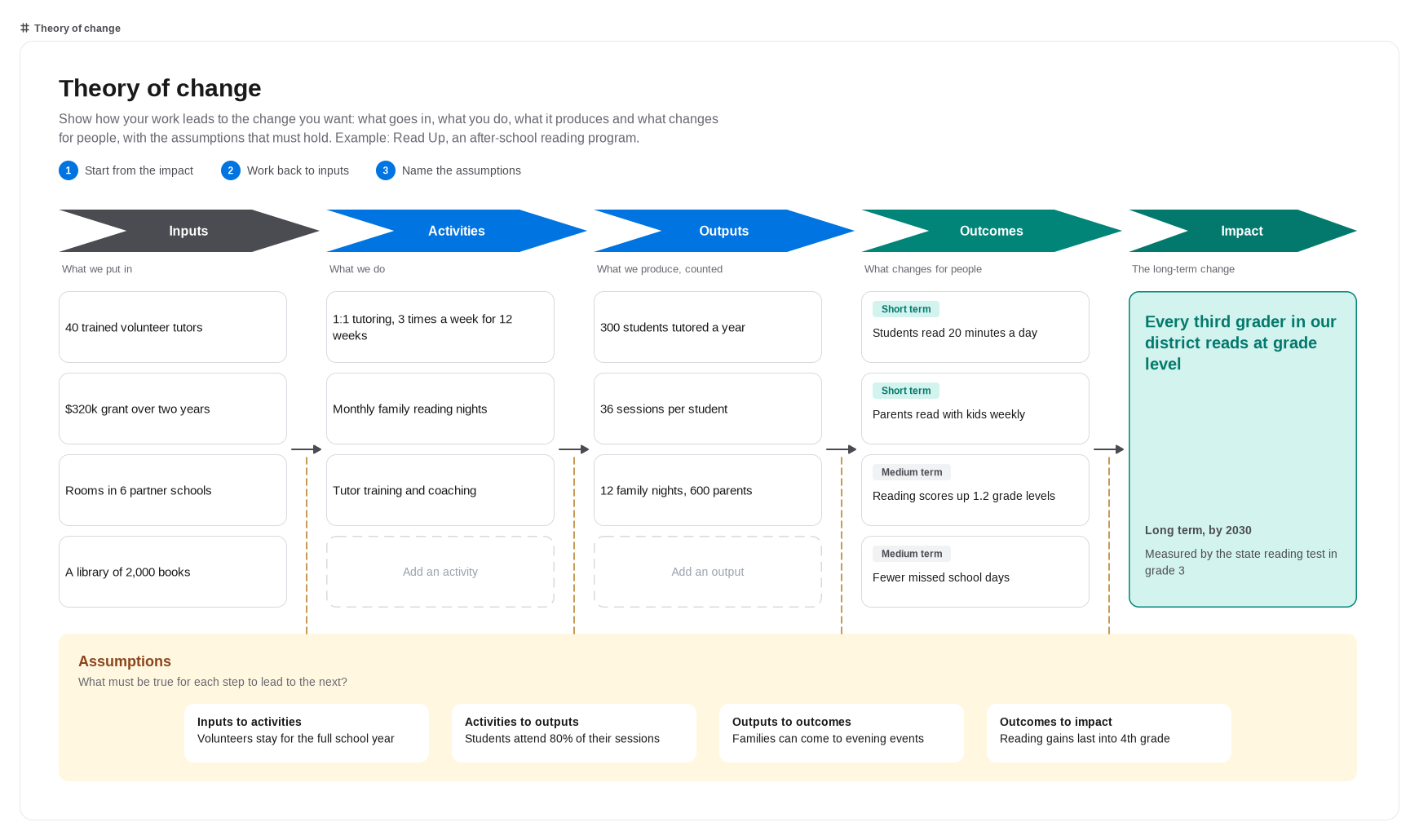
Follow one row across to see the logic. 40 trained volunteer tutors make 1:1 tutoring possible, 3 times a week for 12 weeks. That produces 300 students tutored a year. Those students come to read 20 minutes a day. The subtitles prevent the most common mix-up, which is listing an activity ("we run reading nights") in a column meant for results.
Inputs, activities and outputs: what you control
The first three columns describe the program itself. Read Up’s inputs are specific: 40 trained volunteer tutors, a $320k grant over two years, rooms in 6 partner schools and a library of 2,000 books. Its activities are things people do on a schedule: tutoring, monthly family reading nights, tutor training and coaching.
Outputs are where many drafts go soft. The column’s subtitle says "counted", and the example obeys: 300 students tutored a year, 36 sessions per student, 12 family nights and 600 parents. An output is proof the activity happened at the planned scale. It is not yet proof that anybody reads better. Dashed cards, Add an activity and Add an output, mark where your own lines go.
Outcomes and impact: what changes
The Outcomes column holds four cards, each tagged with a time frame. Short term: students read 20 minutes a day, and parents read with kids weekly. Medium term: reading scores up 1.2 grade levels, and fewer missed school days. An outcome is a change in what people do or can do, and the tags admit that such changes arrive in stages.
Impact is one tall green card: "Every third grader in our district reads at grade level". Under it are a horizon, "Long term, by 2030", and a measure: the state reading test in grade 3. A date and a measure are what separate an impact statement from a mission slogan. Read Up alone will not deliver it, and the card does not pretend otherwise; it names the change the program contributes to.
Name the assumptions between the steps
The band along the bottom asks "What must be true for each step to lead to the next?" It holds one card for every gap between columns, and a dashed line rises from the band to the gap it belongs to.
- Inputs to activities: volunteers stay for the full school year.
- Activities to outputs: students attend 80% of their sessions.
- Outputs to outcomes: families can come to evening events.
- Outcomes to impact: reading gains last into 4th grade.
This is the part that makes the diagram a theory and not a brochure. Each assumption is a place where the chain can break, and each suggests something to monitor: tutor retention, attendance, turnout, follow-up scores.
How to use the theory of change template
- Open it as a new board. Read Up’s chain is included, so you can see how full each column should be.
- Start from the impact. Write the long-term change in the green card, with a year and a way to measure it.
- Work back to inputs. Ask what must change for people before that impact is possible, then what you must produce, do and have. Fill the columns from right to left.
- Name the assumptions. For every gap between columns, write the one condition you are least sure of.
- Test it on an outsider. Share the board with someone outside the program and ask where they stop believing the chain.
When a theory of change fits, and when another template does
Use it to design a program, apply for a grant, plan an evaluation or explain to a new team member why the work is shaped the way it is. It is common in nonprofits, education and public health, and just as useful for an internal change program.
If you are still working out what causes the problem, map it with a problem tree first. To track a small set of measurable goals each quarter, use OKR planning. And for a commercial product, where the chain runs through customers and revenue, a business model canvas asks better questions.
Questions about the Theory of change template
What is the difference between an output and an outcome?
An output is what your activities produce and can be counted the day they end: 300 students tutored, 36 sessions each. An outcome is what changes for those people as a result: they read 20 minutes a day, and their scores rise. Outputs are in your control; outcomes are what you hope they cause.
Is a theory of change the same as a logic model?
They share the same columns. A logic model usually stops at describing the chain. A theory of change also explains why each step should lead to the next, by naming the assumptions between them, and it is normally written backward from the impact.
Why work backward from the impact?
Starting from activities tempts you to justify what you already do. Starting from the long-term change forces the question of what would really have to happen first, and sometimes shows that a favorite activity does not lead there at all.
How many assumptions should I list?
At least one for each link between columns, four in this layout. Choose the condition you would bet on least. If a link has several shaky assumptions, list them all; that link is where your monitoring should concentrate.