What is a tree diagram?
A tree diagram breaks one thing into its parts, and those parts into smaller parts. It starts from a single root and spreads into branches that end in leaves. Every box except the root has exactly one parent, which is what makes it a tree and not a network.
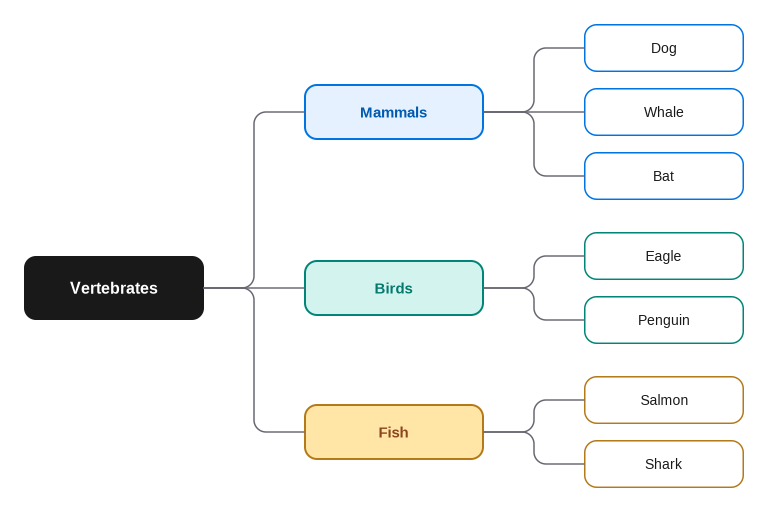
The template grows from left to right. The root, Vertebrates, splits into three branches: Mammals, Birds and Fish. Each branch ends in two or three examples, seven in all, from Dog at the top to Shark at the bottom.
The root and its branches
The root is the largest box and stands alone at the left: Vertebrates. It names the whole set you are dividing. Three lines leave it, one to each branch.
The branches are the first cut, and they have to follow one rule. Mammals, Birds and Fish are all classes of animal, so the split is consistent. A first level of “Mammals, Birds and Animals that swim” would mix two different rules, and a whale would belong in two places at once. When a tree feels wrong, the cause is usually a level that divides by two things at the same time.
Leaves: where a branch ends
Follow the top branch. Mammals leads to three leaves: Dog, Whale and Bat. A leaf is a box with nothing below it, the most specific level the tree goes to.
The three were picked to stretch the idea: one mammal that walks, one that swims and one that flies. That is a good habit for any example leaves. If every leaf under a branch looks alike, the reader learns little about what the branch really covers. Leaves that sit at the edges of a category show where its limits are.
Keep each level to one kind of thing
Read the tree by column, not by row. The middle column holds only classes. The right column holds only single animals: Salmon and Shark under Fish, Eagle and Penguin under Birds. Nothing in a column belongs to a different level of detail from its neighbors.
Two tests help when you fill in your own. No overlap: each leaf fits under one parent only. Shark is a fish and nothing else on this board. No gaps: the branches together should cover the root, or you should say what you left out. This example leaves out reptiles and amphibians. For a study aid that is fine. For a breakdown of a budget or a problem, a missing branch is a mistake.
How to use the tree diagram template
- Open it as a new board. Use this template adds the vertebrates tree to your workspace.
- Name the root. Replace Vertebrates with the one thing you are breaking down: a goal, a product, a topic, a problem.
- Choose the rule for the first split. Decide whether you divide by type, by part, by cause or by step, then rename Mammals, Birds and Fish to match. Add a fourth branch if the rule needs one.
- Fill the leaves from the top down. Replace Dog, Whale and the others, and stop when a leaf is specific enough to act on or to remember.
- Check the two tests. Look for a leaf that could sit under two branches, and for anything under the root that has no branch.
When a tree fits, and when it does not
A tree suits anything that divides cleanly: a classification, a table of contents, a product family, a goal split into sub-goals. If you can say “is a kind of” or “is a part of” for every line, a tree is the right shape.
When items connect across branches, a tree cannot show it. Use a concept map, which labels each link and allows cross-links. For choices with outcomes and probabilities, the decision tree has the right symbols. For people and reporting lines, start from the org chart, and for project deliverables, the work breakdown structure.
Questions about the Tree diagram template
What is the difference between a tree diagram and a mind map?
Both branch out from one starting point. A tree diagram is strict: fixed levels, one parent per box, and one rule for each split. A mind map is loose and made for collecting ideas quickly, with branches of any depth. Use a tree when the structure itself has to be correct.
How many levels should a tree diagram have?
Three or four levels are enough for most uses, and the template has three. Deeper trees are hard to read on one screen. If a branch needs more depth than the rest, give that branch its own board and treat its top box as a new root.
Can the tree run from top to bottom instead?
Yes. Every box and line on the board can be moved, so you can place the root at the top and the leaves in a row at the bottom. Left to right, as in the template, leaves more room for long labels. Top to bottom is the familiar layout for hierarchies of people.
What can I use a tree diagram for in class?
Classification in biology, as in the template, is the classic case. It also works for sorting word types in grammar, breaking a number into prime factors, listing outcomes in probability, and outlining an essay from thesis to supporting points.