What is a work breakdown structure?
A work breakdown structure, or WBS, is a tree that splits a project into smaller and smaller pieces until each piece is small enough to estimate and hand to one person. It answers one question: what is all the work? It does not say when the work happens or in what order.
This template draws the tree in four levels: the project, its phases, the deliverables of each phase and the work packages under each deliverable. The example is “Customer conference 2027”, an event for 600 guests on Oct 14 and 15.
Project, phases and the numbers that link them
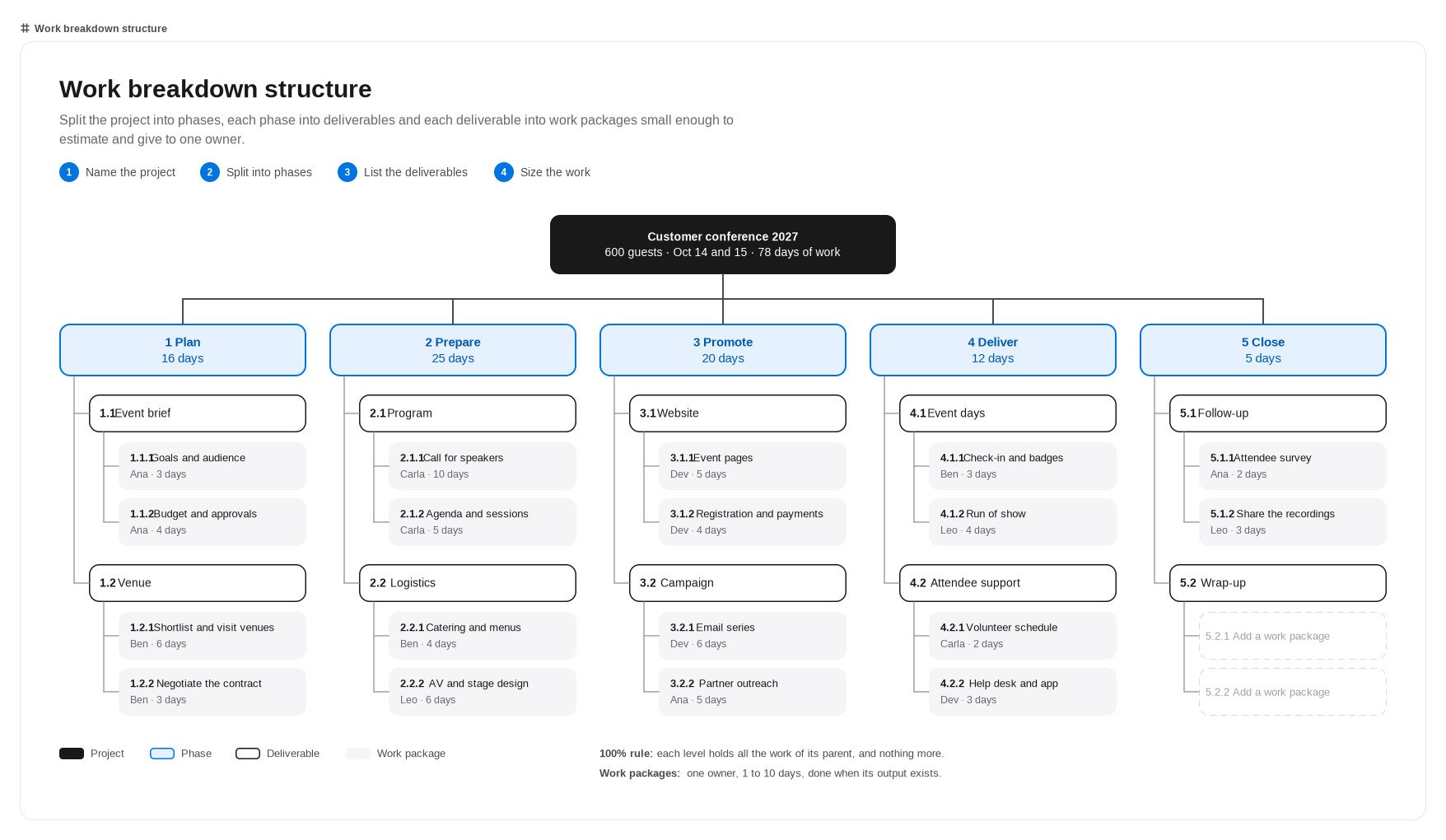
The top box names the project and its size: “600 guests · Oct 14 and 15 · 78 days of work”. A line under it fans out to five phases: 1 Plan with 16 days, 2 Prepare with 25, 3 Promote with 20, 4 Deliver with 12 and 5 Close with 5. Add the five and you get the 78 in the top box.
That is the 100% rule, printed at the bottom of the board: each level holds all the work of its parent, and nothing more. If the phases added up to less than the project, some work would be missing. If they added up to more, something on the board would not belong to the project.
One branch, top to bottom
Read a single column to see how the split works. Phase 1 Plan has two deliverables: 1.1 Event brief and 1.2 Venue. A deliverable is a thing that exists when the work is over, which is why both are nouns.
Under each deliverable sit its work packages. The event brief needs 1.1.1 Goals and audience and 1.1.2 Budget and approvals. The venue needs 1.2.1 Shortlist and visit venues and 1.2.2 Negotiate the contract. The numbering does the bookkeeping: 1.2.1 is the first package of the second deliverable of the first phase, and anyone can find its parent without following a line.
What a good work package looks like
The board states the test in one line: one owner, 1 to 10 days, done when its output exists. Check the example against it.
- One owner. “2.1.1 Call for speakers” says “Carla · 10 days”. A package with two names has no owner.
- 1 to 10 days. The call for speakers sits right at the limit. Anything bigger hides work and should be split, the way the website deliverable is split into “Event pages” and “Registration and payments”.
- An output. “2.2.1 Catering and menus” is done when the menus exist. A package called “Work on catering” would never be done.
How to use the work breakdown structure template
- Copy the board. Use this template opens the conference tree in your workspace, ready to rename.
- Name the project. Write the project and its one-line scope in the top box. Leave the total for later.
- Split into phases. Rename the five phase boxes, or delete one. Three to seven phases is typical.
- List the deliverables. Under each phase, write what must exist when the phase ends. Use nouns.
- Size the work. Fill the work packages with an owner and days, then add them up: packages into phases, phases into the project. The two empty cards under 5.2 Wrap-up show where a new package goes.
The guide How to create a work breakdown structure explains each level with more examples.
When a WBS helps, and what comes after it
Draw a WBS at the start, before anyone talks about dates. It is the fastest way to find forgotten work, and its totals give you a first estimate you can defend.
It is not a schedule. Once the packages are agreed, put them on a Gantt chart to give them dates, or on a PERT chart if the estimates are uncertain. To settle who approves and who is consulted on each deliverable, carry the list into a RACI matrix.
Questions about the Work breakdown structure template
Which plan do I need for the work breakdown structure template?
Pro or Team. The board holds 197 elements, and a board on the Free plan stops at 150. Each box, label and line counts as one element, which is why a full tree of this size goes past the limit.
Should a WBS list deliverables or activities?
Deliverables at the upper levels, work at the lowest. Phases and deliverables are named as things, like Venue or Program. Only the work packages describe doing something, and even those are judged by the output they leave behind.
How many levels should a WBS have?
Three or four cover most projects: project, phase, deliverable, work package. Stop splitting when a piece has one owner and takes 1 to 10 days. Going deeper turns the tree into a to-do list that nobody keeps up to date.
What does the 100% rule mean?
The children of any box must add up to exactly the box above them. In the example the phases of 16, 25, 20, 12 and 5 days make the project’s 78. The rule catches both missing work and work that crept in without being asked for.