What is a BPMN diagram?
BPMN stands for Business Process Model and Notation. It is a standard set of symbols for drawing a process so that analysts, managers and developers all read it the same way. Circles are events, rounded rectangles are tasks, diamonds are gateways, and the kind of line tells you whether work or a message is moving.
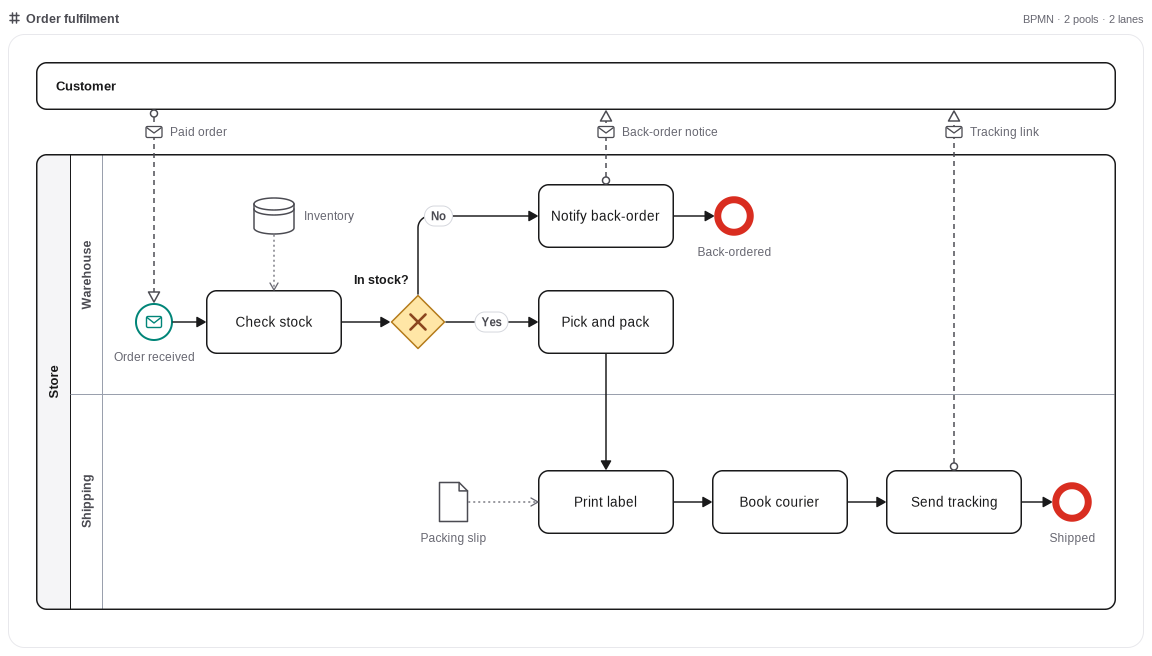
The template is a frame titled Order fulfilment. It follows one order through a store: it arrives, stock is checked, and it is either packed and shipped or put on back-order. The example is short, but it uses the parts of the notation that carry most real models, so each can be copied where you need it.
Pools: who takes part
A pool is one participant in the process. The template has two. Customer is drawn as a thin empty band across the top. That is a collapsed pool: the model says the customer exists and exchanges messages with the store, and deliberately says nothing about what happens on the customer’s side.
Store is the pool the model is about. It is expanded and divided into two lanes, an upper one for the warehouse work and a lower one for shipping. Lanes split one participant into roles, so a task’s lane tells you who inside the store performs it.
The rule to remember: solid arrows never leave a pool. Between pools only messages travel, drawn as dashed lines. Three of them cross the gap in this example, one coming down to start the process and two going back up.
Start event, task and gateway
The process begins at the circle labeled Order received. It is a start event, and it fires when the customer’s message arrives. From there a solid arrow, a sequence flow, leads to the first task, Check stock.
Above the task is a small document shape labeled Inventory. That is a data object: information the task reads. It is tied to the task by a dotted line and is not a step in the flow.
Next comes the diamond, In stock? It is an exclusive gateway, which means exactly one of its exits is taken for each order. The question is written beside the gateway and the answers on the arrows leaving it. A gateway only routes. The work of finding out belongs to the task before it, which is why Check stock comes first.
Two branches, two end events
If the item is not in stock, the flow turns up to Notify back-order and finishes at an end event labeled Back-ordered. If it is, the flow continues to Pick and pack and on toward shipping.
The process therefore has two end events, and that is correct BPMN. Each end event names a distinct result. A reader can list the ways the process can finish by finding the thick-bordered circles, without tracing every path. Resist the urge to draw everything into one final circle called “End”: “Back-ordered” and “Shipped” are different outcomes for the business and deserve different names.
How to use the BPMN template
- Open it as a new board. BPMN is a Pro template, so it opens on the Pro or Team plan.
- Name the pools. Put your organization on the large pool and the outside party on the collapsed one. Rename the lanes to the roles that do the work.
- Rewrite the start event as a trigger. Say what has just happened, in the form “Order received”, not what will be done.
- Name tasks verb first. The shipping lane shows the style: “Print label”, “Book courier”, “Send tracking”. Each is one action by one role.
- Close every path with a named end event, then add the messages that pass between the pools.
The lower lane also has a second data object, Packing slip, which feeds the Print label task, and the last task sends a message up to the customer before the Shipped end event.
When BPMN is worth the formality
Choose BPMN when the diagram is a specification: a process that will be automated, audited or handed between companies, where two readers must not interpret a symbol differently. The guide on how to create a BPMN diagram explains the notation element by element.
For explaining a process to people who have never seen the notation, it is more than you need. A flowchart covers a simple procedure with three shapes. A swimlane diagram shows who does what without events and message flows. For the behavior of a single software feature, a UML activity diagram is the closer fit.
Questions about the BPMN template
What is the difference between a pool and a lane?
A pool is a whole participant, such as a company or a customer. A lane is a subdivision inside one pool, such as a department or a role. Sequence flows can cross lanes freely, but only message flows can cross from one pool to another.
What does a diamond mean in BPMN?
It is a gateway, a point where the flow splits or joins. The template uses an exclusive gateway, where one exit is chosen. Other gateway types let all exits run in parallel or let several be chosen at once.
Can a BPMN process have more than one end event?
Yes, and it often should. The template has two, Back-ordered and Shipped, because the process can finish in two different states. Naming each end makes the possible results easy to see.
Do I need to know all of BPMN to use this template?
No. Events, tasks, gateways, pools and the two kinds of flow cover most processes, and the template shows each of them once. Add other symbols only when a reader would otherwise misunderstand the process.