What is an impact effort matrix?
An impact effort matrix is a two-by-two grid for deciding what to do first. Every idea is placed by two things: how much it would move the goal, and how much work it would take. The four corners of the grid then sort themselves into things to do now, things to plan, things to fit in and things to leave.
This template adds two parts around the grid. A column on the left holds ideas that have not been placed yet, and a row at the bottom turns the result into a plan. The example is an online bookstore with one goal: bring customers back for a second order.
Two axes, four quadrants
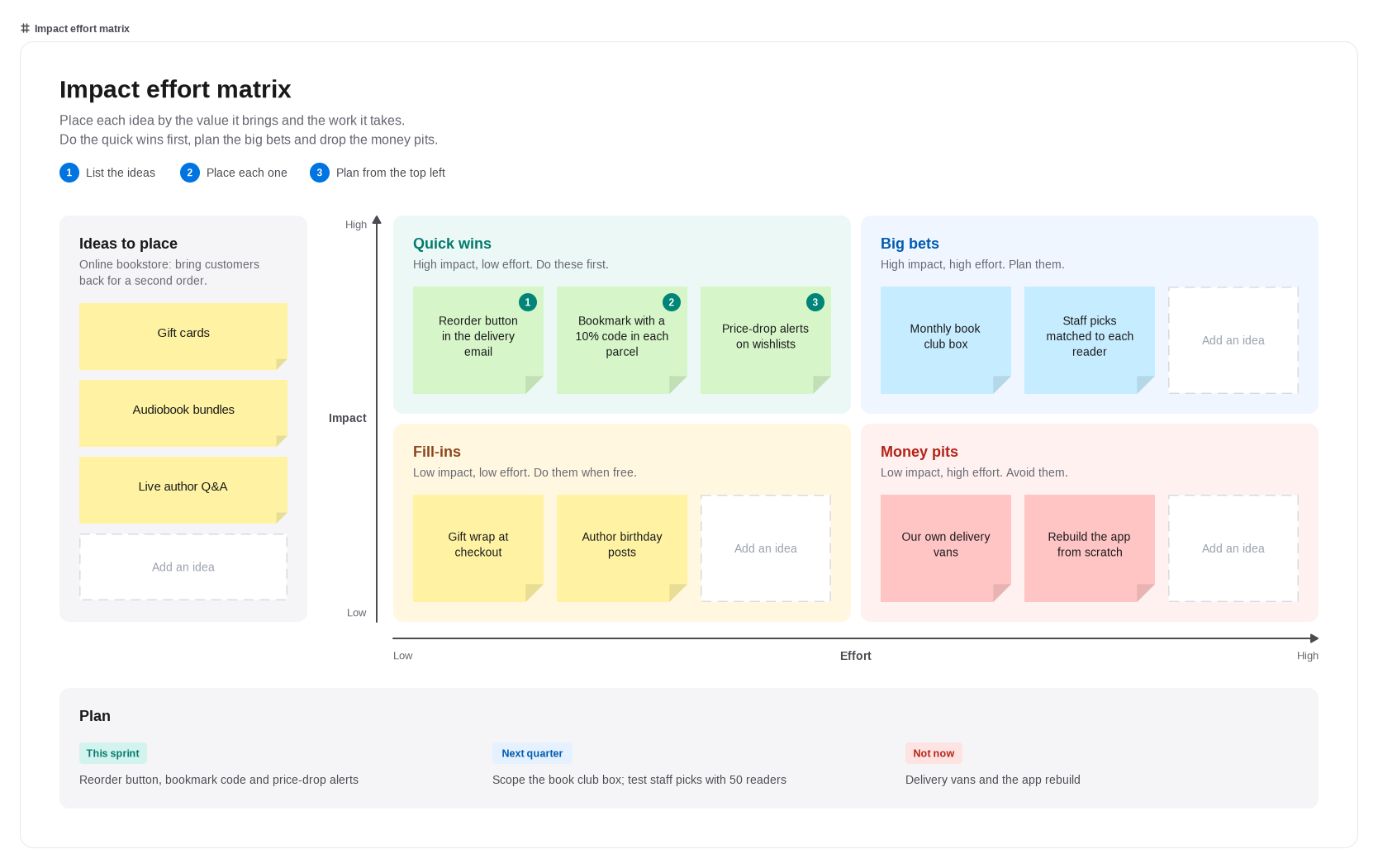
Impact runs up the left side from Low to High. Effort runs along the bottom from Low to High. Each quadrant has a name and an instruction:
- Quick wins. High impact, low effort. Do these first. The bookstore has three, such as a reorder button in the delivery email.
- Big bets. High impact, high effort. Plan them. A monthly book club box sits here.
- Fill-ins. Low impact, low effort. Do them when free. Gift wrap at checkout is one.
- Money pits. Low impact, high effort. Avoid them. The bookstore put “Our own delivery vans” and “Rebuild the app from scratch” here.
The money pits are worth as much as the quick wins. Writing an idea into that corner is how a team agrees, in public, to stop talking about it.
Place each idea against the goal
An idea has no impact on its own. It has impact on a goal, so the goal is written at the top of the left column: “Online bookstore: bring customers back for a second order.” Three ideas are still waiting there to be placed: gift cards, audiobook bundles and a live author Q&A.
Take the first one. Would gift cards bring an existing customer back? Mostly they bring in someone new, so for this goal the impact is modest, even if gift cards are a fine idea for another goal. That is the conversation the matrix is for.
Judge effort the same way, in plain units: days of work, people needed, money spent. Compare ideas with each other instead of chasing exact numbers. “Harder than the reorder button, easier than the book club box” is enough to place a note.
Rank inside the best quadrant
A quadrant is not yet an order of work. The three quick wins in the example carry small badges numbered 1, 2 and 3: the reorder button in the delivery email first, then a bookmark with a 10% code in each parcel, then price-drop alerts on wishlists.
Number only the quadrant you will act on now. Ranking the money pits is wasted effort. If the quick wins corner holds more than five notes, look again at the effort you gave them. A corner that crowded usually means the team has been generous about how easy things are.
Turn the grid into a plan
The row under the grid has three boxes, and each takes its content from one part of the matrix:
- This sprint: “Reorder button, bookmark code and price-drop alerts”. These are the quick wins.
- Next quarter: “Scope the book club box; test staff picks with 50 readers”. The big bets get a small first step, not a full build.
- Not now: “Delivery vans and the app rebuild”. The money pits are named, so nobody raises them again next month.
Notice how the big bets are handled. Staff picks matched to each reader could matter a lot, but nobody knows yet, so the plan is a test with 50 readers. A cheap test is how a big bet earns its place or drops into another corner.
How to use the impact effort matrix template
- Open it as a new board. Write your goal at the top of the Ideas to place column in one sentence.
- List the ideas. One note each in the left column. Ten to twenty is a workable number.
- Place each one. Drag a note into the grid, ask the group “higher or lower impact than this one?”, then “more or less work?”, and move it until nobody objects.
- Plan from the top left. Number the quick wins, give each big bet a small first step and fill in the three plan boxes.
The fill-ins need no plan. Leave them in their corner for a slow week.
When the matrix helps, and when you need more
It is at its best right after idea generation, when a team has a wall of options and limited time. A brainstorm session or a round of dot voting feeds it well.
Its weakness is that two axes hide detail. If you must rank a long backlog and want a number for each item, RICE scoring adds reach and confidence. If the question is what a release must contain, MoSCoW prioritization sorts by necessity instead of payoff.
Questions about the Impact effort matrix template
How do you measure impact and effort?
Roughly, and against each other. Impact is how far an idea moves the one goal written on the board. Effort is the time, people and money it needs. Place the first idea in the middle and position every other idea relative to it.
What should we do with ideas in the fill-ins quadrant?
Keep them, without scheduling them. Fill-ins such as “Author birthday posts” cost little and return little, so they suit a spare afternoon or a new team member looking for a first task. They should never push a quick win out of the sprint.
Is a big bet better than a quick win?
Neither is better. Quick wins pay back sooner and fund trust in the plan. Big bets can pay back more but may fail, which is why the example gives them a small test first. A healthy plan has both.
Who should place the ideas?
The people who would do the work and the people who own the goal, together. The first group knows the real effort and the second knows the real impact. One person editing the board while the others direct works fine.