What is a communication plan?
A communication plan lists the groups a project affects and decides, for each one, what they need to hear, how it reaches them, how often and who sends it. Without one, the people closest to the project hear everything and the people it changes most hear last.
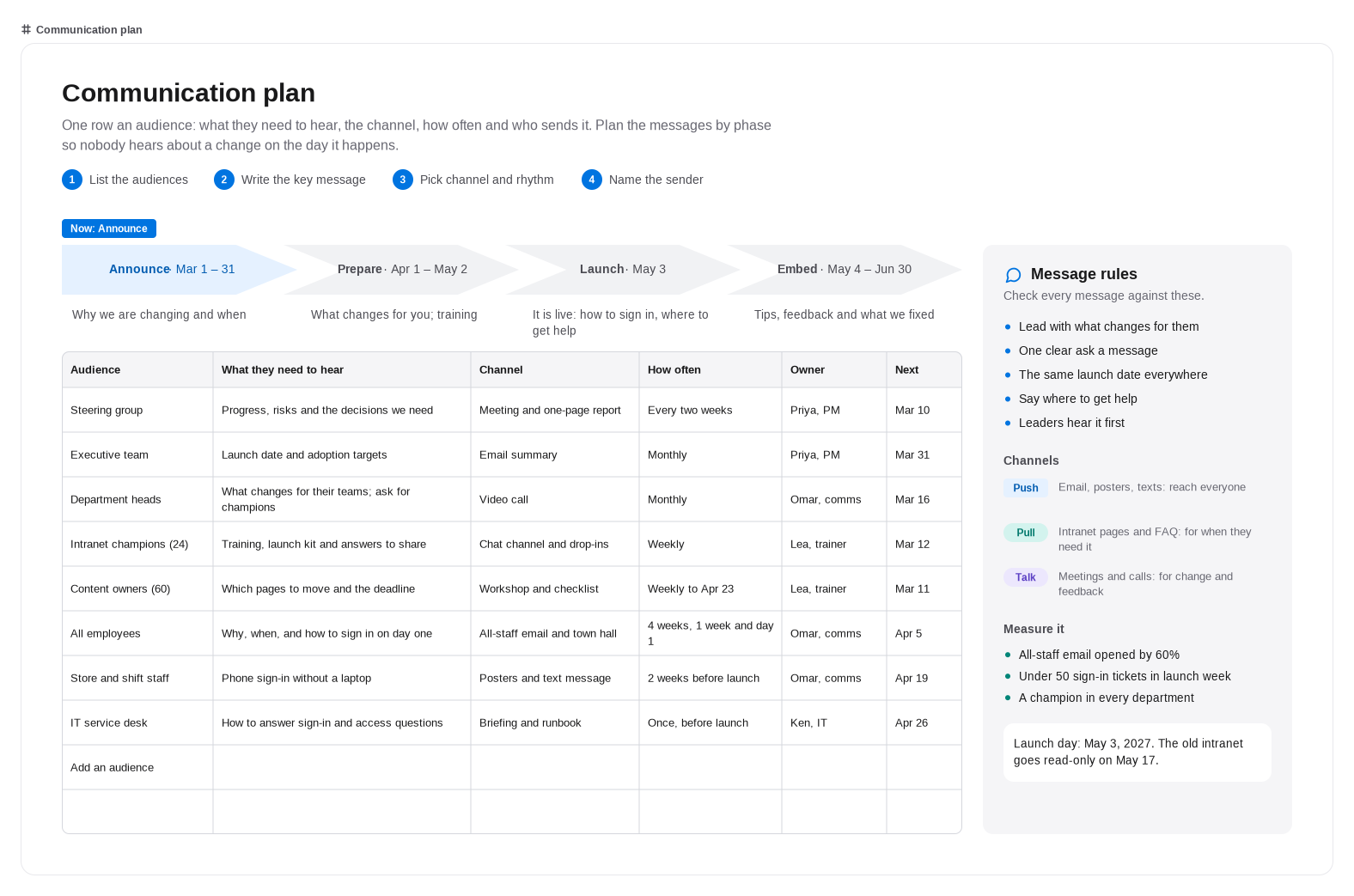
This template has three parts: a row of four phases, a table with one row per audience, and a panel of rules for the messages themselves. The example is a company replacing its intranet, with launch day on May 3, 2027. The board states its aim in the first lines: plan the messages by phase so nobody hears about a change on the day it happens.
Four phases, each with its own message
The arrows across the top divide the project’s communication into phases, and the line under each arrow is what people should take away in that phase.
- Announce, Mar 1 to 31: why we are changing and when.
- Prepare, Apr 1 to May 2: what changes for you, and training.
- Launch, May 3: it is live, how to sign in, where to get help.
- Embed, May 4 to Jun 30: tips, feedback and what we fixed.
A small label above the arrows, “Now: Announce”, marks the current phase. The last phase is the one plans tend to drop. Two months of messages after launch is where questions get answered and habits form.
One row for each audience
The table has six columns: Audience, What they need to hear, Channel, How often, Owner and Next. The first rows are the people who steer and sponsor the work. The steering group hears about progress, risks and the decisions needed, in a meeting with a one-page report every two weeks, from Priya, the project manager. The executive team gets a monthly email summary with the launch date and adoption targets.
Further down come the people who carry the change to others: department heads, 24 intranet champions and 60 content owners. Their rows say what you want from them as well as what you tell them. The department heads’ message ends “ask for champions”. The content owners need to know which pages to move and the deadline.
The Next column holds the date of the next message for that row. It turns a plan into something you can check each Monday.
Reach people where they already are
The lower rows show what a careful plan looks like. “All employees” get an all-staff email and a town hall at three moments: 4 weeks before, 1 week before and on day 1. “Store and shift staff” have their own row, because they do not sit at a laptop. Their message is phone sign-in, their channels are posters and a text message, and the timing is 2 weeks before launch.
The IT service desk is an audience too. They need to know how to answer sign-in and access questions, in a briefing with a runbook, once, before launch. If you forget the people who will take the calls, the first day goes badly whatever the emails said.
When you fill in your own table, test each row with one question: would this group see the message in the channel you chose?
Rules for every message, and three kinds of channel
The panel on the right is a checklist to hold each message against before it is sent: lead with what changes for them, one clear ask a message, the same launch date everywhere, say where to get help, leaders hear it first.
Under the rules, the board sorts channels into three kinds. Push channels such as email, posters and texts reach everyone. Pull channels such as intranet pages and an FAQ are there for when people need them. Talk channels, meetings and calls, are for change and feedback. A plan that uses only push tells people things and never hears back.
How to use the communication plan template
- Open it as a new board. Use this template gives you a copy with the intranet example in place.
- List the audiences. Start from your stakeholder list and split any group whose daily work differs, as the example splits shift staff from other employees.
- Write the key message. One line per row, from the audience’s side. Then rewrite the four phase messages across the top.
- Pick channel and rhythm. Choose a push, pull or talk channel for each row and say how often, in words a reader can check.
- Name the sender. One person per row, plus the next date. Then set two or three measures, as the example does under “Measure it”.
When you need a plan like this
Write one for any change that reaches people outside the project team: a new system, a reorganization, an office move, a policy. Small internal projects can do with a line in the kickoff notes.
The plan assumes you know who the audiences are. If you do not, map them first on a stakeholder map, which sorts people by interest and influence. For who decides and who is consulted, as opposed to who is told, use a RACI matrix. The steering group’s report in the first row can be the status report template.
Questions about the Communication plan template
What should a communication plan include?
For each audience: the message, the channel, the frequency, the person who sends it and the next date. This template adds the phases of the project, rules for wording and a few measures, so you can tell afterwards whether it worked.
How is a communication plan different from a stakeholder map?
A stakeholder map shows who matters and how much influence and interest they have. A communication plan takes that list and decides what each group is told, how and when. The map comes first and the plan follows from it.
How do I know the plan is working?
Choose measures before you start. The example uses three: the all-staff email opened by 60%, under 50 sign-in tickets in launch week, and a champion in every department. If a number is missed, change the channel before you repeat the message.
Who should own each message?
The person the audience expects to hear from. In the example the project manager reports to the steering group, a communications lead writes to all employees, a trainer looks after champions and IT briefs the service desk.