What is a RACI matrix?
A RACI matrix is a table that settles who does what. Tasks go down the side, people or roles go across the top, and each cell holds one letter: R for responsible, A for accountable, C for consulted or I for informed. Its job is to end two common arguments before they start: “I thought you were doing that” and “why did nobody ask me”.
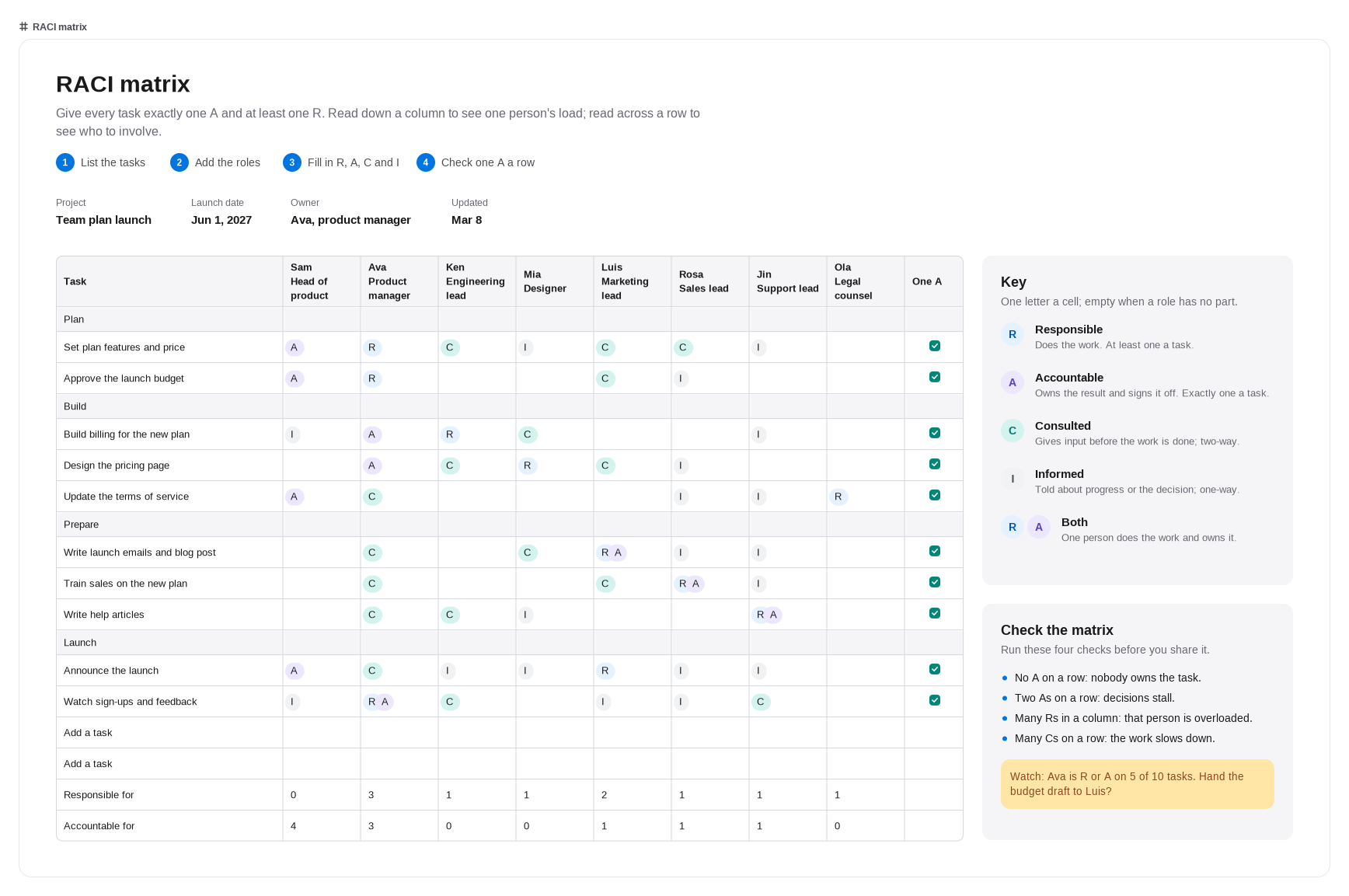
This template has the table, a key that defines the letters and a short list of checks. It is filled in for “Team plan launch”, a software company bringing out a new plan on Jun 1, 2027, with Ava, the product manager, as owner.
The four letters
The key on the right gives each letter one line, and the wording matters.
- Responsible. “Does the work. At least one a task.”
- Accountable. “Owns the result and signs it off. Exactly one a task.”
- Consulted. “Gives input before the work is done; two-way.”
- Informed. “Told about progress or the decision; one-way.”
The key adds a fifth case, R and A in the same cell, for when one person does the work and owns it. A cell stays empty when a role has no part in the task. Empty cells are a good sign: they are people you are not pulling into meetings.
Read a row, then read a column
Read across a row to see who to involve in one task. “Build billing for the new plan”: Ken, the engineering lead, is R. Ava is A. Mia, the designer, is C. Sam and Jin are I. Five people, four different parts, no doubt about who signs it off.
Read down a column to see one person’s load. Ola, the legal counsel, has a single letter in the whole grid: R on “Update the terms of service”. Ava’s column has a letter in every row.
The tasks are grouped under four headings, Plan, Build, Prepare and Launch, so a long list stays easy to scan. Each role shows a name and a job title, which keeps the matrix useful when people change seats.
Count the letters before you share it
Two rows at the bottom add up each column: “Responsible for” and “Accountable for”. They turn a grid of letters into a picture of workload. Sam, the head of product, is responsible for 0 tasks and accountable for 4, which suits a person who approves. Ken is responsible for 1 and accountable for none.
Ava is responsible for 3 and accountable for 3. The note beside the grid says so plainly: “Watch: Ava is R or A on 5 of 10 tasks. Hand the budget draft to Luis?” That is the real use of a RACI matrix. It does not only record who does what. It shows where the plan leans too hard on one person while there is still time to change it.
How to use the RACI matrix template
- Make your copy. Use this template adds the launch matrix to your workspace with every cell editable.
- List the tasks. Start each with a verb, as in “Train sales on the new plan”. Ten to twenty rows is enough; group them by phase.
- Add the roles. Put a name and a title in each column header. Include the people who only approve or only need to hear.
- Fill in R, A, C and I. Place the A in every row first, then the R, then the rest. Leave cells empty where you can.
- Check one A a row. Run the four checks printed on the board: no A on a row means nobody owns the task, two As mean decisions stall, many Rs in a column mean an overloaded person, many Cs on a row mean slow work.
For a worked walk-through, see How to make a RACI matrix.
When a RACI matrix helps, and when it is too much
Use one when work crosses teams, as a launch does: product, engineering, design, marketing, sales, support and legal all touch it. A team of four that sits together rarely needs one.
If you do not have the task list yet, build it with a work breakdown structure. If the people you worry about sit outside the project and need to be won over, a stakeholder map fits better. And when the question is the order of handoffs between teams, draw a swimlane diagram.
Questions about the RACI matrix template
Can one person be both responsible and accountable?
Yes, and for small tasks it is the simplest setup. In the example Luis writes the launch emails and also owns them, so his cell holds R and A together. What a row cannot have is two different people as A.
What is the difference between consulted and informed?
Consulted people give input before the work is finished, so the conversation runs both ways and takes time. Informed people are told afterwards. If you are unsure, choose informed: every extra C adds a round of feedback to the task.
Does the RACI matrix template open on the Free plan?
No. The board holds 159 elements and a Free board is limited to 150, so the template needs the Pro or Team plan. On Team, several people can fill in the letters together in the same session.
Should the columns be people or roles?
Both, when you can. The template writes a name over a job title, such as “Ken, Engineering lead”. The name makes it personal today, and the title keeps the matrix valid if someone else takes the seat later.