What are Cornell notes?
Cornell notes are a way of laying out a page so that the notes you take in class become a study tool afterwards. The method comes from Walter Pauk, who taught at Cornell University. The page has three areas: a wide column for notes, a narrow column for cues, and a strip at the bottom for a summary. The layout matters because each area is filled at a different time and used in a different way.
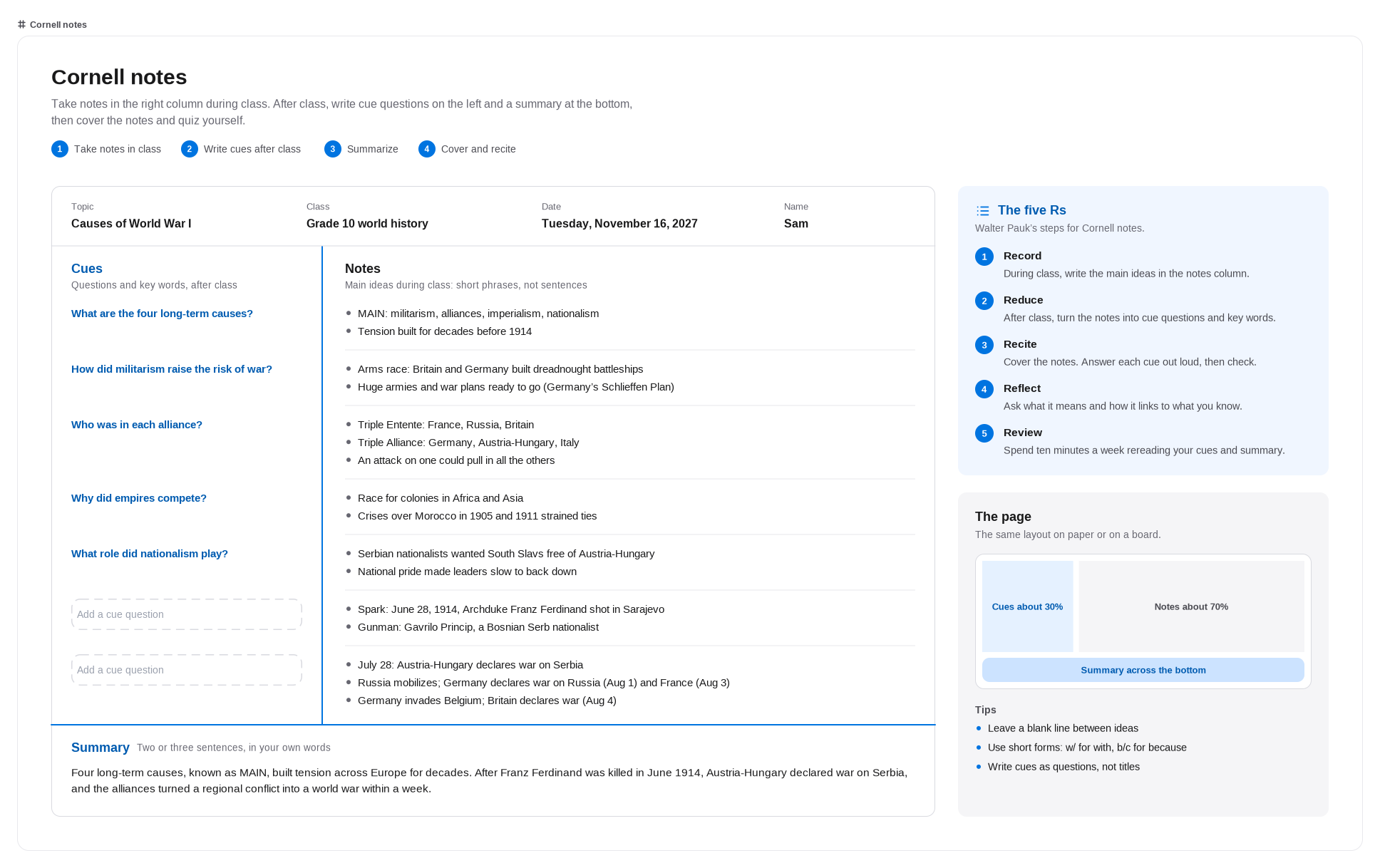
This template is that page as a board, with two reference cards beside it. The example belongs to a student named Sam. Topic: “Causes of World War I”. Class: Grade 10 world history. The header also has fields for the date and name, so a term’s worth of pages can be kept in order.
Notes on the right, during class
The Notes column carries its own instruction: “Main ideas during class: short phrases, not sentences”. Look at how the example follows it. The first line reads “MAIN: militarism, alliances, imperialism, nationalism”. That is four causes in six words, with a memory aid built in. Under alliances, Sam writes “Triple Entente: France, Russia, Britain” and “Triple Alliance: Germany, Austria-Hungary, Italy”, then the point that matters: “An attack on one could pull in all the others”.
Thin rules separate one idea from the next, so the page has seven blocks of two or three lines each. That spacing is what makes the left column possible. Each block will get one cue.
Good notes keep names, dates and terms and drop everything else. “Crises over Morocco in 1905 and 1911 strained ties” is enough to bring the lecture back. A full sentence copied from a slide is not better. It is slower, and it leaves no time to listen.
Cues on the left, after class
The Cues column is subtitled “Questions and key words, after class”. Within a day of the lesson, reread each block of notes and write the question it answers. The example has five: “What are the four long-term causes?”, “How did militarism raise the risk of war?”, “Who was in each alliance?”, “Why did empires compete?” and “What role did nationalism play?”
The last two blocks of notes, on the shooting in Sarajevo and the declarations of war that followed, have no cue yet. Two dashed slots reading “Add a cue question” sit beside them. Writing those is a good first exercise with the template: something like “What was the spark?” and “How did one war become many in a week?”
One of the board’s own tips applies here: write cues as questions, not titles. “Alliances” is a label. “Who was in each alliance?” can be answered, which is the whole point of the next step.
The summary at the bottom
Under both columns is the Summary, with the instruction “Two or three sentences, in your own words”. Sam’s reads: four long-term causes, known as MAIN, built tension across Europe for decades. After Franz Ferdinand was killed in June 1914, Austria-Hungary declared war on Serbia, and the alliances turned a regional conflict into a world war within a week.
Two sentences cover the whole page: the slow causes, then the fast chain of events. If you cannot write a summary without looking up at the notes, you have found out, cheaply and early, that the lesson has not sunk in yet.
The five Rs
The card at the top right lists Walter Pauk’s steps for Cornell notes, each with one line of explanation:
- Record. During class, write the main ideas in the notes column.
- Reduce. After class, turn the notes into cue questions and key words.
- Recite. Cover the notes. Answer each cue out loud, then check.
- Reflect. Ask what it means and how it links to what you know.
- Review. Spend ten minutes a week rereading your cues and summary.
Recite is the step that separates this method from ordinary note-taking. With the right column covered, the page becomes a quiz you wrote for yourself.
How to use the Cornell notes template
- Open it as a new board. Use this template gives you a copy. Fill in the topic, class, date and name, and clear the example’s text.
- Take notes in class. Type short phrases into the Notes column. Start a new block whenever the teacher moves to a new idea.
- Write cues after class. The same evening, add one question to the left of each block.
- Summarize. Write two or three sentences at the bottom without scrolling back up.
- Cover and recite. Drag a blank shape over the Notes column and answer the cues aloud.
The lower card, “The page”, shows the proportions if you rule a paper notebook the same way: cues about 30%, notes about 70%, summary across the bottom.
When Cornell notes fit, and what else to try
The method suits lectures and readings with a clear sequence of ideas: history, biology, economics, literature. Make one board per lesson and review the cues weekly.
For subjects built on diagrams or problem solving, a freer page may serve better. A mind map captures ideas that branch instead of following in order. Once your cues are written, the best ones can become flashcards, and an exam revision plan schedules when to go back over each page.
Questions about the Cornell notes template
What goes in the cue column of Cornell notes?
Questions and key words written after class, one for each block of notes. A good cue is a question the notes beside it answer, such as “Who was in each alliance?”. Later you cover the notes and use the cues to test yourself.
When should I write the summary?
After class, on the same day if you can, once the cues are written. Keep it to two or three sentences in your own words. Writing it from memory first, then checking against the notes, shows what you really understood.
How wide should each column be?
The board’s layout card suggests cues at about 30% of the width and notes at about 70%, with the summary running across the bottom. On a paper page that is a margin of roughly a third on the left.
Are typed Cornell notes as good as handwritten ones?
The layout works either way. What matters is that you write short phrases in your own words instead of copying, and that you come back to add cues and a summary. On a board you can also move blocks around and split one that grew too long.