What is an exam revision plan?
An exam revision plan lists every topic an exam covers and gives each one dates: the day you first study it and the days you come back to it. Coming back after longer and longer gaps is called spaced review. It works because recalling a topic just as it starts to fade fixes it in memory better than rereading it five times in one evening.
This template is a plan of that kind. Its main part is a table of topics with five review dates each. Around it sit the exam date, a log of mock tests, a key for rating your confidence and four ways to review. The example is a student preparing for a Grade 10 chemistry final on Monday, June 14, 2027, seen on Monday, May 24.
The topic table and its review dates
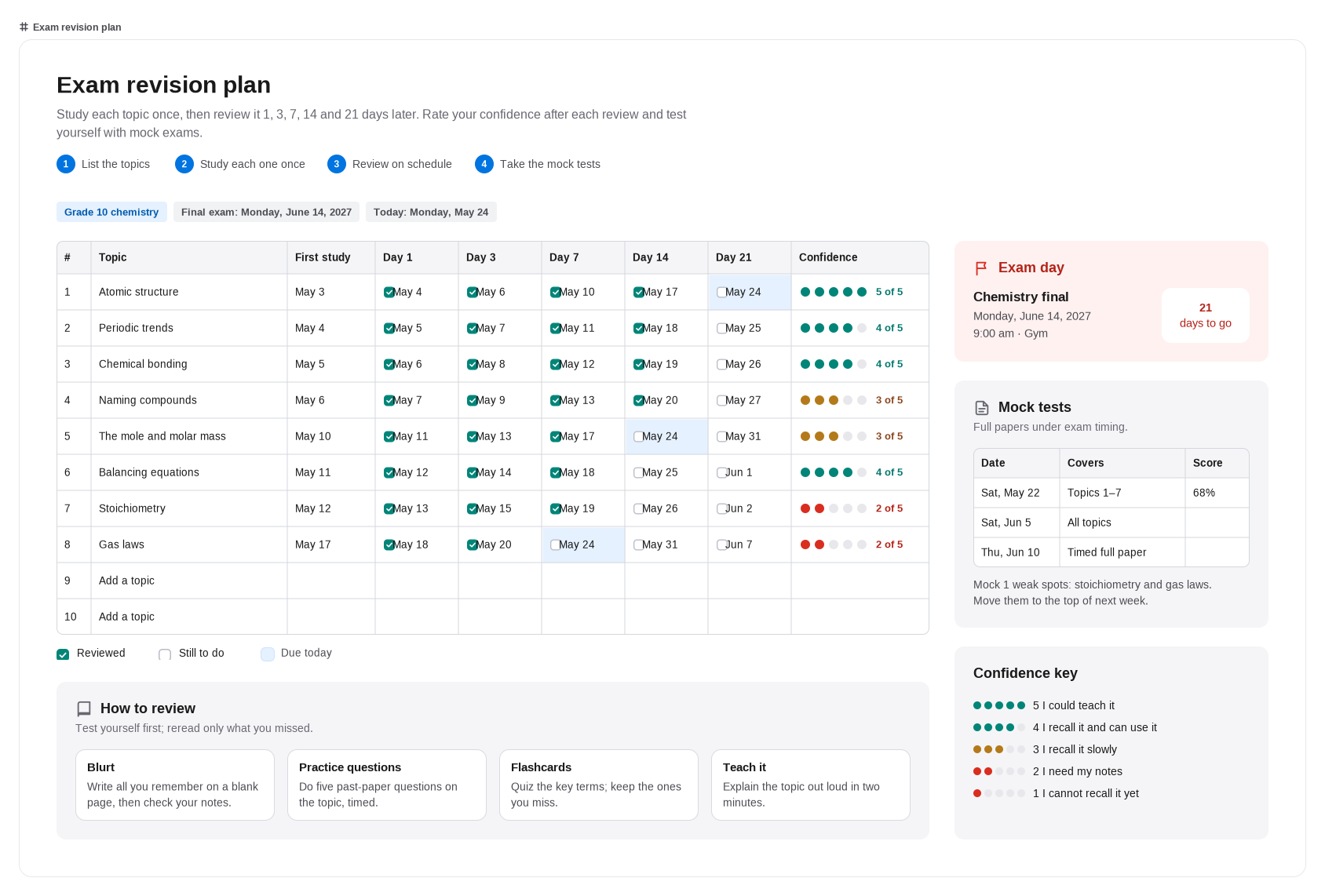
Each row is one topic. The columns read First study, then Day 1, Day 3, Day 7, Day 14 and Day 21. Atomic structure was first studied on May 3, so its reviews fall on May 4, May 6, May 10, May 17 and May 24. Gas laws started two weeks later, on May 17, and its last review lands on Jun 7, one week before the exam.
Every review date has a small mark beside it. The legend under the table names three states: Reviewed, Still to do and Due today. On the example’s today, three reviews are due: the Day 21 review of Atomic structure, the Day 14 review of The mole and molar mass, and the Day 7 review of Gas laws. That is the whole job for the evening, and the student can see it without reading every row.
Rows 9 and 10 say “Add a topic” and wait for yours.
Rate your confidence after every review
The last column of the table holds five dots and a score. The Confidence key says what each score means, in words a student can apply honestly:
- 5 I could teach it
- 4 I recall it and can use it
- 3 I recall it slowly
- 2 I need my notes
- 1 I cannot recall it yet
In the example, Atomic structure is at 5 of 5, while Stoichiometry and Gas laws sit at 2 of 5. A score is a decision tool: a topic at 2 gets an extra session, and a topic at 5 can skip one. Change the score after each review, not at the end of the week, or it turns into a guess.
Exam day and mock tests
The Exam day card states the facts that are easy to get wrong: Chemistry final, Monday, June 14, 2027, 9:00 am, in the gym. A counter beside it shows 21 days to go.
Below it, Mock tests lists full papers under exam timing. The first, on Sat, May 22, covered topics 1 to 7 and scored 68%. Two more are booked: all topics on Sat, Jun 5 and a timed full paper on Thu, Jun 10. The note under the log is the useful part: “Mock 1 weak spots: stoichiometry and gas laws. Move them to the top of next week.” Those are the same two topics rated 2 of 5 in the table. A mock test only helps when its result changes the plan.
How to review: test first, reread second
The strip along the bottom gives the rule, “Test yourself first; reread only what you missed”, and four ways to follow it:
- Blurt. Write all you remember on a blank page, then check your notes.
- Practice questions. Do five past-paper questions on the topic, timed.
- Flashcards. Quiz the key terms; keep the ones you miss.
- Teach it. Explain the topic out loud in two minutes.
Pick a different method for each review of a topic. A short Day 1 review suits flashcards; by Day 14 the topic should stand up to timed questions.
How to use the exam revision plan template
- Open it as a new board. Change the subject line, the exam date and the days-to-go counter first.
- List the topics. Copy them from the syllabus or the exam outline, one per row, in the order you will study them.
- Study each one once and date it. Write the First study date, then add 1, 3, 7, 14 and 21 days to fill the row.
- Review on schedule. Each day, find the dates that match today, do those reviews and update the confidence score.
- Take the mock tests. Log the score, write down the weak spots and move those topics up.
If the exam is less than 21 days away, drop the Day 21 column for the topics you start late. In the example, Gas laws only just fits.
When this plan fits, and when to pick another
Use it for one large exam with many topics: a final, an entrance test, a certification. A teacher can also fill the topic column for the class and share the board, so each student copies it and adds their own dates.
The plan says which topic to review on which day, not at what hour. To fit sessions around classes and practice, add a study planner or a weekly planner. For the reviews themselves, the flashcards template holds the key terms. This board has 178 elements, more than a Free board holds, so it needs the Pro or Team plan.
Questions about the Exam revision plan template
Why are the reviews on days 1, 3, 7, 14 and 21?
The gaps grow because memory fades fast at first and more slowly after each successful recall. A review the next day catches the first drop, and each later one arrives when the topic is starting to slip again. The exact days matter less than keeping the gaps widening.
What if I miss a review day?
Do the missed review the next day and leave the later dates where they are. One late review costs little. If you miss several in a row, rate the topic honestly, usually a point lower, and treat it as a first study again.
How many topics can one plan hold?
The table has ten rows, eight filled in the example and two marked “Add a topic”. For a longer syllabus, add rows to the table or split big topics so each row is something you can review in 20 to 30 minutes.
Does the exam revision plan template work on the Free plan?
No. The board has 178 elements with all its date marks and confidence dots, and a board on the Free plan holds up to 150. You need the Pro or Team plan to open it.