What are flashcards, and what does this board add?
A flashcard has a question on one side and its answer on the other. You read the question, try to answer from memory, then turn the card to check. That small act of pulling an answer out of your head is what makes flashcards work better than rereading a chapter.
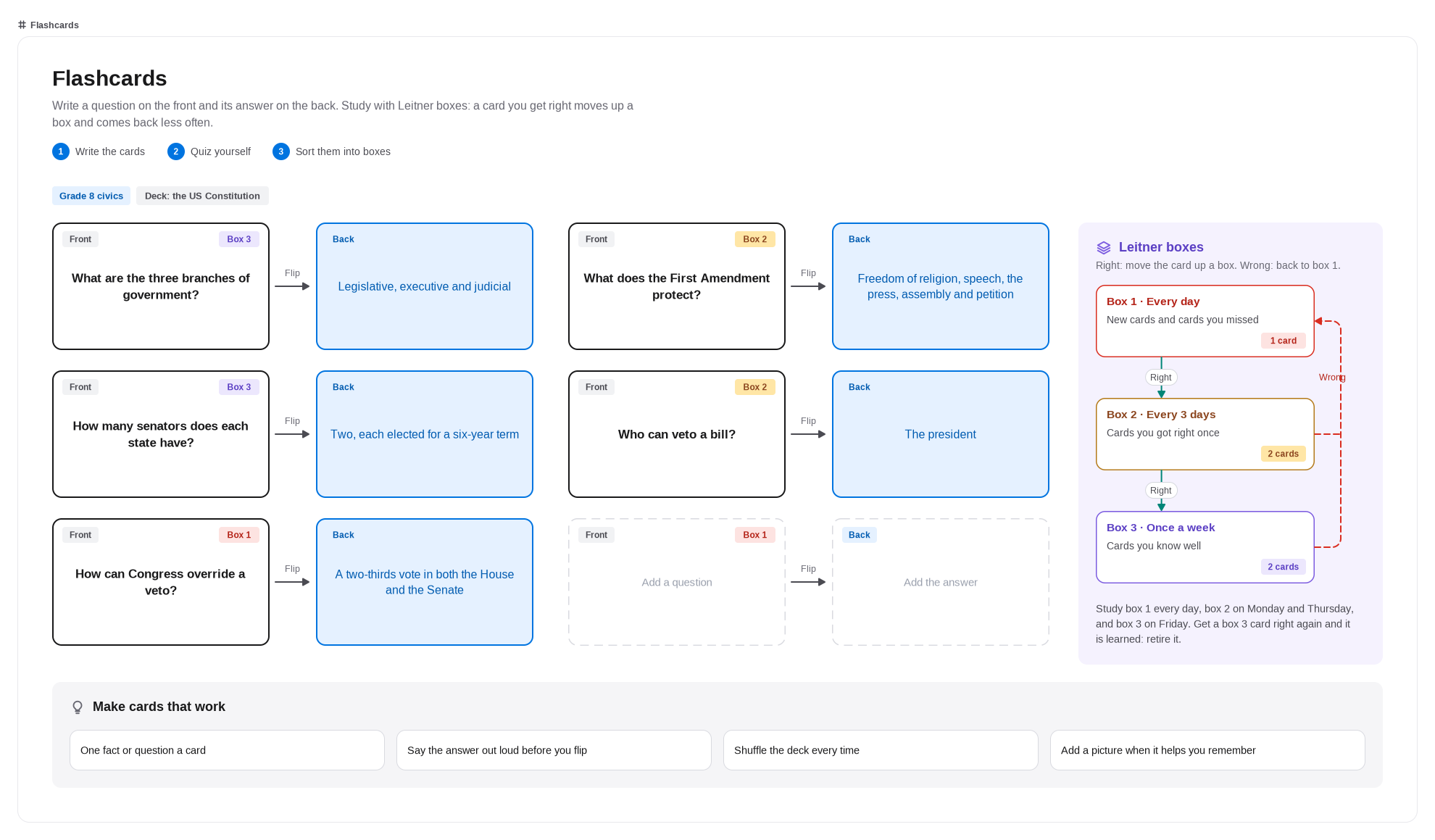
This template shows a deck as pairs of cards, each front next to its back, so you can write and proofread both sides at once. Beside the deck is a panel of three Leitner boxes, a simple system for deciding how often to study each card. A strip at the bottom gives four rules for writing good cards. The example is a Grade 8 civics deck on the US Constitution.
Front and back, side by side
Each pair is one flashcard opened flat. The left card is tagged “Front” and holds the question. The right one is tagged “Back” and holds the answer. A small “Flip” label sits between them.
Read the example pairs and notice how tight they are:
- “What are the three branches of government?” / “Legislative, executive and judicial”
- “How many senators does each state have?” / “Two, each elected for a six-year term”
- “Who can veto a bill?” / “The president”
Every front asks for one thing, and every back can be said in a breath. The longest answer in the deck is the First Amendment card: freedom of religion, speech, the press, assembly and petition. Five items is about the limit for one card. If an answer runs longer than that, split the question.
Each front also carries a tag in its corner, “Box 1”, “Box 2” or “Box 3”. That tag is the card’s current place in the study system on the right.
Leitner boxes: study the hard cards more often
The panel on the right explains the system, named after Sebastian Leitner, in one line: “Right: move the card up a box. Wrong: back to box 1.” The three boxes are reviewed on different schedules:
- Box 1 · Every day. New cards and cards you missed.
- Box 2 · Every 3 days. Cards you got right once.
- Box 3 · Once a week. Cards you know well.
Arrows labelled “Right” lead down from box to box, and a line marked “Wrong” loops back to the top. Each box shows a count. In the example box 1 holds 1 card, the one about overriding a veto, while boxes 2 and 3 hold 2 cards each.
A note under the boxes turns the schedule into a school week: study box 1 every day, box 2 on Monday and Thursday, and box 3 on Friday. Get a box 3 card right again and it is learned, so you retire it. Your time goes to the cards you keep missing, and the ones you know come around just often enough to stay.
Make cards that work
The bottom strip lists four rules, and the deck above follows each of them.
- One fact or question a card. “Who can veto a bill?” and “How can Congress override a veto?” are two cards, not one. You can know the first and miss the second, and the boxes should be able to tell.
- Say the answer out loud before you flip. Thinking “I know this one” is not the same as producing it.
- Shuffle the deck every time. Otherwise you learn the order instead of the answers.
- Add a picture when it helps you remember. A diagram of the three branches can sit on the back of that card.
The last pair in the deck is empty. Its dashed cards read “Add a question” and “Add the answer”, and it starts in box 1 like every new card.
How to use the flashcards template
- Write the cards. Open the template as a new board, rename the deck chip and replace the questions and answers. To add a card, copy a whole pair with its tags and place it below.
- Quiz yourself. Drag the back cards off to one side, or cover them with a blank shape. Answer aloud, then look.
- Sort them into boxes. After each answer, change the card’s box tag: up one if you were right, back to Box 1 if not. Update the counts in the panel.
- Follow the schedule. On each study day, go through only the cards whose box is due.
To study away from a screen, export the board as a PDF, print it and cut along the cards.
When flashcards are the right tool
Flashcards suit facts with one right answer: vocabulary, dates, formulas, definitions, capitals, verb forms. A deck of twenty to thirty cards, reviewed for ten minutes a day over two weeks, beats one long evening before the test.
They are weaker for ideas that need explaining. To understand a concept in depth before drilling it, build a Frayer model. To turn a lesson into questions in the first place, take Cornell notes and lift the cues onto cards. And to fit several decks into the weeks before finals, use an exam revision plan.
Questions about the Flashcards template
What is the Leitner system?
It is a way of spacing flashcard review using boxes. Every card starts in box 1, which you study daily. A correct answer moves the card to the next box, which is studied less often. A wrong answer sends it back to box 1.
How many flashcards should I make for a test?
Enough to cover the key facts, usually twenty to forty for a unit. Start with the six pairs on the board and copy more as you need them. If you are past fifty, check whether some cards test details the exam will not ask for.
Should the question or the answer go on the front?
The question, or the prompt you will see on the test. For vocabulary, make two cards if you need both directions: one with the word on the front and one with the definition on the front.
Can I print the flashcards?
Yes. Export the board as a PDF or PNG and print it. Each pair is drawn at the same size, so you can cut the cards out and fold or glue each front to its back.