What is an exit ticket?
An exit ticket is a short written response that students hand in during the last minutes of a lesson. It is not graded. Its purpose is to tell the teacher, the same day, who understood and who did not, so the next lesson can start from where the class really is.
Most exit ticket templates stop at the slip of paper. This one covers the whole routine in three parts: the ticket itself on the left, a sorting area on the right and a plan underneath. The example is a Grade 7 math lesson on two-step equations, taught on Thursday, October 14, 2027.
The ticket: 3-2-1
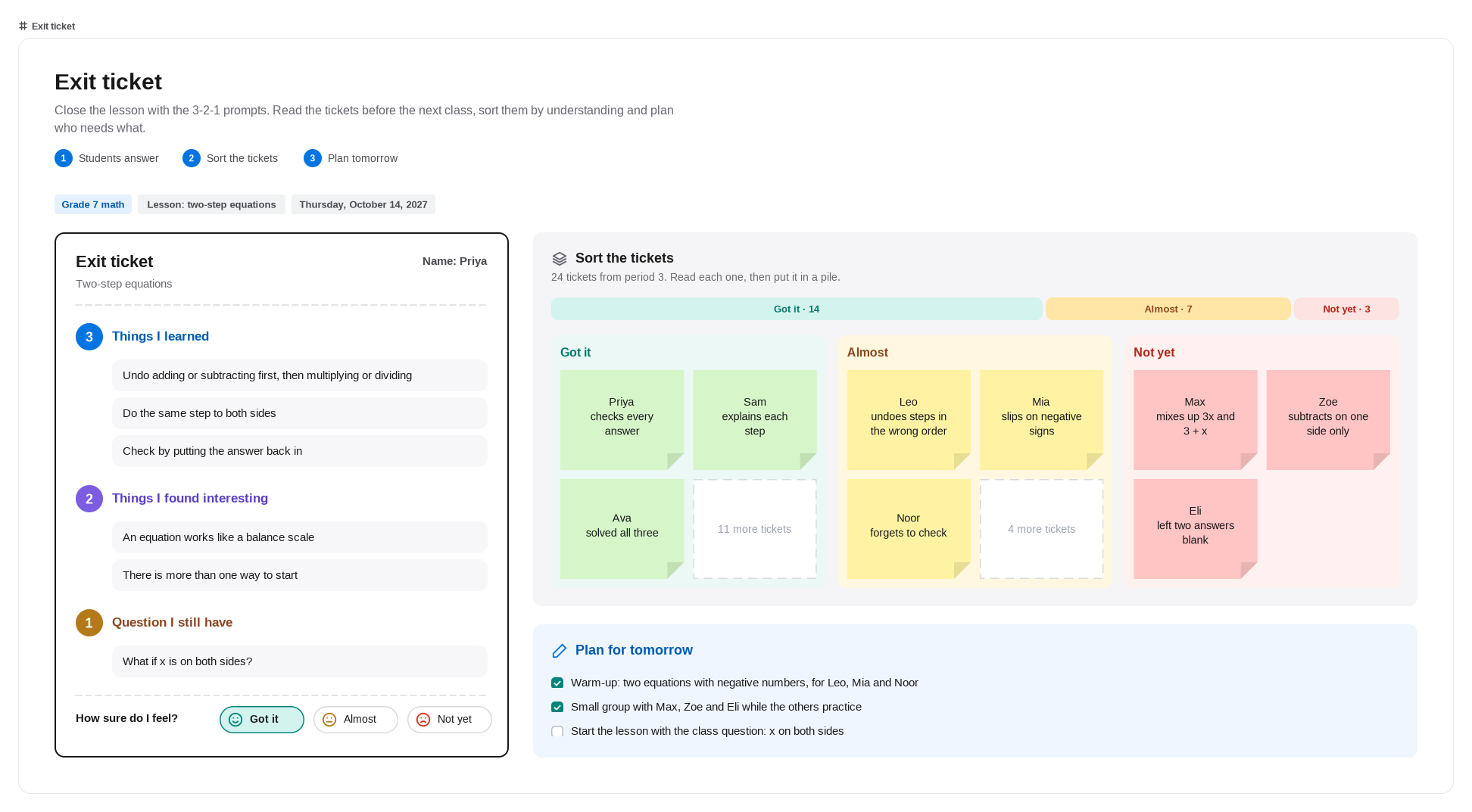
The ticket uses the 3-2-1 prompts: three things I learned, two things I found interesting, one question I still have. The sample is filled in by a student, Priya.
- 3 Things I learned. “Undo adding or subtracting first, then multiplying or dividing”, “Do the same step to both sides” and “Check by putting the answer back in”.
- 2 Things I found interesting. “An equation works like a balance scale” and “There is more than one way to start”.
- 1 Question I still have. “What if x is on both sides?”
At the bottom, “How sure do I feel?” offers three choices: Got it, Almost, Not yet.
The numbers shrink for a reason. Recalling three facts is easy and gets the pen moving. The single question is the hard part, and often the most useful line on the ticket. Priya’s question is exactly where the unit goes next.
Sort the tickets into three piles
The right side is for the teacher after class. Its heading reads “24 tickets from period 3. Read each one, then put it in a pile.” A bar across the top shows the result at a glance: Got it · 14, Almost · 7, Not yet · 3.
Below the bar are three columns of sticky notes, one note per student. The Got it pile shows Priya, Sam and Ava, plus a card that says “11 more tickets”. Almost shows Leo, Mia and Noor and “4 more tickets”. Not yet holds three notes: Max, Zoe and Eli.
Fourteen of 24 is a little over half the class. That is a result the teacher could not have read from the room while everyone nodded. Sort by what the student wrote, not by the box they ticked. A student can feel sure and still show a mistake in the three things they learned.
Write what each student needs, not just the pile
Each sticky note has a name and a few words about what the ticket showed. Those words are what make the sort useful. In the Almost pile, Leo “undoes steps in the wrong order”, Mia “slips on negative signs” and Noor “forgets to check”. In Not yet, Max “mixes up 3x and 3 + x”, Zoe “subtracts on one side only” and Eli “left two answers blank”.
Read like that, the two piles are different problems. The Almost students know the method and make slips. The Not yet students are missing an idea: what 3x means, or why both sides must change together. One extra worksheet would not help both groups. The notes in Got it are short for the same reason: “explains each step” tells the teacher Sam could help a classmate tomorrow.
Plan for tomorrow
The last panel turns the piles into three actions, one for each thing the tickets revealed:
- “Warm-up: two equations with negative numbers, for Leo, Mia and Noor”
- “Small group with Max, Zoe and Eli while the others practice”
- “Start the lesson with the class question: x on both sides”
Every line traces back to a ticket. The warm-up targets the Almost pile’s slips. The small group gives the three Not yet students time with the teacher. The third line picks up Priya’s question and uses it to open the next topic. An exit ticket that changes nothing about the next lesson was not worth collecting; this panel is where the change gets written down.
How to use the exit ticket template
- Open it as a new board. Change the lesson name and date, and clear Priya’s answers so the ticket is blank.
- Students answer. Show the blank ticket on the screen for the last five minutes, or export it as a PDF and print slips. Students write on paper or in their own copy.
- Sort the tickets. After class, add a sticky note per student to one of the three piles, with a few words on what you saw. Update the three counts in the bar.
- Plan tomorrow. Write one action for the Almost pile, one for Not yet and one that uses a student’s question.
Keep one board per lesson. After a few weeks the bars show how the class moved through the unit.
When an exit ticket fits, and when to use another check
Use it at the end of any lesson that introduced a skill or an idea, in any subject. It takes three to five minutes of class time and a short read afterwards.
To find out what students know before a unit starts, a KWL chart is the better opening move. To score finished work against criteria, use a grading rubric. And when the tickets show that tomorrow needs rethinking, put the new sequence into a lesson plan.
Questions about the Exit ticket template
What does 3-2-1 mean on an exit ticket?
Students write three things they learned, two things they found interesting and one question they still have. The format is quick to explain, works in every subject and always produces at least one question for the teacher to use.
Should exit tickets be graded?
No. They are a check for the teacher, not a test for the student. If tickets count toward a grade, students write what they think you want and hide what they do not understand, which removes the point of collecting them.
How long should an exit ticket take?
Three to five minutes at the end of the lesson. If students need longer, shorten the prompts: a 2-1 ticket or a single problem to solve gives you enough to sort the class into the three piles.
Do I need a sticky note for every student?
Not for a large class. The example names three students per pile and counts the rest on cards such as “11 more tickets”. Write notes for the students you plan to act on and keep the totals in the bar accurate.