What is a grading rubric?
A grading rubric is a table that says what is being judged and what each level of quality looks like. The rows are criteria, the things you care about in the work. The columns are performance levels. Each cell describes the work at that level in words a student can understand. A rubric makes grading faster and more consistent, and when students see it before they start, it works as a set of instructions too.
This template is an analytic rubric, the kind that scores each criterion separately and adds up the points. It comes filled in for a Grade 8 English argument essay and scored for a student named Jordan, so it shows a rubric in use as well as its layout.
Criteria down the side, levels across the top
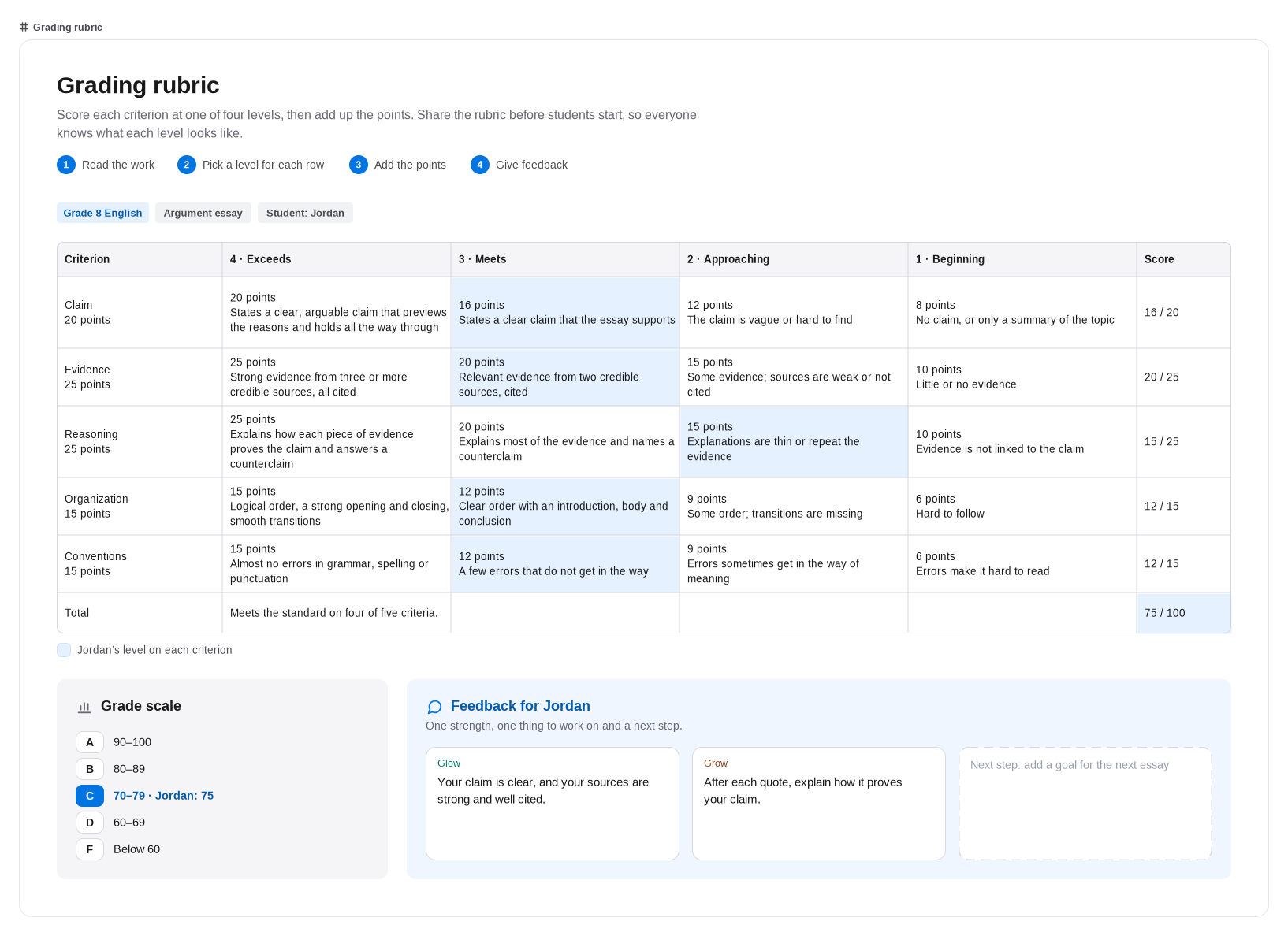
The table has five rows, and each criterion shows its weight: Claim, 20 points; Evidence, 25 points; Reasoning, 25 points; Organization, 15 points; Conventions, 15 points. Together they make 100. The weights are a statement of priorities. In this essay, evidence and reasoning count for half the grade, and grammar counts for less than a sixth.
Four columns set the levels: 4 · Exceeds, 3 · Meets, 2 · Approaching and 1 · Beginning. Every cell gives a point value and a description. For Evidence, the levels run from “Strong evidence from three or more credible sources, all cited” at 25 points, through “Relevant evidence from two credible sources, cited” at 20 and “Some evidence; sources are weak or not cited” at 15, to “Little or no evidence” at 10.
Those descriptions are countable. A student can check whether they have two sources or three. Compare that with “excellent evidence” and “good evidence”, which tell nobody anything.
Scoring one piece of work
To score, the teacher reads the essay and marks one cell in each row. On the board, the chosen cells are highlighted, and a note under the table explains the marking: “Jordan’s level on each criterion”. The Score column records the points.
Jordan’s essay meets the standard for Claim (16 / 20), Evidence (20 / 25), Organization (12 / 15) and Conventions (12 / 15). The Reasoning row is highlighted one column to the right, at 2 · Approaching: “Explanations are thin or repeat the evidence”, for 15 / 25. The Total row sums it up: “Meets the standard on four of five criteria”, 75 / 100.
The row-by-row score is the value of an analytic rubric. A single mark of 75 says “average”. The highlighted cells say the essay is sound everywhere except in explaining its evidence, which is something a student can act on.
From points to a letter grade
The Grade scale card translates the total into a letter: A for 90 to 100, B for 80 to 89, C for 70 to 79, D for 60 to 69 and F below 60. The C row is marked “Jordan: 75”.
Keeping the scale on the same page as the rubric avoids a common argument. Students and parents can see how the points became the letter without asking. Edit the bands to match your school’s scale, or delete the card if you report points only.
One design choice is worth noticing. The lowest level in each row still earns points: 8 of 20 for Claim, 10 of 25 for Evidence. A student who hands in a weak essay lands at 40, not at zero. If your policy differs, change the values in the Beginning column.
Feedback: glow, grow, next step
A score tells students where they stand. Feedback tells them what to do. The panel “Feedback for Jordan” asks for “One strength, one thing to work on and a next step” and gives each its own card:
- Glow. “Your claim is clear, and your sources are strong and well cited.”
- Grow. “After each quote, explain how it proves your claim.”
- Next step. An open card: “add a goal for the next essay”.
Both comments come straight from the table. The glow matches the Claim and Evidence rows. The grow turns the Reasoning description into an instruction: the essay’s explanations were thin, so explain each quote. Feedback written from the rubric’s own language takes a minute, and the student can find the row it refers to.
How to use the grading rubric template
- Open it as a new board. Replace the five criteria with the ones your assignment needs, and set weights that add up to your total.
- Write the Meets column first. Describe work that fully satisfies the standard. Then write Exceeds, Approaching and Beginning by changing what can be counted or observed.
- Share it before the work starts. Go through one row with the class and score a sample piece together.
- Read the work and pick a level for each row. Move the highlights to the cells you choose and type the points in the Score column.
- Add the points and give feedback. Fill the Total row, mark the grade scale and write the glow and grow from the rows that stood out.
Open a fresh copy for each student, or export a blank one as a PDF for the class.
When a rubric helps, and when something simpler will do
Use a rubric for work with no single right answer: essays, presentations, projects, lab reports, art. It is also a strong tool for peer review and self-assessment, since students can score a draft against the same table the teacher will use.
Write the criteria from what the unit set out to teach, which a learning objectives board helps pin down. For the essay this example grades, students can plan with an essay outline built on the same criteria. For a quick check of one lesson, a rubric is too heavy; an exit ticket does that job in a few minutes.
Questions about the Grading rubric template
What is the difference between an analytic and a holistic rubric?
An analytic rubric, like this one, scores each criterion on its own row and adds the points. A holistic rubric gives one overall level for the whole piece. Analytic takes longer and gives more useful feedback; holistic is faster for large sets of short work.
How many criteria should a rubric have?
Four to six. The example uses five. With fewer, important qualities get lumped together; with more, grading slows down and students cannot keep the list in mind while they work.
How many performance levels work best?
Four is a common choice because there is no middle column to hide in: work either meets the standard or it does not yet. Three levels suit younger students, and five can help when you need finer steps for older ones.
Should students see the rubric before the assignment?
Yes. The instruction on the board says to share it before students start, so everyone knows what each level looks like. A rubric shown only with the grade explains the result but cannot improve the work.
Can I change the point values?
Yes. Every cell of the table is editable on your copy. Change the weights, the points per level and the grade bands, then check that the top level of each row adds up to the total you want.