What is a Frayer model?
A Frayer model is a vocabulary organizer named after the educator Dorothy Frayer. A word or concept sits in the center, and four boxes around it build its meaning: a definition, its characteristics, examples, and non-examples. A student who can fill all four knows the word far better than one who has memorized a sentence from a glossary.
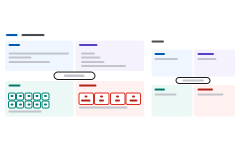
This template has two models side by side. The large one on the left is fully worked for “Prime number”, from a Grade 6 math unit on factors and multiples. The smaller one on the right, headed “Your turn”, is started for “Composite number” and left for students to finish.
Definition and characteristics
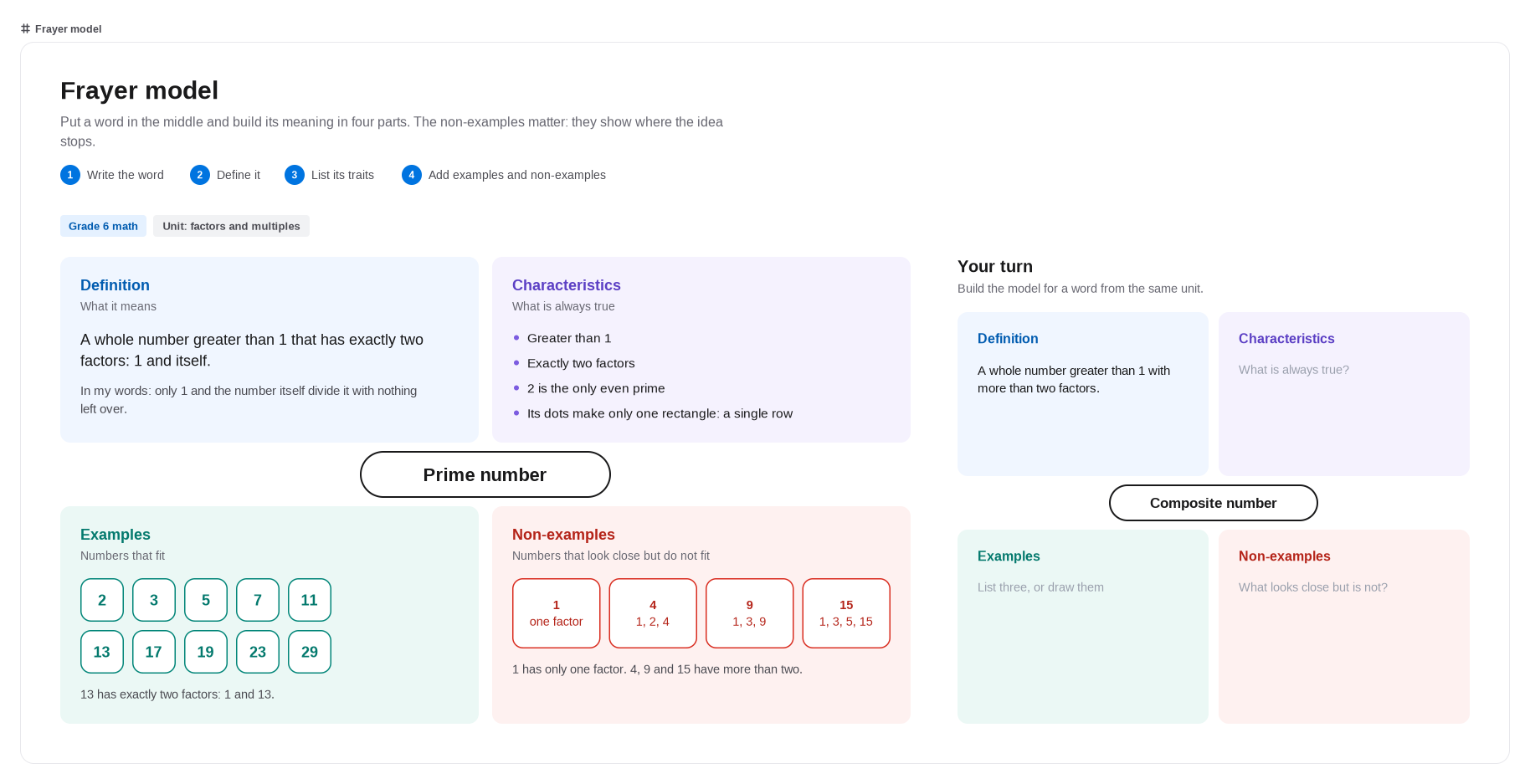
The top two boxes say what the word means in general. Definition, subtitled “What it means”, holds two versions. The first is the formal one: “A whole number greater than 1 that has exactly two factors: 1 and itself.” The second begins “In my words:” and restates it: only 1 and the number itself divide it with nothing left over. Asking for both stops students from copying a line they do not understand.
Characteristics, subtitled “What is always true”, breaks the definition into separate tests. The example lists four: greater than 1, exactly two factors, 2 is the only even prime, and “Its dots make only one rectangle: a single row”. The last one gives the idea a picture. Seven dots can only be laid out as one row of seven, while six dots also make a 2 by 3 block.
Examples, and the non-examples that mark the edge
The bottom two boxes make the idea concrete. Examples, “Numbers that fit”, shows the first ten primes as tiles, from 2 up to 29, with one explained underneath: “13 has exactly two factors: 1 and 13.”
Non-examples is the box students skip and the one that teaches most. Its subtitle sets the bar: “Numbers that look close but do not fit”. A non-example should be a near miss, not something absurd. The board gives four tiles, each with its factors written under it: 1 with “one factor”, 4 with 1, 2, 4, then 9 and 15. The line below sums it up: 1 has only one factor, and 4, 9 and 15 have more than two.
These are well chosen. Many students believe 1 is prime, and 9 and 15 are odd numbers that feel prime. Each non-example fails exactly one of the characteristics, so the two boxes check each other.
Your turn: a second model to finish
The right side of the board repeats the four boxes at a smaller size around a new word from the same unit, “Composite number”. Only the definition is given: “A whole number greater than 1 with more than two factors.” The other three boxes hold prompts instead of answers: “What is always true?”, “List three, or draw them”, and “What looks close but is not?”
The pairing is deliberate. Composite is the opposite of prime, so the non-examples of one are the examples of the other, and students can lift tiles from the left model to the right. When you adapt the board, choose a second word that sits close to the first for the same reason.
How to use the Frayer model template
- Write the word. Open the template as a new board and replace “Prime number” in the center label. Pick a word that carries a concept, not a simple label.
- Define it. Paste the textbook definition, then have students write the “In my words” line under it.
- List its traits. Ask what must be true every time. Three or four bullets are enough.
- Add examples and non-examples. Retype the tiles. For every non-example, write why it fails under the tile, as the board does with factors.
For words that are not numbers, a tile can hold a short phrase instead: “a simile uses like or as” works as well as a 7.
When to use a Frayer model
Use it for the handful of words a unit depends on: prime, photosynthesis, democracy, metaphor. It works before a unit as a preview, during it as pair work, and before a test as review. Because each model takes real thought, save it for key terms.
For a long word list, flashcards cover more ground. To set two related ideas against each other in detail, such as prime and composite, use the compare and contrast template. To show how many terms link together, a concept map is the better drawing.
Questions about the Frayer model template
What are the four parts of a Frayer model?
Definition, characteristics, examples and non-examples, arranged around the word in the center. Some versions swap characteristics for facts or add a drawing. This template uses the classic four and adds a short subtitle to each box so students know what goes in it.
Why does a Frayer model include non-examples?
Because a concept is defined by its edges. Listing things that look close but do not fit, like 1 or 9 for prime numbers, forces students to apply the definition instead of recognizing familiar cases. It also brings common mistakes into the open.
Is the Frayer model only for math?
No. It is used across subjects, for any term with a clear definition: a science concept, a literary device, a form of government, a grammar rule. The example here is from math, but only the text in the boxes needs to change.
Can each student have a copy?
Yes. Each student can open the template in their own workspace. The Free plan includes three boards, and this template fits on it. To hand it out on paper, export the board as a PDF and print it.