What are learning objectives?
A learning objective is a sentence that says what students will be able to do after a lesson or unit. A good one starts with a verb you can see or hear a student perform, such as “calculate” or “compare”, so you can tell afterwards whether it was met. “Understand food chains” is a hope. “Explain why only about 10% of energy passes to the next trophic level” is an objective.
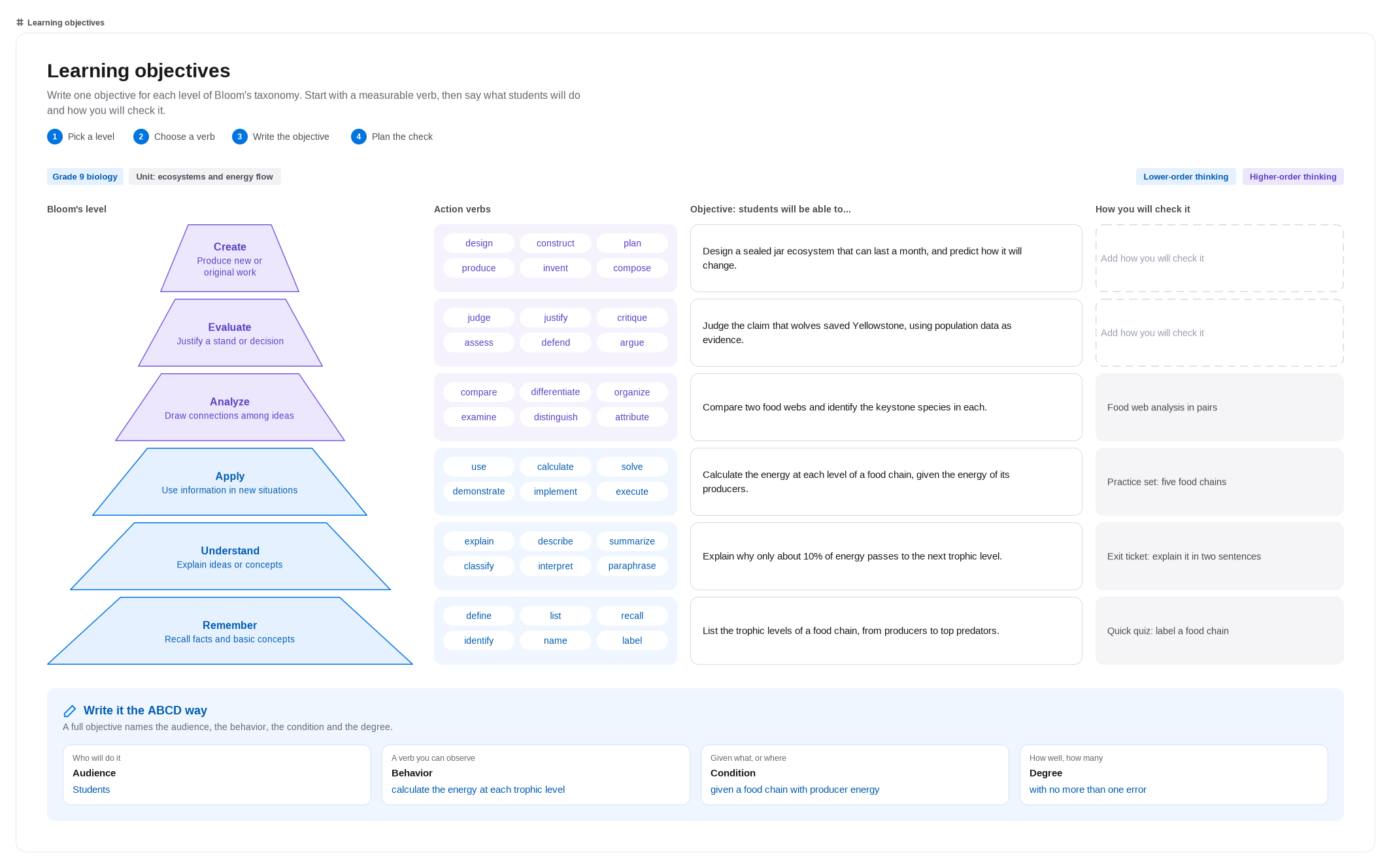
This template organizes objectives by Bloom’s taxonomy, a ladder of six kinds of thinking named after the educational psychologist Benjamin Bloom. Each level has its own row: the level, a set of action verbs, an objective written with one of them, and a way to check it. A band at the bottom shows a second tool, the ABCD formula for writing a complete objective.
Six levels and the verbs that belong to them
The left side of the board stacks the levels as a pyramid, widest at the bottom. Each step carries a one-line description:
- Create. Produce new or original work.
- Evaluate. Justify a stand or decision.
- Analyze. Draw connections among ideas.
- Apply. Use information in new situations.
- Understand. Explain ideas or concepts.
- Remember. Recall facts and basic concepts.
Next to each step are six verb chips. Remember has define, list, recall, identify, name and label. Apply has use, calculate, solve, demonstrate, implement and execute. Create has design, construct, plan, produce, invent and compose. The chips are the working part of the board. When an objective feels vague, find its level and pick a verb from that row.
A legend at the top right splits the ladder in two: lower-order thinking for the bottom rows and higher-order thinking for the top ones.
One objective for every level
The third column, headed “Objective: students will be able to...”, shows the same unit at all six levels. Read from the bottom up and the demands grow:
- Remember: list the trophic levels of a food chain, from producers to top predators.
- Apply: calculate the energy at each level of a food chain, given the energy of its producers.
- Analyze: compare two food webs and identify the keystone species in each.
- Evaluate: judge the claim that wolves saved Yellowstone, using population data as evidence.
- Create: design a sealed jar ecosystem that can last a month, and predict how it will change.
Every sentence opens with a verb from its own row of chips, and every one names real content from the unit. That pairing is the pattern to copy. A unit does not need all six levels in every lesson, but if all your objectives sit in the bottom two rows, students are only being asked to recall and restate.
Match the check to the verb
The last column, “How you will check it”, keeps objectives honest. For each one it names the task that will show whether students got there. In the example, the four lower rows are filled:
- Remember: “Quick quiz: label a food chain”.
- Understand: “Exit ticket: explain it in two sentences”.
- Apply: “Practice set: five food chains”.
- Analyze: “Food web analysis in pairs”.
Notice that the task uses the same kind of thinking as the verb. A labeling quiz checks recall. It would not show whether a student can calculate energy transfer, which is why Apply gets a practice set instead. The two top rows, Evaluate and Create, hold dashed boxes reading “Add how you will check it”. Filling them is a good first exercise: what would students hand in to show they can judge a claim with data?
Write it the ABCD way
The band at the bottom states that a full objective names the audience, the behavior, the condition and the degree, and takes the Apply objective apart into those four pieces:
- Audience, who will do it: “Students”.
- Behavior, a verb you can observe: “calculate the energy at each trophic level”.
- Condition, given what, or where: “given a food chain with producer energy”.
- Degree, how well, how many: “with no more than one error”.
Bloom’s level tells you which verb to use. ABCD tells you what else the sentence needs. The degree is the part most often left out, and it is the part that turns an objective into something you can grade.
How to use the learning objectives template
- Pick a level. Open the template as a new board, change the chips to your grade and unit, and decide which levels this unit should reach.
- Choose a verb. Take one from that level’s chips. Skip “know”, “learn” and “understand”: you cannot watch a student do them.
- Write the objective. Replace the example sentence in that row. Name the content, and add a condition and a degree where they help.
- Plan the check. Fill the last column with the task that will show the verb in action.
Delete the rows you do not need. Three well-checked objectives serve a unit better than six that are never assessed.
Where the objectives go next
Use this board when you plan a unit, rewrite a course, or review whether your assessments match what you say you teach. Trainers can use it the same way for a workshop.
Once written, objectives move into other plans. A single period’s objectives go at the top of a lesson plan. A course’s outcomes go on the course syllabus. And for an objective at the Evaluate or Create level, a grading rubric spells out what each level of quality looks like.
Questions about the Learning objectives template
What are the six levels of Bloom’s taxonomy?
From the base up: remember, understand, apply, analyze, evaluate and create. The lower levels are about recalling and explaining knowledge. The upper levels ask students to break ideas apart, judge them and make something new with them.
Why should I avoid the verb “understand” in an objective?
Because you cannot observe it. Understanding happens inside a student’s head. Choose a verb that shows it from the outside, such as explain, describe, summarize or classify, which are the chips this template lists on the Understand row.
How many objectives should a lesson have?
Usually two or three, each with a way to check it. A unit can have more, spread across levels. The six in this example cover a whole unit on ecosystems and would be taught over several weeks, not in one period.
What does ABCD stand for in objective writing?
Audience, behavior, condition and degree. The audience is who will perform, the behavior is the observable verb and its content, the condition is the situation or materials given, and the degree is the standard for success, such as a number correct.