What is a hiring debrief?
A hiring debrief is the meeting where everyone who interviewed a candidate compares notes and the hiring manager decides whether to make an offer. Done loosely, it is where bias gets in: the most senior person speaks first, the others adjust, and a “gut feeling” replaces what the candidate actually said and did.
This template gives the debrief a structure that resists that. Scores are written before the meeting, evidence is sorted by skill, and the decision is recorded with its reasons. The example is the debrief for Jordan, a candidate for senior product designer, after a final round of four interviews.
The role, the score key and the ground rules
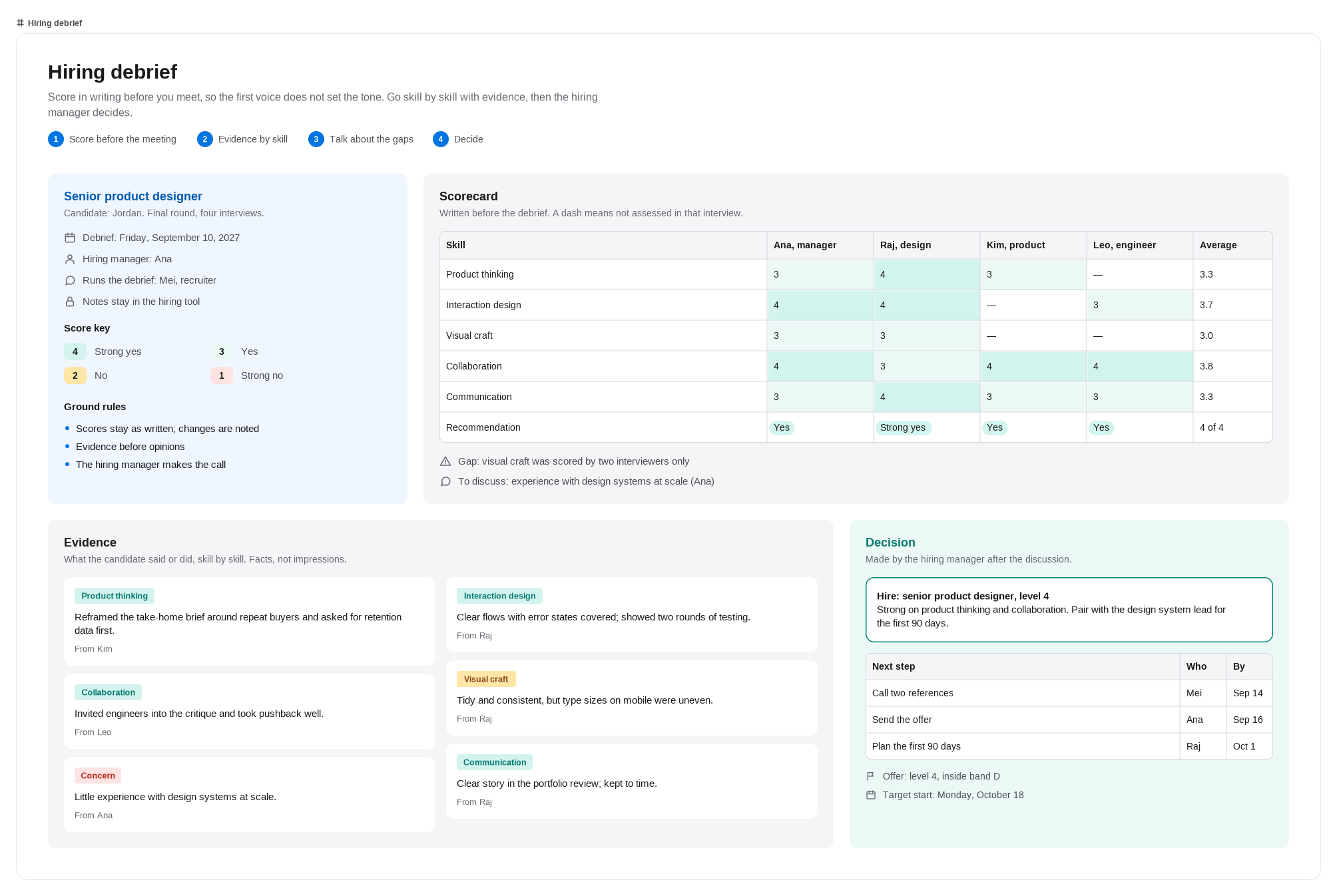
The left panel sets the terms. It names the role and the candidate, the date, Friday, September 10, 2027, the hiring manager, Ana, and the person who runs the debrief, Mei, the recruiter. Splitting those two jobs lets the manager listen.
The score key has four levels and no middle: 4 is a strong yes, 3 a yes, 2 a no and 1 a strong no. With no neutral score to hide in, every interviewer has to lean one way. Three ground rules follow:
- Scores stay as written; changes are noted.
- Evidence before opinions.
- The hiring manager makes the call.
The scorecard
The scorecard is a table with a row per skill and a column per interviewer: Ana the manager, Raj from design, Kim from product and Leo, an engineer. Five skills are scored: product thinking, interaction design, visual craft, collaboration and communication. A dash means the skill was not assessed in that interview, and the last column averages the scores that exist.
Collaboration averages highest at 3.8 and visual craft lowest at 3.0. The bottom row holds each person’s overall recommendation: three say Yes and Raj says Strong yes, 4 of 4 in favor. Under the table, two lines flag what the numbers cannot show. One is a gap: visual craft was scored by two interviewers only. The other is a topic Ana wants to discuss.
Evidence: facts, not impressions
The subtitle of the Evidence panel is the best advice on the board: what the candidate said or did, skill by skill. Facts, not impressions. Each card names a skill, quotes one observation and says who it came from.
Compare two ways to back a score of 3 for product thinking. An impression would be “smart, good instincts”. The card from Kim reads: “Reframed the take-home brief around repeat buyers and asked for retention data first.” Anyone can weigh that. The same holds for weak spots. Raj’s card on visual craft says the work was tidy and consistent, but type sizes on mobile were uneven. One card is labelled Concern: little experience with design systems at scale, from Ana.
The decision and what follows
The Decision panel states the outcome first: “Hire: senior product designer, level 4”. Two sentences explain it. The candidate is strong on product thinking and collaboration, and will pair with the design system lead for the first 90 days. That second sentence answers Ana’s concern directly: the team hires with the gap in view and plans around it.
A short table lists next steps: Mei calls two references by September 14, Ana sends the offer by September 16, and Raj plans the first 90 days. Two closing lines fix the offer at level 4, inside band D, and a target start of Monday, October 18.
How to use the hiring debrief template
- Open it as a new board. Make one copy per candidate. Set the role, the interviewers’ names and the skills from your job description.
- Score before the meeting. Collect each interviewer’s scores and recommendation in writing, and enter them without showing anyone the others’ numbers first.
- Go through evidence by skill. For each row, the scorer reads their observation aloud and it goes on a card. No card, no score.
- Talk about the gaps. Spend the time where scores differ or a skill has too few assessments.
- Decide. The hiring manager states the outcome and the reasons, and the recruiter fills in the next steps.
When to use it, and related boards
Use the board for every final-round debrief, including the easy ones. A unanimous yes is exactly when a panel skips the evidence, and a record helps when the next candidate for the same role comes through.
Candidate notes are personal data. The example reminds the panel that notes stay in the hiring tool, so keep the board to scores and short observations, and share it only with the interviewers.
To compare several finalists on the same criteria, a decision matrix puts them side by side with weights. Once the offer is accepted, an org chart shows where the new hire sits, and a one-on-one board gives the manager a place for the first check-ins.
Questions about the Hiring debrief template
Why should interviewers score before the debrief?
Because people adjust to what they hear first. A score written alone reflects what that interviewer saw. The board’s first ground rule protects this: scores stay as written, and if someone changes their mind in the meeting, the change is noted, not overwritten.
Who makes the final hiring decision?
The hiring manager. Interviewers supply scores and evidence, and the recruiter runs the meeting. The example states it as a ground rule and repeats it in the Decision panel, which reads “Made by the hiring manager after the discussion.”
What if the interviewers disagree?
Disagreement is useful. Ask each side for the observation behind its score; often they saw different things in different interviews. If a skill was assessed by too few people, as visual craft was in the example, decide whether another conversation is needed.
How long should a debrief take?
Thirty minutes for one candidate when scores are in beforehand. Five minutes to read the scorecard, fifteen on evidence and gaps, ten on the decision and next steps. Hold it within a day or two of the last interview.