What is a one-on-one?
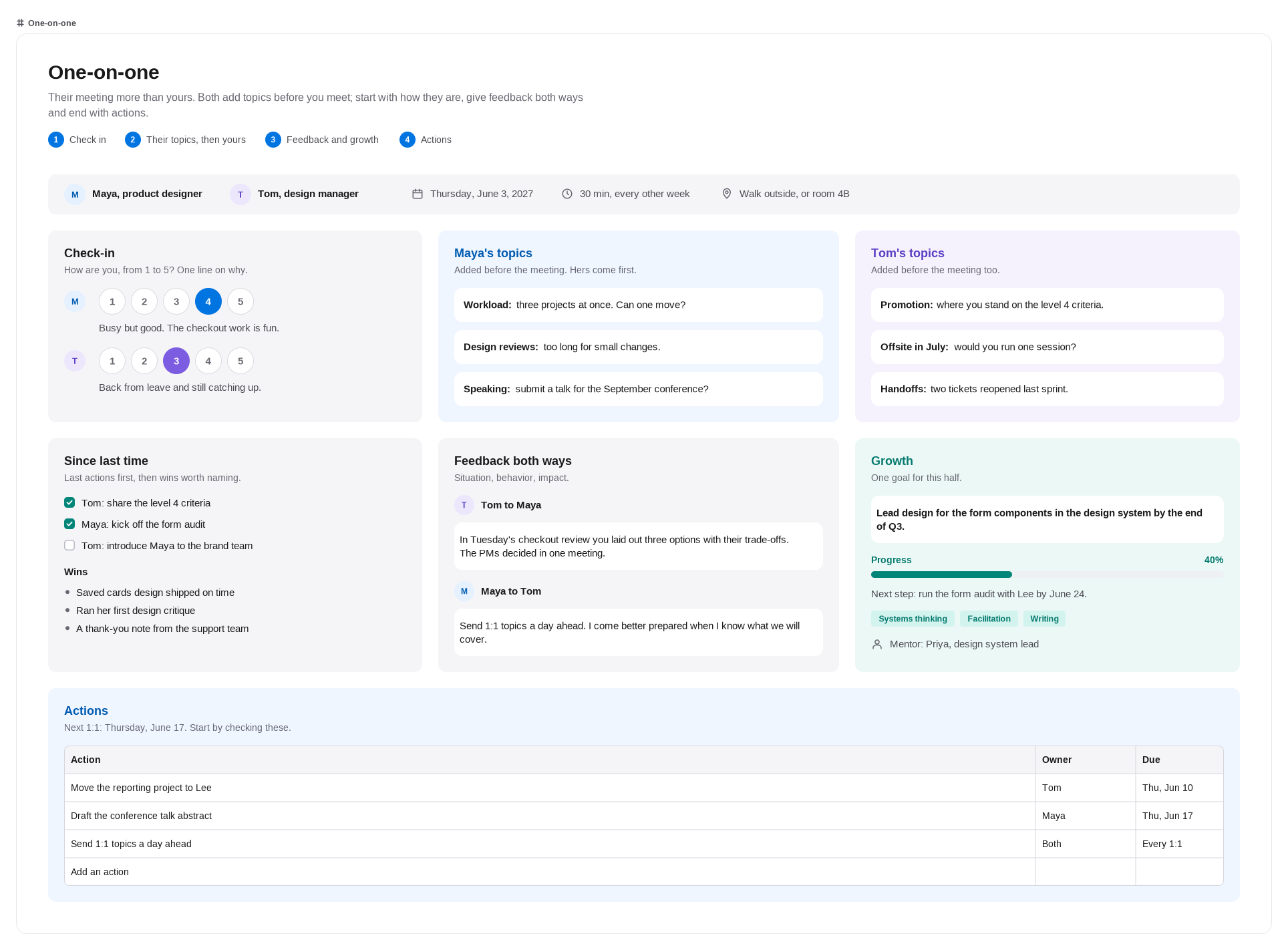
A one-on-one, often written 1:1, is a regular private meeting between a manager and one person on the team. It is the place for what does not fit in a team meeting: workload, feedback, career, and anything that is bothering either of them. The sentence printed above the board sums up whose meeting it is: “Their meeting more than yours.”
This template gives the pair one board to keep between meetings. It has seven cards: a check-in, a topic list for each person, a look back at the last meeting, feedback, growth and actions. The example is Maya, a product designer, and Tom, her design manager, who meet for 30 minutes every other week.
Start with the person, then the last actions
The Check-in card asks “How are you, from 1 to 5? One line on why.” Both people answer. Maya picks 4 and writes “Busy but good. The checkout work is fun.” Tom picks 3: “Back from leave and still catching up.” A number is quick to give, and the line after it often shows what the meeting should really be about.
Under it, Since last time comes in two parts. First the actions from the previous meeting, as a checklist with a name on each line. Two are ticked, and “Tom: introduce Maya to the brand team” is still open, so it gets asked about. Then Wins, such as “Ran her first design critique”. Writing wins down every two weeks also makes review season much easier.
Two topic lists, theirs first
The middle and right cards of the top row are Maya’s topics and Tom’s topics. Both are “Added before the meeting”, and the note on Maya’s card settles the order: “Hers come first.” If time runs out, the manager’s list is the one that waits.
Each topic is a label and one line. Maya’s are “Workload: three projects at once. Can one move?”, “Design reviews: too long for small changes.” and “Speaking: submit a talk for the September conference?” Tom brings a promotion update, a request for the July offsite and a concern: “Handoffs: two tickets reopened last sprint.” Because each topic is phrased as a question or a plain fact, the other person can think about it before they sit down.
Feedback both ways
The Feedback both ways card has a three-word guide: “Situation, behavior, impact.” Tom’s feedback to Maya follows it exactly: “In Tuesday’s checkout review you laid out three options with their trade-offs. The PMs decided in one meeting.” It names when, what she did, and what it led to. She can repeat that on purpose.
The second box is the one many one-on-ones never fill: Maya to Tom. “Send 1:1 topics a day ahead. I come better prepared when I know what we will cover.” A slot on the board makes upward feedback a normal part of the meeting. An empty box is a visible prompt to ask for it.
Growth: one goal, kept in view
Growth holds “One goal for this half.” Maya’s is “Lead design for the form components in the design system by the end of Q3.” A progress bar under it stands at 40%, and the next step has a date: “run the form audit with Lee by June 24”.
Three skill tags, Systems thinking, Facilitation and Writing, say what the goal is meant to build, and the last line names a mentor. Because the card stays on the board, career talk happens a little in every meeting. It does not have to wait for a yearly review.
End with actions for both people
The Actions table has Action, Owner and Due, and its subtitle sets up the next meeting: “Next 1:1: Thursday, June 17. Start by checking these.”
The rows come straight from the cards above. Maya’s workload topic became “Move the reporting project to Lee”, owned by Tom. Her speaking question became “Draft the conference talk abstract”, owned by Maya. Her feedback to Tom became a habit for both, due “Every 1:1”. The Owner column should show both names over time. If every action belongs to one person, check who the meeting is serving.
How to use the one-on-one template
- Open it as a new board. Use this template makes a copy. Put both names in the strip at the top and share the board with the other person.
- Add topics before you meet. Each of you writes up to three, a day ahead if you can.
- Check in, then go through their topics, then yours. Tick off last time’s actions on the way.
- Give feedback and look at growth. One note in each direction, then update the progress and the next step.
- Write the actions and the next date. Before the next meeting, move this meeting’s actions into Since last time and clear the topic lists.
When this board fits, and when another does
Use it for any recurring one-on-one: manager and report, mentor and mentee, two co-founders. Its value grows with each meeting, as the actions and wins build up on one board.
It is not a status meeting. Project updates for the whole group belong in a weekly team sync. To hear how the whole team is doing at once, run a team check-in. And when the growth goal needs more room than one card, write it out with the SMART goals template.
Questions about the One-on-one template
How often should one-on-ones happen?
The example pair meets for 30 minutes every other week. Weekly suits new hires and people going through a hard stretch. Less often than every two weeks, and topics pile up or get raised somewhere worse.
Who sets the agenda for a one-on-one?
Both people add topics before the meeting, but the report’s list is discussed first. The template says so on the card itself. A manager who fills the whole time with their own list has turned the meeting into a briefing.
What should we talk about when there are no topics?
Go to the cards that never run dry: the check-in score and the reason behind it, the growth goal and its next step, and feedback in both directions. An empty topic list is also a good moment to ask what is going well and why.
Should each person have their own board?
Yes, one board per pair works best, because the actions, wins and growth goal carry over from meeting to meeting. The Free plan includes three boards with one editor, and the other person can view and leave topics as comments. On the Team plan both of you edit the same board.