What is a decision meeting?
A decision meeting exists to make one choice and record it. That sounds obvious, yet many meetings end with “let’s think about it” because nobody agreed beforehand what was being decided, by whom, or on what basis. A decision meeting fixes those three things first.
This template is the working surface for it. It frames the question, names who plays which part using DACI roles, compares the options on equal terms, scores them, and ends with the choice, the reasons and the next steps. The example company is choosing between Canada, the UK and Australia for its next launch.
Frame the decision
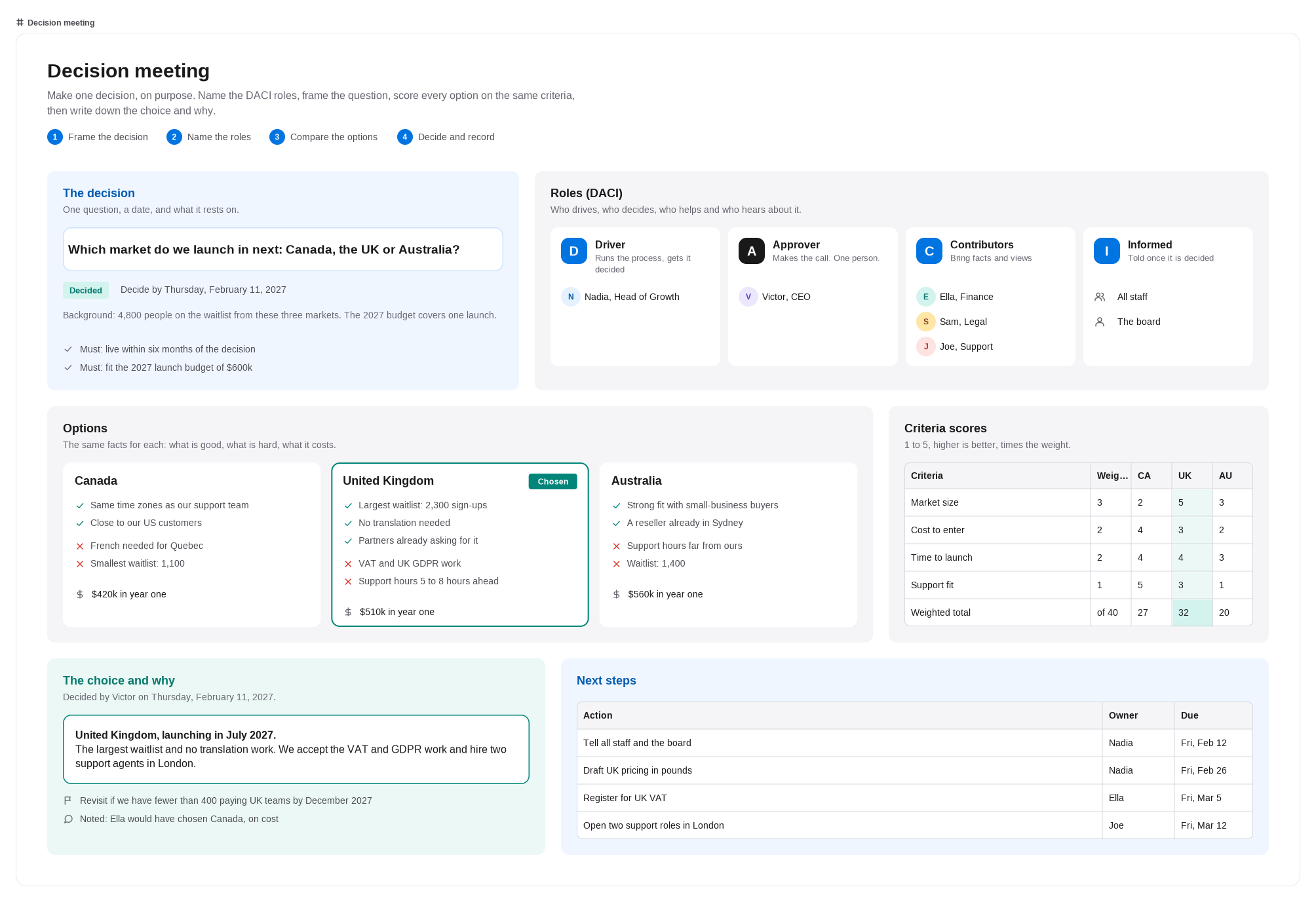
The first panel holds one question, a date and what the answer rests on. The question is written so it can be answered in a word: “Which market do we launch in next: Canada, the UK or Australia?” The deadline is beside it, Thursday, February 11, 2027, with a tag that now reads Decided.
Below come the background and the constraints. Background: 4,800 people on the waitlist from these three markets, and a 2027 budget that covers one launch. Then two lines that start with “Must”: live within six months of the decision, and fit the launch budget of $600k. Musts are useful because any option that breaks one is out before the debate starts.
Name the roles with DACI
DACI gives everyone involved one of four parts, and the board has a card for each:
- Driver. Runs the process and gets it decided. Here: Nadia, Head of Growth.
- Approver. Makes the call. One person. Here: Victor, the CEO.
- Contributors. Bring facts and views: Ella from Finance, Sam from Legal, Joe from Support.
- Informed. Told once it is decided: all staff and the board.
The words “One person” on the Approver card carry the most weight. When two people approve, a tie has no way out. Contributors are heard and then step back, which lets them disagree and still support the result.
Give every option the same facts
The Options panel has one card per market, and each card follows the same pattern: what is good, what is hard, and what it costs. Canada shares time zones with the support team but has the smallest waitlist, 1,100, and needs French for Quebec; $420k in year one. The United Kingdom has the largest waitlist, 2,300 sign-ups, and needs no translation, at the price of VAT and UK GDPR work; $510k. Australia fits small-business buyers and has a reseller in Sydney, but support hours are far away; $560k.
The equal pattern is the point. If one card lists five advantages and another lists none, the board is arguing, not informing. Fill the cards before the meeting and let the contributors check them.
Score the options on weighted criteria
Beside the cards a small table turns the comparison into numbers. Four criteria each carry a weight: market size 3, cost to enter 2, time to launch 2, support fit 1. Every market gets a score from 1 to 5 per row, higher is better, and each score is multiplied by its weight.
The weighted totals, out of 40, are 27 for Canada, 32 for the UK and 20 for Australia. Canada matches or beats the UK on three of the four rows, yet the UK wins overall, because market size has the heaviest weight and the UK scores 5 there against Canada’s 2. Agree on the weights before anyone scores, or people will tune them to reach the answer they already wanted.
Write down the choice and why
The panel at the bottom left is the record. It states the outcome first, “United Kingdom, launching in July 2027”, then the reasons in two sentences: the largest waitlist and no translation work, accepting the VAT and GDPR work and hiring two support agents in London. A line above says who decided and when: Victor, on the deadline.
Two smaller lines make this record better than most. One sets a tripwire: revisit if there are fewer than 400 paying UK teams by December 2027. The other notes a dissent: Ella would have chosen Canada, on cost. Writing the disagreement down costs nothing and shows the choice was made with open eyes.
How to use the decision meeting template
- Open it as a new board. Two or three days ahead, write your question, the decide-by date and the musts.
- Name the roles. Put one name on the Approver card and tell that person. Add or remove contributor rows as needed.
- Compare the options. Have contributors fill the cards and the score table before the meeting, and share the board as pre-reading.
- Decide and record. In the room, the approver hears the contributors, makes the call and dictates the reasons. Then fill Next steps, as the example does with “Tell all staff and the board” on the day after the decision.
When this format fits, and when a lighter one will do
Use it for choices that are expensive to reverse and touch several teams: a market, a vendor, a pricing model, a reorganization. The preparation takes a few hours and saves weeks of reopened debate.
For a quick choice between two paths, a pros and cons list is enough. If the scoring is the hard part and you have many options or criteria, use the full decision matrix. When the difficulty is who does what after the decision, a RACI matrix spells out the work role by role.
Questions about the Decision meeting template
What does DACI stand for?
Driver, Approver, Contributors, Informed. The driver runs the process, the approver makes the final call, contributors supply facts and opinions, and the informed are told the outcome. The board prints a one-line description under each role.
Why should there be only one approver?
A single approver cannot deadlock, and everyone knows whose judgment to prepare for. In the example the CEO approves while Finance, Legal and Support contribute. If a decision truly needs two people to agree, split it into two decisions.
What if the scores and the approver disagree?
The approver decides; the table advises. Scores make the reasoning visible and expose weak spots, but weights are judgments too. If the choice goes against the totals, say why in the reasons panel so readers can follow it later.
How long should a decision meeting last?
Thirty to forty-five minutes when the options and scores were shared ahead of time. Spend the first ten on questions about the facts, the middle on what contributors think, and the last ten on the call, the reasons and the next steps.