What is a kanban board?
A kanban board shows work as cards that move through columns. Each column is a stage, each card is one piece of work, and a card moves one column to the right when its stage is finished. The board replaces the status meeting: the answer to “where are we?” is on the wall.
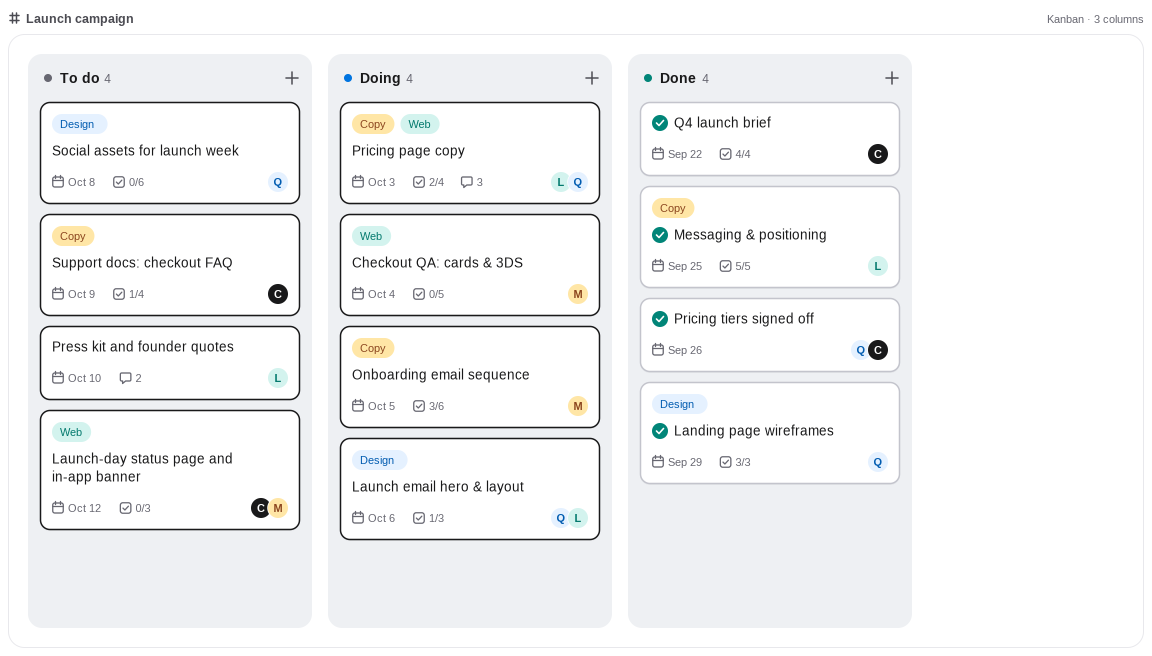
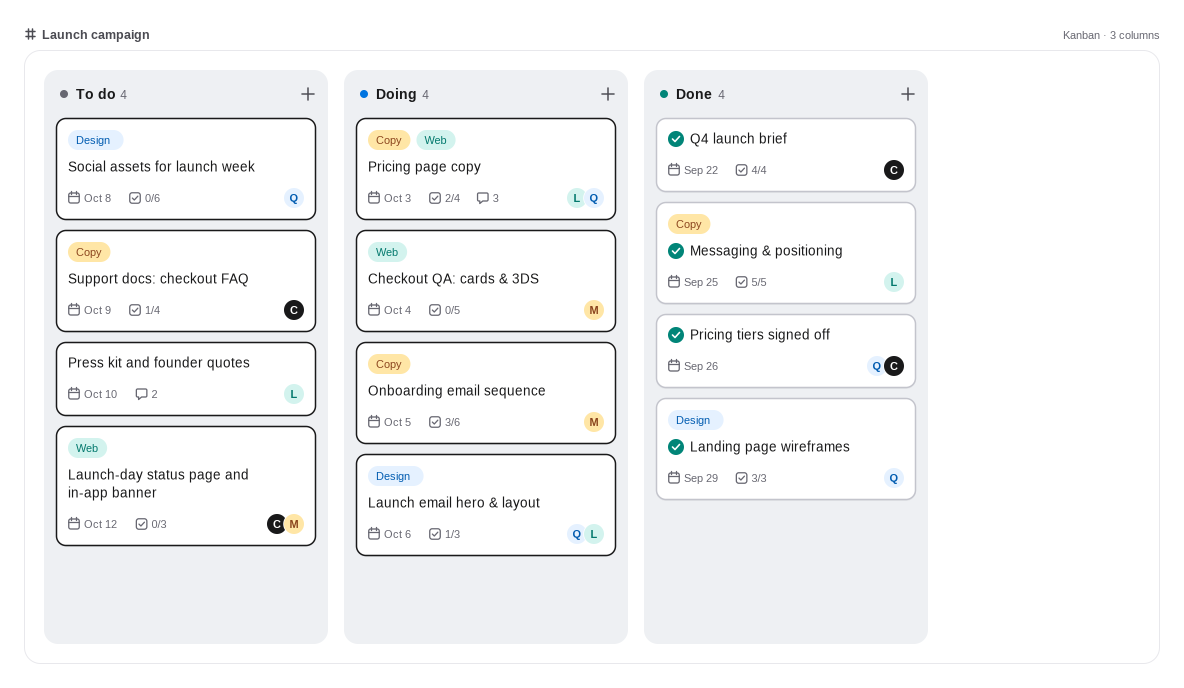
The template is a board named Launch campaign. It has the three classic columns, To do, Doing and Done, with four cards in each. The cards are the tasks of a marketing team getting a product launch out of the door.
Three columns, one direction
The columns are the smallest workflow that still tells the truth. To do holds work that is agreed but not started, such as “Press kit and founder quotes”. Doing holds work somebody has picked up, such as “Pricing page copy”.
A card only ever moves to the right. If a card has to go back, say a draft that failed review, that is a signal the board is missing a column. Add one, for example Review between Doing and Done, when a stage really exists in how your team works. Do not add columns for stages you wish you had.
Keep the Doing column short
The middle column is the one to watch. In the example it holds four cards: “Pricing page copy”, “Checkout QA: cards & 3DS”, “Onboarding email sequence” and “Launch email hero & layout”.
Four cards in progress is fine for a team of four. It is too many for a team of two, because every extra card in Doing is a card nobody is finishing. Agree on a limit for this column, write the number in its title, and hold to it: when the column is full, the next person free helps finish a card there before pulling a new one from To do. This single rule is what separates a kanban board from a to-do list with columns.
Write cards as things you can finish
Read the To do cards: “Social assets for launch week”, “Support docs: checkout FAQ”, “Launch-day status page and in-app banner”. Each names a deliverable. You could hold the finished thing in your hand, and two people would agree on whether it exists.
Compare that with cards like “Marketing” or “Look into support”. They never reach Done because nobody knows what done means. A useful test for a new card: can you picture what will be different when it moves to the last column? If not, split it until you can. A card that stays in Doing for more than a week or two is usually three cards wearing one title.
How to use the kanban template
- Open it as a new board. The campaign cards come along as an example.
- Rename the frame. Change Launch campaign to the project or team the board serves, and keep one board per stream of work.
- Empty the board, then refill To do. Delete the sample cards and write one card for each piece of work you have already agreed to do. Put the most urgent at the top.
- Move only what has started. Drag a card to Doing when someone begins it, not when someone plans to.
- Clear Done on a schedule. Once a week, look at what reached the last column, then archive or delete those cards so the column shows recent progress.
The Done column in the example reads like a history of the project so far: “Q4 launch brief”, “Messaging & positioning”, “Pricing tiers signed off”, “Landing page wireframes”.
When kanban fits, and when to choose another board
Kanban suits work that arrives steadily and varies in size: a marketing team, a support queue, a personal task list, a small product team between releases. The guide to making a kanban board goes further into limits and columns.
If your team works in fixed sprints with a committed set of stories, the scrum board adds the sprint structure. If the question is when things will be done, not what state they are in, a Gantt chart puts the same work on a calendar. And if the list is long and unsorted, order it first in a product backlog.
Questions about the Kanban template
What is a WIP limit?
WIP means work in progress. A WIP limit is the largest number of cards a column may hold at once. When the column is full, nobody starts new work until a card leaves it. The limit keeps the team finishing things instead of starting them.
How many columns does a kanban board need?
Start with three: To do, Doing and Done. Add a column only for a stage where cards really wait, such as Review or Blocked. Past six columns the stages are usually too fine to be worth tracking.
Who moves the cards?
The person doing the work moves their own card, at the moment its state changes. A board that one manager updates once a week shows last week, and people stop trusting it.
Is the kanban board template free?
Yes, it opens on the Free plan with three boards. On Free and Pro one person edits the board and others view and comment. On the Team plan several people can move cards at the same time.