What is a project charter?
A project charter is the short document that turns an idea into an approved project. It records the reason, the goals, the limits, the people, the money and the dates, and the sponsor signs it before work begins. Later, when someone asks “why are we doing this?” or “was that ever in scope?”, the charter is where you look.
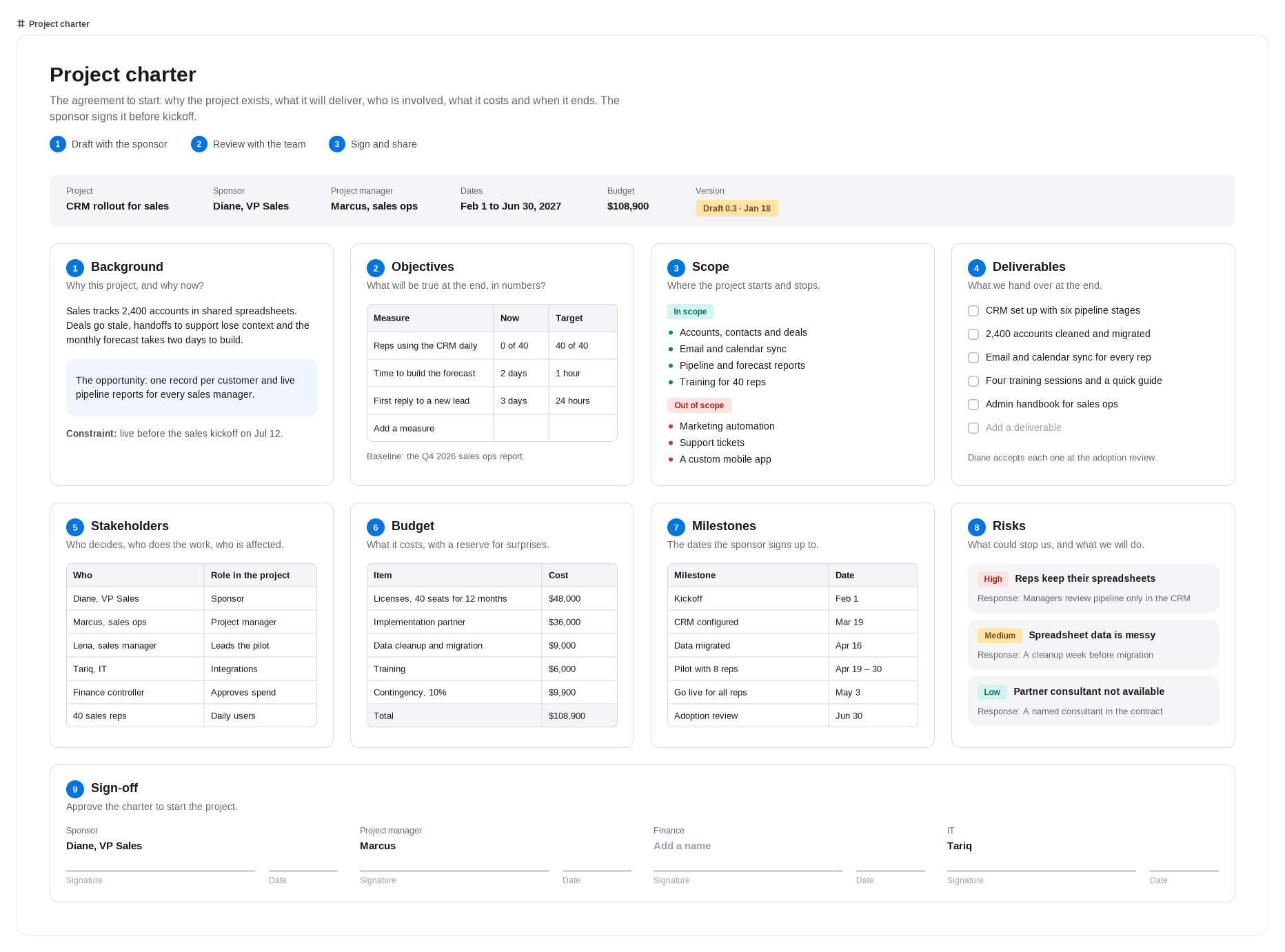
This template puts the charter on one board in nine numbered blocks. The example is “CRM rollout for sales”: Diane, the VP Sales, sponsors it, Marcus from sales ops manages it, and it runs from Feb 1 to Jun 30, 2027. A label in the header reads “Draft 0.3 · Jan 18”, a reminder that a charter goes through versions before it is signed.
Why, and what will be true at the end
Block 1, Background, answers “Why this project, and why now?” in three sentences: “Sales tracks 2,400 accounts in shared spreadsheets. Deals go stale, handoffs to support lose context and the monthly forecast takes two days to build.” Under it sit the opportunity and one hard constraint: live before the sales kickoff on Jul 12.
Block 2, Objectives, asks for numbers. Its table has three columns, Measure, Now and Target. Reps using the CRM daily: from 0 of 40 to 40 of 40. Time to build the forecast: from 2 days to 1 hour. First reply to a new lead: from 3 days to 24 hours. A line below names the baseline, the Q4 2026 sales ops report, so nobody can argue later about where “now” came from.
Where the project starts and stops
Block 3, Scope, has two lists. In scope: accounts, contacts and deals, email and calendar sync, pipeline and forecast reports, and training for 40 reps. Out of scope: marketing automation, support tickets and a custom mobile app. The second list is the more useful one. Each line on it is a request someone will make in month three, already answered.
Block 4, Deliverables, lists what is handed over, each as a countable thing: “CRM set up with six pipeline stages”, “2,400 accounts cleaned and migrated”, “Four training sessions and a quick guide”. The last line says who accepts them and when: Diane, at the adoption review.
People, money and dates
The second row starts with three small tables. Block 5, Stakeholders, names six people or groups and their role, from “Diane, VP Sales, Sponsor” to “40 sales reps, Daily users”. Block 6, Budget, lists four cost lines, adds “Contingency, 10%” of $9,900 and ends on the total of $108,900, the same number as in the header. Block 7, Milestones, gives six dates the sponsor signs up to: kickoff on Feb 1, a pilot with 8 reps from Apr 19 to 30, go live for all reps on May 3 and an adoption review on Jun 30.
Keep these tables short. A charter is not the plan. It holds only the totals and the dates that need a signature.
Risks, each with a response
Block 8 holds the three risks most likely to stop the project, each tagged High, Medium or Low and followed by a response. The high one is about people, not software: “Reps keep their spreadsheets”. Its response is a management decision: “Managers review pipeline only in the CRM”.
Three is the right number for a charter. The sponsor should sign knowing the main dangers. A full list with owners and review dates comes later, in a register.
How to use the project charter template
- Create your board from it. Use this template copies the nine blocks, with the CRM example, into your workspace.
- Draft with the sponsor. Fill blocks 1 to 4 together in one sitting. If the two of you cannot agree on objectives and scope, nothing after them will hold.
- Review with the team. Let the people who will do the work challenge the budget, the milestones and the risks, then raise the version label in the header.
- Sign and share. Block 9 has a signature and date line for the sponsor, the project manager, finance and IT. Export the signed board as a PDF and keep it where the team can find it.
When you need a charter, and what follows it
Write a charter for any project that spends real money or takes people away from their usual work. It costs an afternoon and saves weeks of confusion about goals and scope.
After it is signed, the charter stays as it is. The living document is the plan: a one-page project plan carries the same goal and adds a timeline and a status you update. Present both at the project kickoff. If block 5 grows past a handful of names, give them a stakeholder map of their own.
Questions about the Project charter template
Who writes the project charter?
The project manager usually drafts it, but the sponsor owns it. The sponsor supplies the reason, the objectives and the budget limit, and signs the result. A charter written by the project manager alone is a proposal, not an agreement.
What is the difference between a project charter and a project plan?
The charter says why the project exists and what it must achieve, and it is fixed once signed. The plan says how and when the work gets done, and it changes as the project moves. The charter comes first and the plan answers to it.
How long should a project charter be?
Short enough that the sponsor reads all of it: one board or one to two pages. The example fits its background into three sentences and its budget into six lines. Detail belongs in the plan, the schedule and the risk register.
Is the project charter template free?
Yes. Its 136 elements fit a board on the Free plan, where the limit is 150. One person edits on Free, and the sponsor and the team can view the board and leave comments on any block before it is signed.