What is a project kickoff?
A project kickoff is the first meeting of everyone who will work on a project. Its job is agreement. By the end, people should give the same answers to five questions: why are we doing this, what does success look like, what is in and out, who does what, and by when. A kickoff that skips one of them pays for it weeks later.
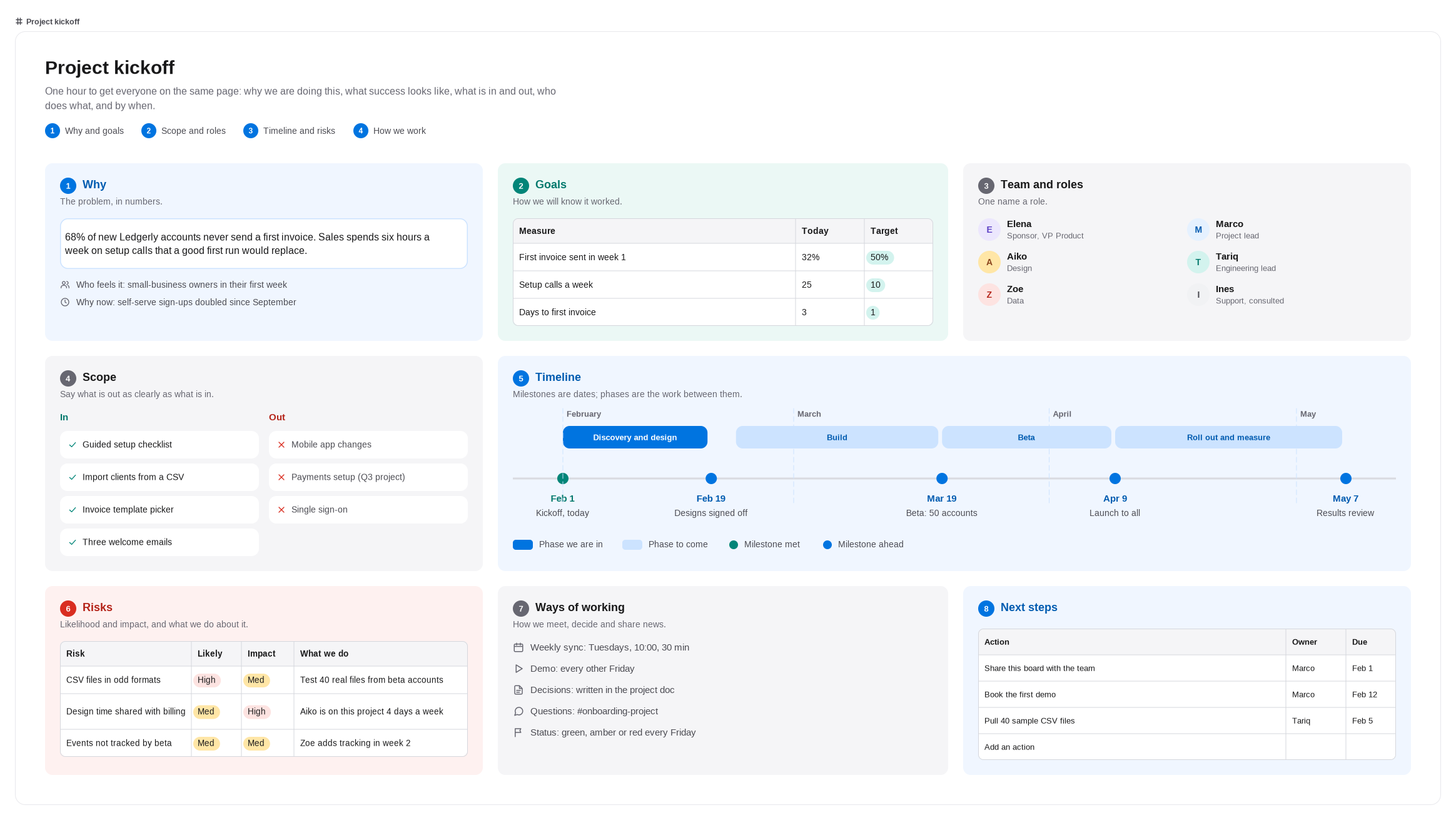
This template lays the answers out as eight numbered cards, to be walked through in order in one hour. The example is an onboarding project at a company that makes invoicing software. It kicks off on February 1 and plans to launch on April 9.
Why and goals: the problem in numbers
Card 1, Why, has the subtitle “The problem, in numbers.” The example states that 68% of new accounts never send a first invoice, and that “Sales spends six hours a week on setup calls that a good first run would replace.” Two lines under it add “Who feels it” and “Why now”: small-business owners in their first week, and self-serve sign-ups that have doubled since September.
Card 2, Goals, answers “How we will know it worked” with a table of Measure, Today and Target:
- First invoice sent in week 1: from 32% to 50%.
- Setup calls a week: from 25 to 10.
- Days to first invoice: from 3 to 1.
The goals measure the same problem the Why card describes. That link is what to check in your own kickoff: if a goal could be met without the problem getting smaller, it is the wrong goal.
Team and roles: one name a role
Card 3 carries its rule in four words: “One name a role.” Six people are listed. Elena is the sponsor, Marco the project lead, Aiko does design, Tariq leads engineering, Zoe covers data, and Ines from support is marked “consulted”.
The sponsor and the project lead are the two roles a kickoff must name. One settles disputes about scope and money, the other runs the work week to week. Marking someone as consulted is also useful. It tells Ines she will be asked for input, and tells everyone else she is not expected at every meeting.
Scope: say what is out
Card 4 splits into two lists, In and Out, under the line “Say what is out as clearly as what is in.”
In scope are four deliverables: “Guided setup checklist”, “Import clients from a CSV”, “Invoice template picker” and “Three welcome emails”. Out of scope are “Mobile app changes”, “Payments setup (Q3 project)” and “Single sign-on”.
The Out list is where a kickoff earns its hour. Each item on it is something a reasonable person might assume was included. Notice that one of them comes with a reason: payments setup already has a home as a Q3 project. Saying where an excluded item will be handled makes the no much easier to accept.
Timeline: milestones are dates
Card 5 runs across four months, February to May, and opens with a definition: “Milestones are dates; phases are the work between them.” Four bars show the phases: Discovery and design, Build, Beta, and Roll out and measure.
Under the bars are five milestones: the kickoff on Feb 1, designs signed off on Feb 19, a beta with 50 accounts on Mar 19, launch to all on Apr 9 and a results review on May 7. A legend separates the phase the team is in from phases to come, and milestones met from milestones ahead.
Two details are worth copying. Each milestone is something a person can verify on that day, and the last one comes after launch. A project that aims to change a number is not done until someone has checked the number.
Risks and ways of working
Card 6, Risks, is a table of Risk, Likely, Impact and What we do. The top row reads “CSV files in odd formats”, High and Med, with the response “Test 40 real files from beta accounts”. Every risk has a response that is already a task.
Card 7, Ways of working, covers “How we meet, decide and share news” in five lines: a weekly sync on Tuesdays at 10:00 for 30 minutes, a demo every other Friday, decisions written in the project doc, one channel for questions, and a status of “green, amber or red every Friday”. Settling these at the kickoff saves the first two weeks of asking where things go.
How to use the project kickoff template
- Open it as a new board. Use this template gives you all eight cards with the onboarding example still filled in.
- Draft cards 1 to 5 before the meeting. The project lead and the sponsor fill in why, goals, team, scope and timeline. The kickoff is for testing a draft, not for writing one from nothing.
- Walk the cards in order. Follow the four steps on the board: why and goals, scope and roles, timeline and risks, how we work. Stop longest on the Out list.
- Collect risks in the room. The people doing the work know risks the draft missed. Add rows as they speak.
- End on card 8. Next steps is a table of Action, Owner and Due. The first row in the example is “Share this board with the team”, owned by Marco, due the same day.
When to use it, and what to pair it with
Use this board for any project with more than a couple of people and more than a few weeks of work, especially when the people come from different teams. It is a summary on purpose: each card holds only what fits on a card.
When a card needs more room, give it its own board. A project charter is the formal document for approval. A RACI matrix spells out roles task by task, a Gantt chart carries the detailed schedule, and a risk register tracks risks through the project.
Questions about the Project kickoff template
Who should attend a project kickoff?
Everyone who will do the work, the sponsor, and anyone whose team is affected or will be consulted. In the example that is six people. Keep it to those who need to agree. Others can read the board afterwards.
How long should a kickoff meeting last?
One hour is what this template is designed for, with most cards drafted in advance. If scope is contested, book 90 minutes or hold a separate scope session first. Do not use the kickoff to discover what the project is.
What is the difference between a kickoff and a project charter?
A charter is a document that authorizes the project, usually written before the team is in place. A kickoff is a meeting that gets the team to a shared understanding. This board covers much of the same ground in a shorter form.
Does the project kickoff template fit the Free plan?
Yes, but it is close to the limit. The board has 148 elements and a Free board holds up to 150. Replace the example’s text instead of adding new elements, or delete a card you do not need to make room.