What is rose thorn bud?
Rose thorn bud is a way to review an experience by sorting observations into three kinds. A rose is something that went well. A thorn is something that hurt or got in the way. A bud is an idea or an opening that could grow into something good. The third kind is what makes the method different from a list of pros and cons: it asks people to look for potential, not only to judge what happened.
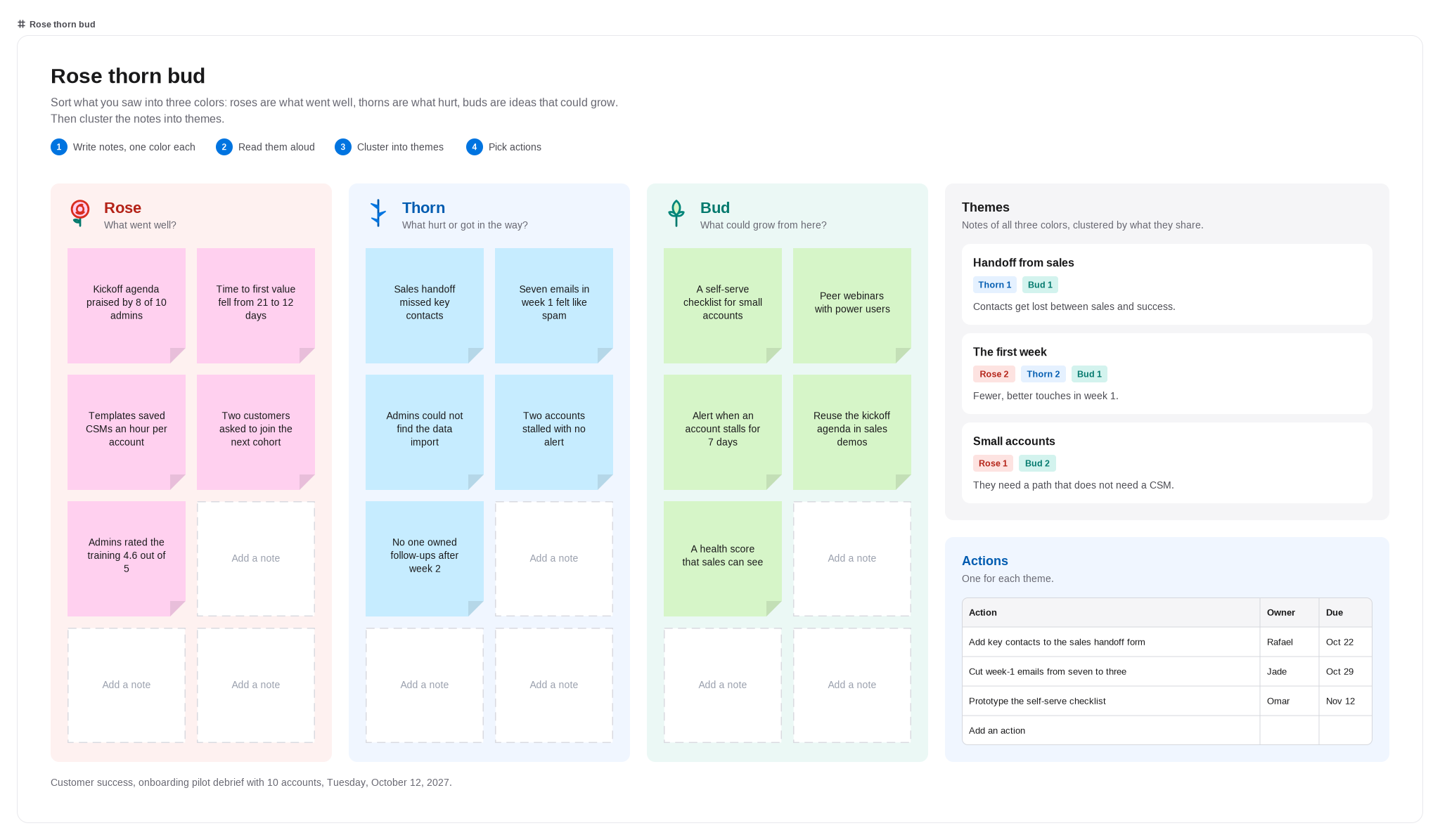
This template gives each kind a column and a note color, then adds a card for themes and a table for actions. The example is a customer success team looking back on an onboarding pilot with 10 accounts, on Tuesday, October 12, 2027.
Three colors, three questions
Each column has a question under its name and five notes in the example.
- Rose, pink: “What went well?” For instance, “Time to first value fell from 21 to 12 days”.
- Thorn, blue: “What hurt or got in the way?” For instance, “Sales handoff missed key contacts”.
- Bud, green: “What could grow from here?” For instance, “Peer webinars with power users”.
The first step printed on the board is “Write notes, one color each”. The color carries the meaning, so a note stays a rose or a thorn after it is dragged out of its column and into a theme. That is why this format clusters so well.
Write roses with evidence
The Rose column in the example is a good model, because no note in it is a vague compliment. “Kickoff agenda praised by 8 of 10 admins” gives a count. “Admins rated the training 4.6 out of 5” gives a score. “Templates saved CSMs an hour per account” gives a saving.
A rose with a number does two jobs. It tells the team what to keep, and it gives them something to quote when they ask for the pilot to be extended. “Two customers asked to join the next cohort” is not a measurement, but it is a fact someone can check. Aim for that standard in all three columns.
Buds grow from thorns and from roses
People new to the method often ask where buds come from. Put the Thorn and Bud columns side by side and the answer shows.
Some buds are a thorn turned around. “Two accounts stalled with no alert” is a thorn. “Alert when an account stalls for 7 days” is the bud that answers it. Others grow from a rose: the kickoff agenda that admins praised leads to “Reuse the kickoff agenda in sales demos”. And a few are new ideas the pilot made visible, like “A health score that sales can see”.
A bud is not yet a plan. It has no owner and no date. It is written as a possibility, which keeps the column open to ideas that would be shot down if they had to be justified on the spot.
Cluster the notes into themes
The Themes card holds “Notes of all three colors, clustered by what they share.” Each theme has a name, small tags that count its notes by color, and one sentence that sums it up.
- Handoff from sales, tagged Thorn 1 and Bud 1: “Contacts get lost between sales and success.”
- The first week, tagged Rose 2, Thorn 2 and Bud 1: “Fewer, better touches in week 1.”
- Small accounts, tagged Rose 1 and Bud 2: “They need a path that does not need a CSM.”
The tags tell you what kind of theme you have. One with thorns and no roses is a problem to fix. A theme with roses and buds is a strength to extend. A mixed one, like the first week, needs care: something there works and should survive the fix.
One action for each theme
The Actions table keeps to its subtitle, “One for each theme.” It has Action, Owner and Due.
The handoff theme produced “Add key contacts to the sales handoff form”, owned by Rafael and due Oct 22. The first week produced “Cut week-1 emails from seven to three”, owned by Jade, which answers the thorn “Seven emails in week 1 felt like spam”. Small accounts produced “Prototype the self-serve checklist”, owned by Omar and due Nov 12. That last action started life as a bud, and “prototype” is the right verb for one: try it small before committing.
How to use the rose thorn bud template
- Open it as a new board. Use this template opens a copy with the pilot example in it. Change the footer line to say what you are reviewing and when.
- Write notes, one color each. Ask everyone for at least one of each kind, so the Bud column fills along with the other two.
- Read them aloud. Go column by column. Questions are welcome, arguments are not.
- Cluster into themes. Drag notes that share a subject together, whatever their color, then name each cluster and count its colors.
- Pick actions. Write one per theme, with an owner and a date.
When rose thorn bud fits best
Use it to debrief something that has an end: a pilot, an event, a research round, a product launch, a course. It works with people who have never run a retrospective, because the three words need no explaining. It is also a good fit when you expect new ideas to come out of the review, not just fixes.
For a sprint team tuning its habits, start stop continue is more direct. To give feedback on a design or a draft, I like, I wish, what if follows a similar three-part shape. And when something went badly wrong and you need causes, write a post-mortem.
Questions about the Rose thorn bud template
What does each part of rose thorn bud mean?
A rose is something that went well, a thorn is something that hurt or got in the way, and a bud is an idea or opportunity that could grow. On this template they are pink, blue and green notes.
What is the difference between a thorn and a bud?
A thorn describes a problem that happened, such as two accounts stalling with no alert. A bud describes something that could exist, such as an alert when an account stalls for 7 days. Many buds start as the answer to a thorn.
Can I use rose thorn bud on my own?
Yes. It works for a personal review of a week, a project or a course. Write a few notes of each color, cluster them, and choose one action. The Free plan is enough for that.
How many notes should we write?
The example has five of each color, fifteen in all, from a pilot with 10 accounts. For a group, three to five notes a person across the three colors gives enough material to cluster without burying the themes.