What is a starfish retrospective?
A starfish retrospective sorts a team’s practices into five groups: keep doing, more of, less of, start doing and stop doing. The five lines that divide the groups spread from one center like the arms of a starfish, which gives the format its name.
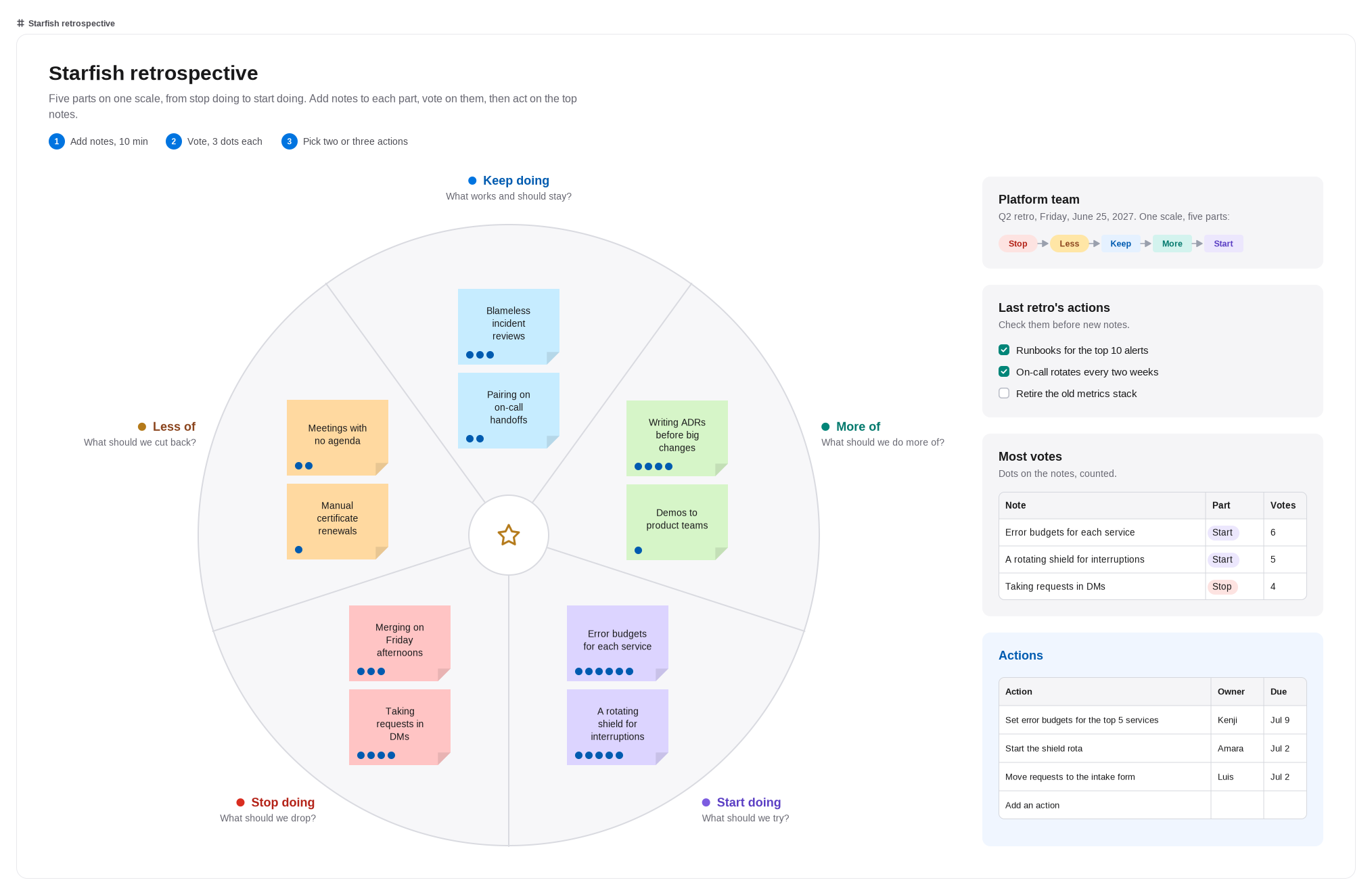
Its strength is the two middle words, more and less. Many habits are neither good enough to leave alone nor bad enough to drop. The starfish gives the team a way to say “a bit more of this” or “not so much of that”. This template draws the five parts as a circle and adds cards for last retro’s actions, the vote count and new actions. The example is a platform team’s Q2 retro on Friday, June 25, 2027.
One scale, five parts
The card at the top right explains how to read the circle: “One scale, five parts”. Five chips sit in a row under it: Stop, Less, Keep, More, Start. Read left to right, they run from doing none of something to doing something new.
Thinking of it as a scale helps people place a note. Ask how much of the practice the team should have next quarter compared with now. None at all is Stop. Some, but reduced, is Less. The same is Keep. Extra is More. And if the team does not do it yet, it is Start. Every part also prints its own question, such as “What should we cut back?” for Less of.
Stop doing and Less of
The left side of the circle holds the two ways of doing less.
- Stop doing asks “What should we drop?” The team wrote “Merging on Friday afternoons” and “Taking requests in DMs”. Both are habits with no upside worth keeping.
- Less of asks “What should we cut back?” Here are “Meetings with no agenda” and “Manual certificate renewals”. The team still needs meetings and still has to renew certificates. It wants fewer of the bad kind.
The test is simple: could the team go to zero next week? If so, the note belongs in Stop. If going to zero is impossible or unwise for now, put it in Less and say what a smaller amount looks like.
Start doing and More of
The right side mirrors the left.
- More of asks “What should we do more of?” The notes name things the team already does now and then: “Writing ADRs before big changes” and “Demos to product teams”.
- Start doing asks “What should we try?” These are new: “Error budgets for each service” and “A rotating shield for interruptions”.
More of is cheap, because the habit exists and only needs to happen more often. Start costs more: someone has to design the new practice and get it going. That difference matters when the team picks actions, and it is a reason not to fill Start with ten ideas.
Keep doing sits at the top
Keep doing has the top of the circle and the question “What works and should stay?” The platform team put “Blameless incident reviews” and “Pairing on on-call handoffs” there.
Fill this part with care. A practice that nobody names can vanish without anyone noticing, squeezed out by everything the team decides to start. Writing it down is a small promise to protect it.
Count the votes, then write actions
After the notes are read out, each person places three dots. The Most votes table lists the winners with the part they came from. In the example “Error budgets for each service” has 6 votes and “A rotating shield for interruptions” has 5, both from Start. “Taking requests in DMs”, from Stop, has 4.
The Actions table then gives each winner an owner and a date: “Set error budgets for the top 5 services” goes to Kenji for Jul 9, “Start the shield rota” to Amara for Jul 2, and “Move requests to the intake form” to Luis for Jul 2. Notice that the Stop note became an action about what to do instead. A team drops a habit more easily when it has a replacement.
How to use the starfish retrospective template
- Open it as a new board. Use this template copies it to your workspace with the example notes in place.
- Check last retro’s actions. The card for them says “Check them before new notes.” In the example two are ticked and “Retire the old metrics stack” is still open.
- Add notes, 10 minutes. Go around the circle in scale order, Stop first and Start last, or let people write wherever they have something to say.
- Vote, 3 dots each. Votes can go anywhere on the circle.
- Pick two or three actions. Write them in the table with one owner each.
When the starfish is the right retro
Choose the starfish for a team that has worked together for a while and has many practices to tune. It suits a quarterly review better than a first retro, because people need enough shared history to tell a Keep from a More.
If five parts are more than the team needs, start stop continue uses three of them. To include what the team learned and wished for, try the 4Ls retrospective. When a deadline is coming and risks matter more than habits, the sailboat retrospective looks ahead.
Questions about the Starfish retrospective template
What are the five parts of a starfish retrospective?
Keep doing, More of, Less of, Start doing and Stop doing. On this template each part has a question, for example “What should we try?” for Start doing and “What works and should stay?” for Keep doing.
How is the starfish different from start stop continue?
It adds two parts in the middle. Start stop continue only lets a team begin, end or keep a practice. The starfish also lets it turn a practice up or down, which fits habits that are useful in the right amount.
How many notes should each part have?
The example has two in each part, ten in all. Up to four or five a part is workable. If one part overflows, group similar notes before voting so that the three dots each person has are not spread too thin.
In what order should we go around the starfish?
Either follow the scale from Stop to Start, or begin with Keep doing so the session opens on what works. Whichever you choose, read all five parts aloud before anyone votes.