What is a 4Ls retrospective?
The 4Ls is a retrospective format built on four words that start with L. The team looks back on a stretch of work and sorts its thoughts into what it liked, what it learned, what it lacked and what it longed for. Two of the four look at what the team had. The other two look at what it did not have.
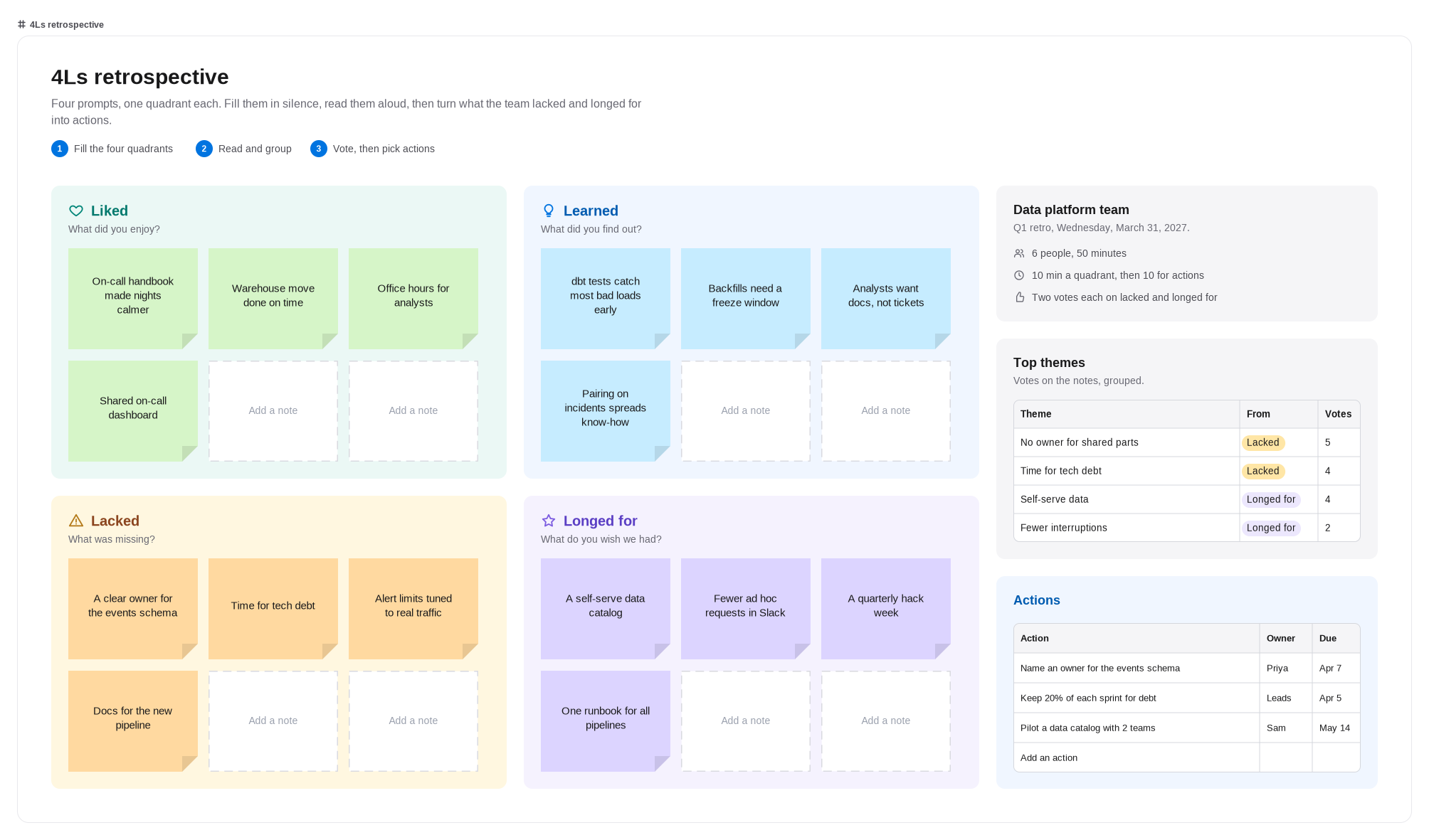
This template draws the four as a grid of sticky notes and adds what the grid alone does not give you: a table of the themes that got the most votes and a table of actions. The example is the Q1 retro of a six-person data platform team, held on Wednesday, March 31, 2027.
Liked and Learned: what the quarter gave you
The top row is about what happened. Each quadrant prints its question under the title.
- Liked: “What did you enjoy?” The team wrote “On-call handbook made nights calmer” and “Warehouse move done on time”.
- Learned: “What did you find out?” Notes here read like small lessons: “Backfills need a freeze window” and “Analysts want docs, not tickets”.
Learned is the quadrant that sets this format apart. Most retrospectives sort notes into good and bad. This one also asks what the team now knows that it did not know before, including lessons that came from things going wrong. “Pairing on incidents spreads know-how” came out of incidents, yet it is worth keeping.
Lacked and Longed for: what was missing
The bottom row is where the actions come from, and the two words are easy to mix up.
- Lacked asks “What was missing?” It is about a gap the team already felt: “A clear owner for the events schema”, “Time for tech debt”, “Docs for the new pipeline”.
- Longed for asks “What do you wish we had?” It is a wish, often for something the team has never had: “A self-serve data catalog”, “A quarterly hack week”, “One runbook for all pipelines”.
A quick test: a Lacked note names something whose absence hurt during the period. A Longed for note would still make sense if the quarter had gone well. Both are written as the thing wanted, not as a complaint, so each one is already half an action.
Vote and name the top themes
Sixteen notes are too many to act on. The card at the top right sets the rule for narrowing them: “Two votes each on lacked and longed for”. Nobody votes on the top row, because Liked and Learned are there to be heard, not fixed.
The Top themes table records the result with three columns: Theme, From and Votes. Similar notes are grouped under one name first. In the example “No owner for shared parts” leads with 5 votes, “Time for tech debt” and “Self-serve data” have 4 each, and “Fewer interruptions” has 2. The From column keeps track of which quadrant a theme grew out of.
Turn themes into actions
The Actions table has Action, Owner and Due. Each of the three leading themes got one row:
- “Name an owner for the events schema”, Priya, Apr 7.
- “Keep 20% of each sprint for debt”, the leads, Apr 5.
- “Pilot a data catalog with 2 teams”, Sam, May 14.
Notice the size of the third one. The wish was a data catalog; the action is a pilot with two teams. A Longed for note is usually too big to do at once, so write the first step that would test it.
How to use the 4Ls retrospective template
- Open it as a new board. Use this template adds the grid to your workspace as a board you can edit. Clear the example notes or keep a few as a guide for the first round.
- Fill the quadrants one at a time. The example gives each one 10 minutes. Go in order, Liked first, so the session starts on what worked.
- Read and group. Read every note aloud, then drag similar ones in the bottom row next to each other and name each group.
- Vote, then pick actions. Give everyone two votes for the bottom row, fill in Top themes, and keep the last 10 minutes for owners and dates.
The whole session in the example takes 50 minutes for six people.
When to pick the 4Ls over another format
Choose the 4Ls after a long stretch: a quarter, a project, a migration. There is enough behind you to have learned something, and enough ahead to make wishes worth writing down. For a two-week sprint, four quadrants can be more than the team has to say.
For a short, regular retro about working habits, start stop continue is faster. When a sprint left people upset and they need to say so first, use mad sad glad. If you want degrees, doing more of one thing and less of another, the starfish retrospective has five parts for that.
Questions about the 4Ls retrospective template
What do the 4 Ls stand for?
Liked, Learned, Lacked and Longed for. Liked is what the team enjoyed, Learned is what it found out, Lacked is what was missing, and Longed for is what it wishes it had.
What is the difference between lacked and longed for?
Lacked is a gap that hurt during the period, such as no clear owner for a shared schema. Longed for is a wish that goes beyond fixing a gap, such as a hack week every quarter. If you are unsure, ask whether its absence caused a problem. If it did, it is Lacked.
How long does a 4Ls retrospective take?
The example runs 50 minutes for six people: 10 minutes for each quadrant and 10 for actions. A larger team needs more time for reading notes aloud, so plan about an hour for eight to ten people.
Do we need actions for Liked and Learned?
Usually not. Those two quadrants are for recognition and for sharing lessons across the team. In this template votes go only to Lacked and Longed for. If a lesson should change how you work, write it as an action anyway.