What is a sailboat retrospective?
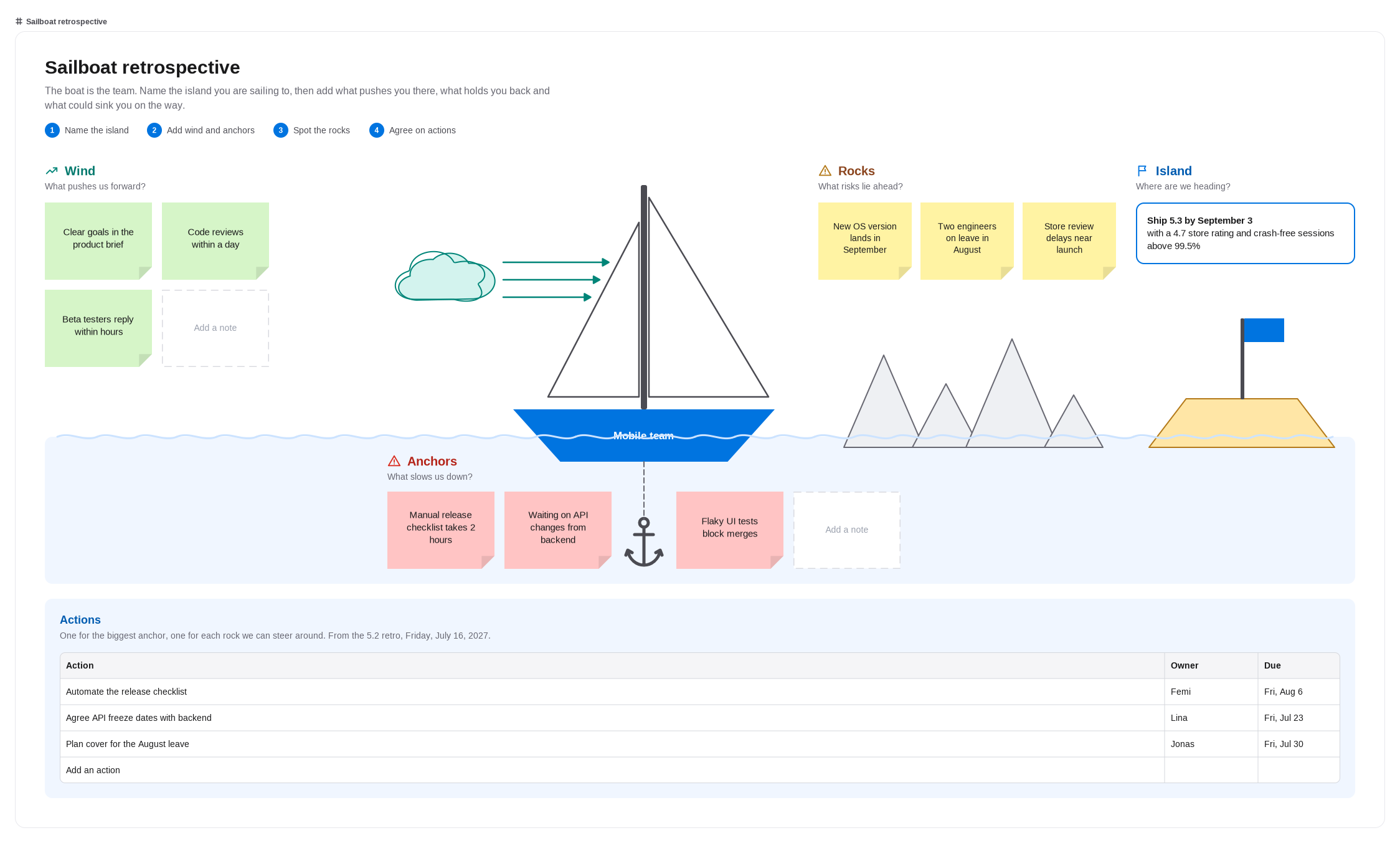
A sailboat retrospective turns the team’s situation into a picture. The boat is the team. The island is where it wants to arrive. Wind pushes the boat on, anchors drag behind it, and rocks wait between the boat and the island. People add notes to each part of the picture, then decide what to do about them.
Unlike most retrospective formats, this one looks forward as well as back. Wind and anchors describe how the work has gone. Rocks and the island describe what is still to come. This template draws the scene and adds an actions table below it. In the example the boat is labelled “Mobile team”, and the notes come from its retro on Friday, July 16, 2027.
The island: where the team is heading
Start at the far right. The Island asks “Where are we heading?” and holds one card instead of a pile of notes: “Ship 5.3 by September 3 with a 4.7 store rating and crash-free sessions above 99.5%”.
That card is a goal with a date and two numbers, so the team can tell later whether it landed. It also gives the other three areas their meaning. Wind is only wind if it blows toward this island, and a rock only matters if it lies on this route. Fill in the island first and agree on it before anyone writes a note.
Wind: what pushes the boat forward
Wind sits behind the boat, top left, with the question “What pushes us forward?” The mobile team named three things: “Clear goals in the product brief”, “Code reviews within a day” and “Beta testers reply within hours”.
These notes are not there for applause. They are the things to protect while the team fixes everything else. If reviews start taking three days because people are busy removing anchors, the boat is no faster. Read the wind notes aloud and ask of each one: what keeps this going?
Anchors: what holds it back
Anchors hang in the water under the hull and ask “What slows us down?” The three red notes are all about waiting: “Manual release checklist takes 2 hours”, “Waiting on API changes from backend” and “Flaky UI tests block merges”.
An anchor is something that is slowing the team right now, every week. That makes it different from a rock, which has not happened yet. Good anchor notes say what the drag costs, as the first one does with its two hours. A number makes it easy to pick the heaviest anchor when it is time to choose.
Rocks: the risks ahead
Rocks rise out of the water between the boat and the island. The question is “What risks lie ahead?”, and two of the three notes name a month: “New OS version lands in September”, “Two engineers on leave in August” and “Store review delays near launch”.
Sort rocks into two kinds. Some you can steer around: leave in August can be covered if it is planned now. Others stay where they are: a new OS version will arrive whatever the team does, so the only choice is to be ready for it. This is the part other retrospectives leave out, and it is why the format suits a team that has a deadline in front of it.
Agree on actions
The Actions table under the water states its own rule: “One for the biggest anchor, one for each rock we can steer around.” The example follows it closely.
- The two-hour checklist became “Automate the release checklist”, owned by Femi, due Fri, Aug 6.
- Waiting on backend became “Agree API freeze dates with backend”, owned by Lina, due Fri, Jul 23.
- The August leave became “Plan cover for the August leave”, owned by Jonas, due Fri, Jul 30.
All three dates fall before September 3. An action due after the island’s date does not help the team reach it.
How to use the sailboat retrospective template
- Open it as a new board. Use this template copies the scene to your workspace. Type your team’s name on the hull.
- Name the island. Write one goal with a date. If the team cannot agree on it, that is the first finding of the retro.
- Add wind and anchors. Give people a few quiet minutes for both, then read the notes aloud, wind first.
- Spot the rocks. Ask what could stop you between today and the island’s date, and put a month or a date on each note.
- Agree on actions. Pick the heaviest anchor and the rocks you can steer around. Each gets an owner and a due date.
When the sailboat fits, and when to pick another
Pick the sailboat when the team has a clear destination: a release, a launch, a migration date. It works well in the middle of a project, when there is still time to change course. The picture also helps people who find a plain grid of columns dull or hard to start on.
With no goal in sight, the island stays empty and the format loses its point. For a routine sprint, start stop continue is quicker. To go deep on risks alone before a project starts, run a pre-mortem. After the project is over, lessons learned records what to carry into the next one.
Questions about the Sailboat retrospective template
What do the parts of the sailboat stand for?
The boat is the team and the island is its goal. Wind is whatever pushes the team forward, anchors are what slows it down today, and rocks are risks that lie ahead on the way to the island.
What is the difference between an anchor and a rock?
An anchor is already slowing the team, like a release checklist that takes two hours every time. A rock has not happened yet and may never happen, like delays in store review near launch. Anchors get removed. Rocks get avoided or prepared for.
Does the island have to be a release?
No. Any goal the whole team shares will do: a quality target, a migration, a number to reach by the end of the quarter. It needs a date or a measure, so that the team can say whether it arrived.
Can we add a sun or other parts to the picture?
Yes. Every element on the copied board can be edited, moved and deleted, and you can add shapes and notes of your own. Keep the four core parts, since the actions rule on the board refers to anchors and rocks.