What is a team check-in?
A team check-in is a short round at the start of a meeting or a week where everyone says how they are doing before the work talk begins. It takes minutes, and it tells the team who has room to help and who needs some.
This template turns the round into three quick marks: a weather for your week, an energy number from 1 to 10, and one word. A fourth area holds what the team will do about what it heard. The example is a design team’s Monday check-in on May 17, 2027: six people, five minutes.
The weather row
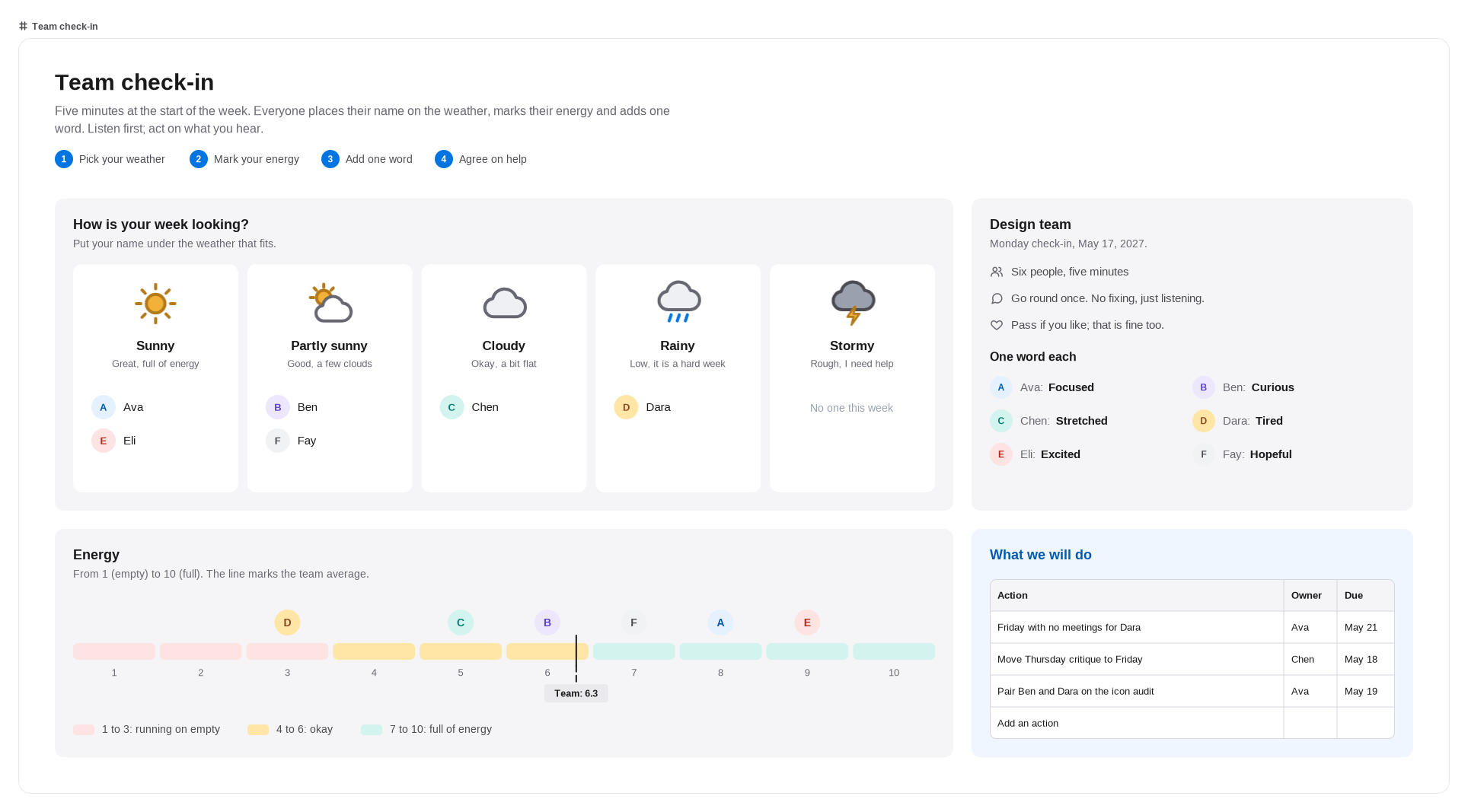
The first area asks “How is your week looking?” and offers five cards. Each has a picture, a name and a plain description, so nobody has to find words for a mood:
- Sunny. Great, full of energy. Ava and Eli are here.
- Partly sunny. Good, a few clouds. Ben and Fay.
- Cloudy. Okay, a bit flat. Chen.
- Rainy. Low, it is a hard week. Dara.
- Stormy. Rough, I need help. The card reads “No one this week”.
People put their name under the card that fits. A weather is easier to say out loud than “I am struggling”, which is why the row works with teams that do not usually talk about how they feel.
The energy scale
Below the weather sits a scale from 1 (empty) to 10 (full). Everyone drops their initial on a number. In the example Dara is at 3, Chen at 5, Ben at 6, Fay at 7, Ava at 8 and Eli at 9, and the label under the scale shows the average: Team: 6.3.
A key under the scale groups the numbers into three bands: 1 to 3 is running on empty, 4 to 6 is okay, 7 to 10 is full of energy. The average is useful from week to week. The spread is useful today: one initial sitting far to the left of the others is the thing to notice.
One word, and the rules of the round
The panel on the right carries the ground rules and the words. The rules in the example are short: go round once, no fixing, just listening, and “Pass if you like; that is fine too.”
Then each person adds a single word. The design team wrote Focused, Curious, Stretched, Tired, Excited and Hopeful. One word is enough to explain a mark. Chen’s “Stretched” says more about that Cloudy card than a number would, and Dara’s “Tired” matches the 3 on the scale.
Keep to one word. The moment people write sentences, the check-in turns into a status meeting and stops fitting in five minutes.
Agree on help
Listening comes first, but a check-in that never changes anything teaches people to answer “fine”. The last area, What we will do, is a small table of actions with an owner and a due date.
Look at how the example answers what it heard. Dara was rainy, tired and at 3, so the first row is “Friday with no meetings for Dara”, owned by Ava and due May 21. Chen was stretched, so the Thursday critique moves to Friday. A third row pairs Ben and Dara on the icon audit. Each action is small and lands within the week.
How to use the team check-in template
- Open it as a new board. Use this template copies the board into your workspace. Replace the six names and initials with your team’s.
- Pick your weather. Each person moves their name under one of the five cards. Clear last week’s names first so nobody anchors on them.
- Mark your energy. Drag each initial onto a number, then update the team average under the scale.
- Add one word. Go round once and type each word next to its name. Nobody comments until the round is done.
- Agree on help. Write one to three rows in the action table and delete the example rows.
When a check-in fits, and when to use something else
Use it weekly with a team of up to about ten people, at the start of a planning meeting or a workshop, or after a hard stretch such as a launch. It suits remote teams most, because the signals a shared room gives for free are missing on a call.
A check-in asks how people are, not what they did. For progress and blockers, run a daily stand-up. For a longer look at how the last sprint felt, mad sad glad gives feelings more room. A team health check rates the team’s working conditions area by area once a quarter.
Questions about the Team check-in template
How long should a team check-in take?
About five minutes for six people, as the example board says. Allow under a minute per person: place the name, mark the number, say the word. If it runs longer, people are explaining too much; hold the detail for after the round.
What if someone does not want to share?
Let them pass. The example’s ground rules say so in writing. A check-in only works when it is safe to skip, and people who are allowed to pass usually join in after a few weeks.
Can everyone place their own name on the board?
On the Team plan several people edit the same board at once, so each person moves their own name and initial. On the Free and Pro plans one person edits: the facilitator places the marks as people speak, and the others watch and comment.
Should we keep a record of past check-ins?
Keep the team average and the actions, not the individual marks. Writing 6.3 in a corner each week shows the trend. A person’s rainy week is for the team in the room and does not need to be stored.