What is a mad sad glad retrospective?
Mad sad glad is a retrospective that starts from feelings. Team members write what made them mad, sad and glad during the last sprint, one thought per note. Only after everyone has been heard does the team look for causes and fixes. The line printed above the board says it in nine words: “Name how the sprint felt before you fix anything.”
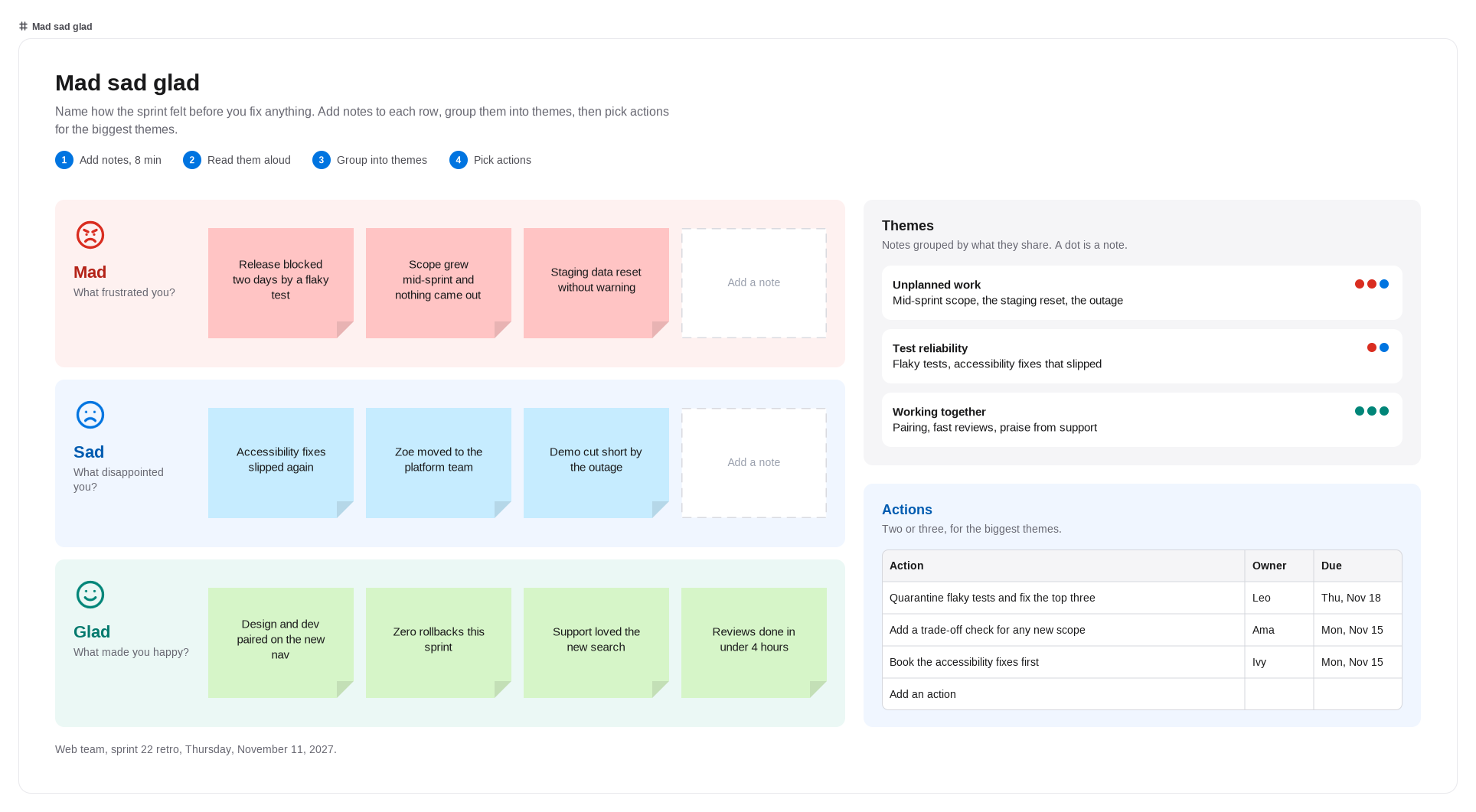
This template sets the three feelings out as rows and puts two cards beside them, one for themes and one for actions. The example comes from a web team’s sprint 22 retro, held on Thursday, November 11, 2027, after a sprint that included a blocked release and an outage during the demo.
Mad and Sad are different rows for a reason
Each row prints its question. Mad asks “What frustrated you?” and Sad asks “What disappointed you?” New teams often treat them as one bucket of bad news. They are not the same.
- Mad is for things that should not have happened: “Release blocked two days by a flaky test”, “Scope grew mid-sprint and nothing came out”, “Staging data reset without warning”. Somebody could have prevented each one.
- Sad is for losses and letdowns: “Accessibility fixes slipped again”, “Demo cut short by the outage”, “Zoe moved to the platform team”.
The note about Zoe has no fix, and it does not need one. A colleague left the team and people miss her. A format built on columns of things to change has no place for that note. This one does, and saying it aloud is the whole point.
Glad is not a warm-up
The Glad row asks “What made you happy?” and is the fullest in the example, with four green notes: “Design and dev paired on the new nav”, “Zero rollbacks this sprint”, “Support loved the new search” and “Reviews done in under 4 hours”.
Treat this row as data. Two of the four notes are about people working closely, and one is a number the team can try to hold. After a rough sprint it also gives the room some balance: the sprint that had an outage also had zero rollbacks.
Group the notes into themes
Feelings are sorted by row, but causes are not. The Themes card regroups the notes “by what they share”, across all three rows, and gives each theme a name and a one-line list of what went into it:
- Unplanned work: “Mid-sprint scope, the staging reset, the outage”. Two Mad notes and one Sad note turn out to have one root.
- Test reliability: “Flaky tests, accessibility fixes that slipped”.
- Working together: “Pairing, fast reviews, praise from support”, drawn from the Glad row.
Small dots on each theme count its notes, so the biggest theme is easy to see. This step is what moves the meeting from how people feel to what the team can do.
Pick two or three actions
The Actions card limits itself in its subtitle: “Two or three, for the biggest themes.” The table has Action, Owner and Due.
In the example, test reliability led to “Quarantine flaky tests and fix the top three”, owned by Leo and due Thu, Nov 18. Unplanned work led to “Add a trade-off check for any new scope”, owned by Ama. The slipped accessibility work got its own line: “Book the accessibility fixes first”, owned by Ivy. All three are due within a week of the retro, which means the team can report on them at the next one.
How to use the mad sad glad template
- Open it as a new board. Use this template places the three rows in your workspace. Remove the example notes and change the footer line to your team and sprint.
- Add notes, 8 minutes. Everyone writes in silence, one feeling per note, in whichever rows they like. Nobody has to fill all three.
- Read them aloud. Go row by row. The author may add a sentence, and nobody argues with a feeling.
- Group into themes. Ask which notes share a cause, name each group, and write it on the Themes card.
- Pick actions. Choose the two or three largest themes and give each an owner and a date.
When to pick mad sad glad
Pick it after a sprint that left a mark: an incident, a missed date, a change in the team. It also helps when retros have turned into a routine list of process tweaks and people have stopped saying what they think. Because it asks for feelings, it needs a team where people trust each other enough to answer.
When the mood is fine and you only want to tune how you work, start stop continue gets to actions faster. For a look back over a whole quarter, the 4Ls retrospective adds what the team learned. To take the team’s pulse outside a retro, try a team health check.
Questions about the Mad sad glad template
What is the difference between mad and sad?
Mad is frustration at something that could have been avoided, like a release blocked by a flaky test. Sad is disappointment or loss, like a teammate moving to another team. Mad notes usually point to a fix. Sad notes sometimes only need to be heard.
How long does a mad sad glad retro take?
Plan 45 minutes for a team of six. The template gives 8 minutes to writing notes. Reading aloud takes about as long again, and the remaining time goes to themes and actions.
What if the Mad row gets personal?
Ask for notes about events, not people. “Staging data reset without warning” describes what happened and leaves room to ask why. If a note names a colleague, the facilitator can ask the author to rewrite it as the event and its effect.
Does every note need an action?
No. The Actions table on this template takes two or three rows for the biggest themes. Many notes, especially sad and glad ones, are complete once they have been read aloud and understood.