What is a value chain?
A value chain lists everything a company does to turn inputs into something customers pay for, and asks which of those activities create the most value and which cost the most. Michael Porter’s model splits them into five primary activities, which handle the product itself, and four support activities, which make the primary ones possible. What is left after the costs is margin.
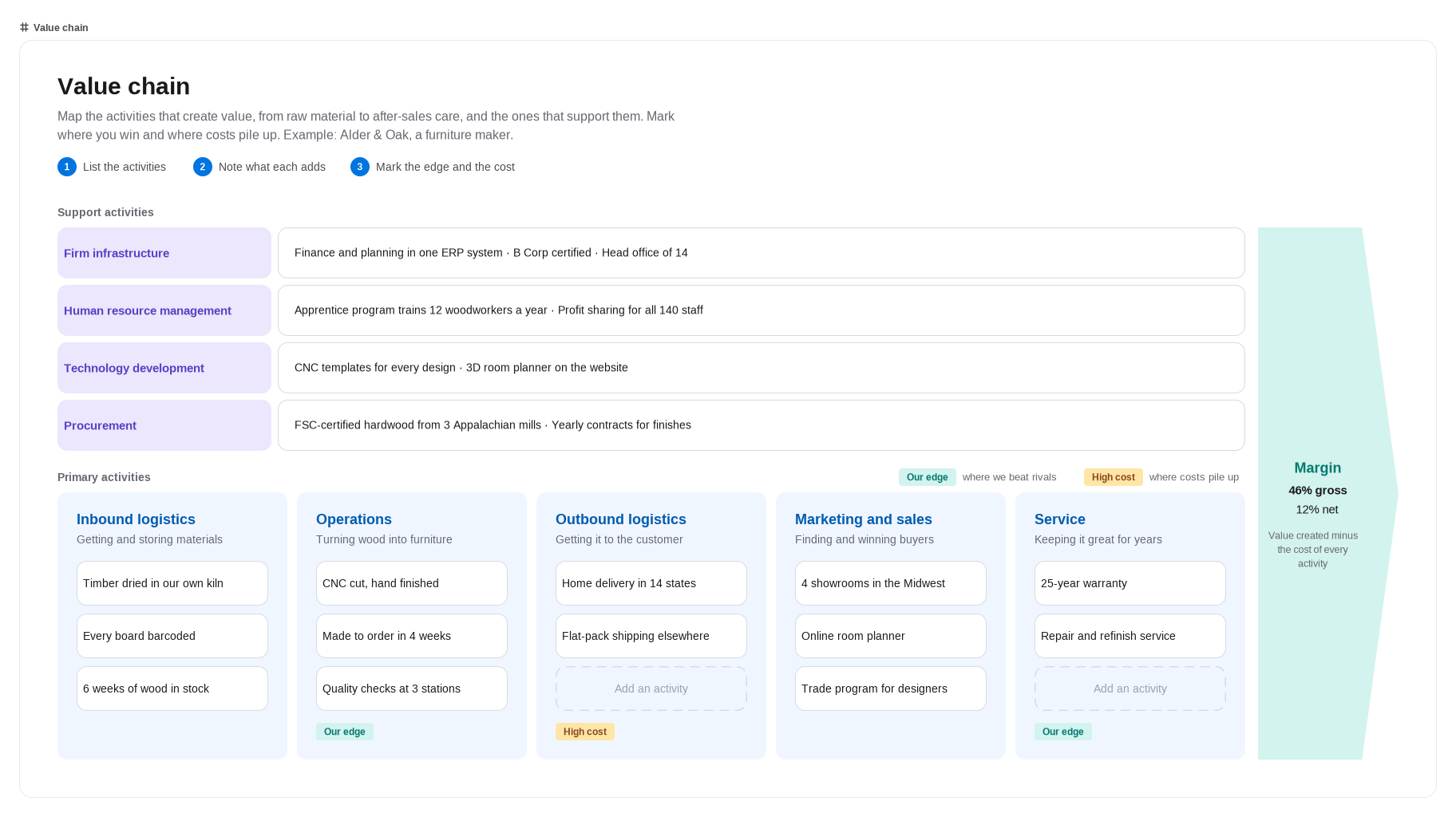
This template lays the model out for Alder & Oak, a furniture maker, with tags that mark where the company wins and where costs pile up. To start from a description of your own business instead, FlowDraw AI can draft a value chain for you to edit.
Five primary activities
The lower half follows the product from raw material to after-sales care. Each column has a plain-language subtitle and up to three activity cards:
- Inbound logistics, “Getting and storing materials”: “Timber dried in our own kiln”, “6 weeks of wood in stock”.
- Operations, “Turning wood into furniture”: “CNC cut, hand finished”, “Made to order in 4 weeks”.
- Outbound logistics, “Getting it to the customer”: “Home delivery in 14 states”, “Flat-pack shipping elsewhere”.
- Marketing and sales, “Finding and winning buyers”: “4 showrooms in the Midwest”, “Trade program for designers”.
- Service, “Keeping it great for years”: “25-year warranty”, “Repair and refinish service”.
The subtitles are written for this company. Rewrite them for yours, so nobody has to ask what “inbound logistics” means for a software team or a clinic.
Four support activities
The upper half holds the activities that serve every column below. Each row has a label on the left and a line of specifics on the right:
- Firm infrastructure: finance and planning in one system, and a head office of 14.
- Human resource management: “Apprentice program trains 12 woodworkers a year” and profit sharing for all 140 staff.
- Technology development: “CNC templates for every design” and a 3D room planner on the website.
- Procurement: certified hardwood from 3 Appalachian mills and yearly contracts for finishes.
Support activities are easy to treat as overhead. The example shows why they matter: the apprentice program is what makes “hand finished” possible in Operations, and the room planner built under Technology shows up again as a sales tool.
Mark the edge, the cost and the margin
A value chain is a diagnosis, so the template has two tags. “Our edge” marks where the company beats rivals. “High cost” marks where costs pile up. Alder & Oak puts “Our edge” under Operations and Service, and “High cost” under Outbound logistics, where finished furniture is delivered to homes in 14 states.
The column at the far right closes the chain with the result: “46% gross” and “12% net”, described as “Value created minus the cost of every activity”. Read together, the tags and the margin give the strategy question. Can the company protect its edge in making and servicing furniture while it brings the cost of delivery down?
Use the tags sparingly. If every column is an edge, none is.
How to use the value chain template
- Open it as a new board. Keep the furniture example visible while you work; its level of detail is the one to match.
- List the activities. Rewrite the five column subtitles for your business, then replace the cards, two or three per column.
- Note what each adds. On every card and support row, write the specific thing you do, with a number where you have one: weeks, sites, staff, years.
- Mark the edge and the cost. Place “Our edge” and “High cost” under the columns that deserve them, and enter your gross and net margin.
When a value chain helps, and when to choose another template
Use it when you need to explain where a company’s advantage comes from, or when margins are thin and you must decide which activity to fix, outsource or invest in. It suits one business unit at a time.
It shows what the company does, not how long each step takes. For timing and waste inside one process, draw a value stream map. For a quick view of a process with its suppliers and customers, use SIPOC. To set the chain against the market it competes in, pair it with Porter’s five forces.
Questions about the Value chain template
What is the difference between primary and support activities?
Primary activities touch the product on its way to the customer: bringing materials in, making, delivering, selling and servicing. Support activities, such as hiring, technology and purchasing, make the primary ones work and usually serve several of them at once.
What does margin mean in a value chain?
Margin is what remains when the cost of every activity is taken from the value customers pay for. The example shows it two ways, 46% gross and 12% net. A wider margin means the chain as a whole creates more than it consumes.
Does a value chain work for a service or software company?
Yes. Rename the columns to fit. Inbound logistics may become data or content coming in, operations the delivery of the service, outbound logistics deployment or scheduling. The five-step order from input to after-sales care still holds.
Is the value chain template free?
Yes. The board has 65 elements and opens on the Free plan, which allows 150 per board. Every card and tag can be moved or rewritten, and you can export the finished chain as PNG, SVG or PDF.