What is a lessons learned review?
A lessons learned review is a meeting at the end of a project, or of a large phase, where the team writes down what it would repeat and what it would do differently. The audience is the next project. The team that did the work already knows.
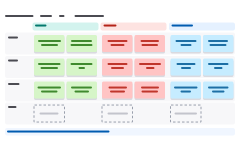
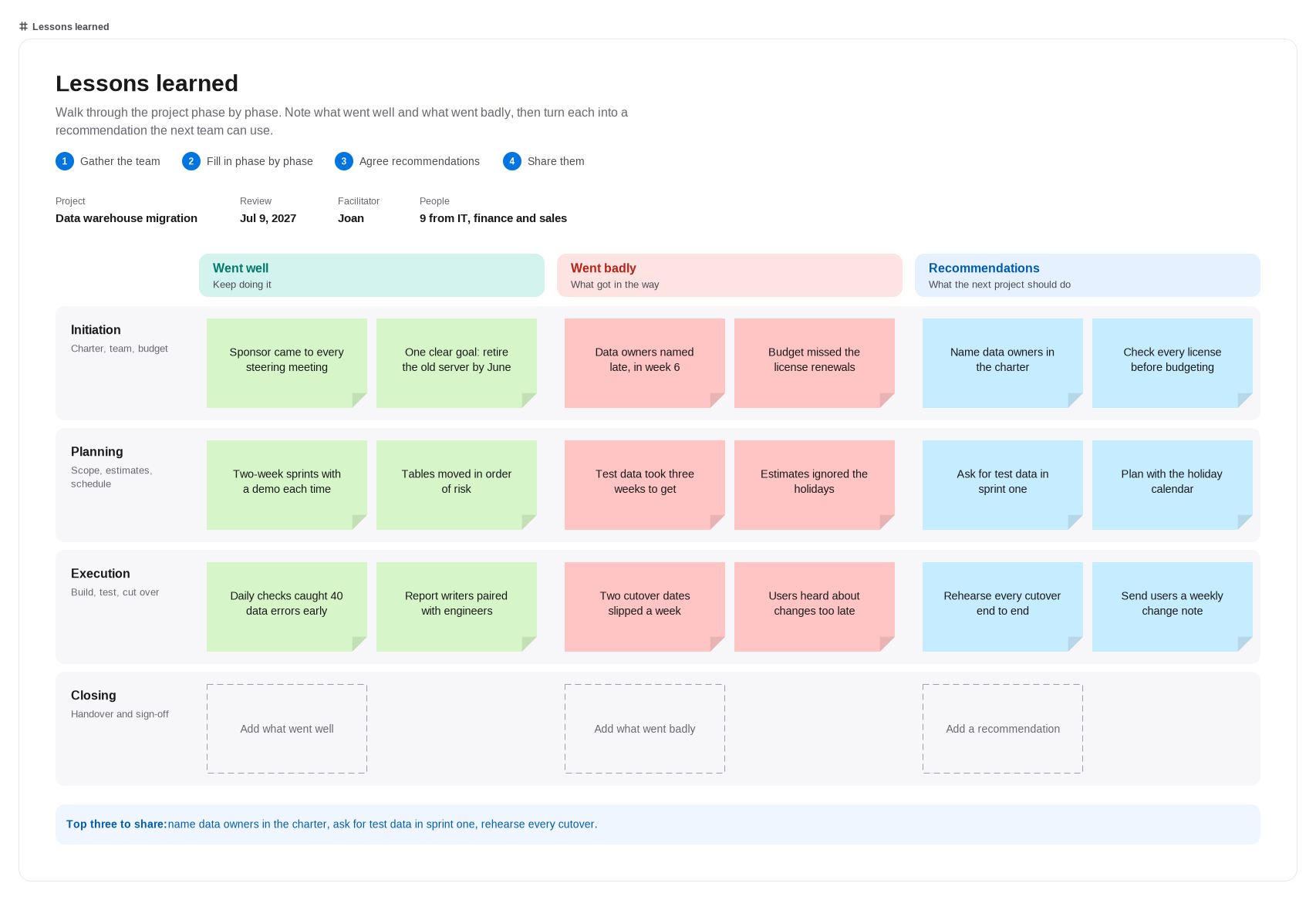
This template gives the meeting a grid. The rows are the phases of a project and the columns are Went well, Went badly and Recommendations. The example is a data warehouse migration reviewed on Jul 9, 2027, with eighteen notes on the board and a strip at the bottom that picks the three lessons worth passing on.
Three columns, four phases
Each column head has a second line that says what belongs there. Went well is “Keep doing it”. Went badly is “What got in the way”. Recommendations is “What the next project should do”.
The rows walk through the project in order: Initiation (charter, team, budget), Planning (scope, estimates, schedule), Execution (build, test, cut over) and Closing (handover and sign-off). Going phase by phase is what makes people remember the early months. Without it a review is about the last three weeks, because those are fresh.
In the Initiation row the green notes say the sponsor came to every steering meeting and the project had one clear goal: retire the old server by June. The red notes say data owners were named late, in week 6, and the budget missed the license renewals.
Every problem gets a recommendation
The right-hand column is where a review earns its time. Each blue note answers a red one in the same row, and it is written as an instruction someone could follow on day one of another project.
- “Data owners named late, in week 6” becomes “Name data owners in the charter”.
- “Test data took three weeks to get” becomes “Ask for test data in sprint one”.
- “Estimates ignored the holidays” becomes “Plan with the holiday calendar”.
- “Two cutover dates slipped a week” becomes “Rehearse every cutover end to end”.
Compare those with a lesson like “communicate better”. Nobody can act on that. A good recommendation names the thing to do and the moment to do it: in the charter, in sprint one, before budgeting.
Write down what worked, with the reason
The left column is easy to rush. It deserves the same care, because good practice gets dropped when nobody says why it mattered. The notes in the example carry their evidence: “Daily checks caught 40 data errors early”, “Tables moved in order of risk”, “Report writers paired with engineers”, “Two-week sprints with a demo each time”.
Each one describes a habit another team could copy, and the first has a number attached. If a note only says “good teamwork”, ask what the team actually did and write that down.
Pick the top three to share
A list of every recommendation gets filed and forgotten. The strip at the bottom forces a choice: “Top three to share: name data owners in the charter, ask for test data in sprint one, rehearse every cutover.” Three is what a colleague will remember from a five-minute talk.
Above the strip, the Closing row is still open in the example. It holds three dashed cards, “Add what went well”, “Add what went badly” and “Add a recommendation”, one per column. Copy them whenever a row needs another note.
How to use the lessons learned template
- Open it as a new board. Use this template copies it with the migration example. Clear the notes but keep one row as a model until the team has seen it.
- Gather the team. Fill in the header: project, review date, facilitator and who takes part. The example has 9 people from IT, finance and sales, with Joan as facilitator.
- Fill in phase by phase. Start with Initiation. Give everyone a few minutes to add green and red notes for that phase alone, then read them out before moving down a row.
- Agree recommendations. For each red note, and each green one worth making a rule, write one blue note that starts with a verb.
- Share them. Choose the top three together, write them in the strip, and send the board or a PDF of it to whoever starts the next project.
Lessons learned, retrospective or post-mortem?
Hold a lessons learned review when a project closes, or at the end of each major phase of a long one. It looks at the whole life of the work and is written for other teams.
A sprint retrospective is smaller and more frequent. It is for the same team to adjust its own next two weeks, and a board like start, stop, continue suits it better. When one thing failed badly and you need the timeline and causes of that single event, run a post-mortem. To use old lessons before the next project starts, bring them to a pre-mortem.
Questions about the Lessons learned template
When should a lessons learned session take place?
Within two or three weeks of the project closing, while people still remember and before they are absorbed by other work. On projects longer than six months, hold a short one at the end of each phase as well.
Who should run the session?
Someone who was not in charge of the project. People speak more freely about what went badly when the project manager is a participant and a neutral facilitator keeps the time and asks the follow-up questions.
How do you keep the session from turning into blame?
Write about events and not about people. “Test data took three weeks to get” describes what happened. Then move quickly to the recommendation, which points at the process to change for next time.
Where should the lessons go afterwards?
To the people who can use them: the next project manager, the team that owns the project method, the sponsor. Share the board, and put the top three into the kickoff of the next similar project.