What is analogous inspiration?
Analogous inspiration is a research method from design work. Instead of studying your own field harder, you look at a different field that struggles with the same underlying difficulty and has had longer to solve it. A hospital that wants calmer waiting does not visit another hospital. It asks who else manages long, uncertain waits, and goes to look there.
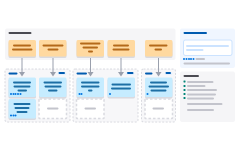
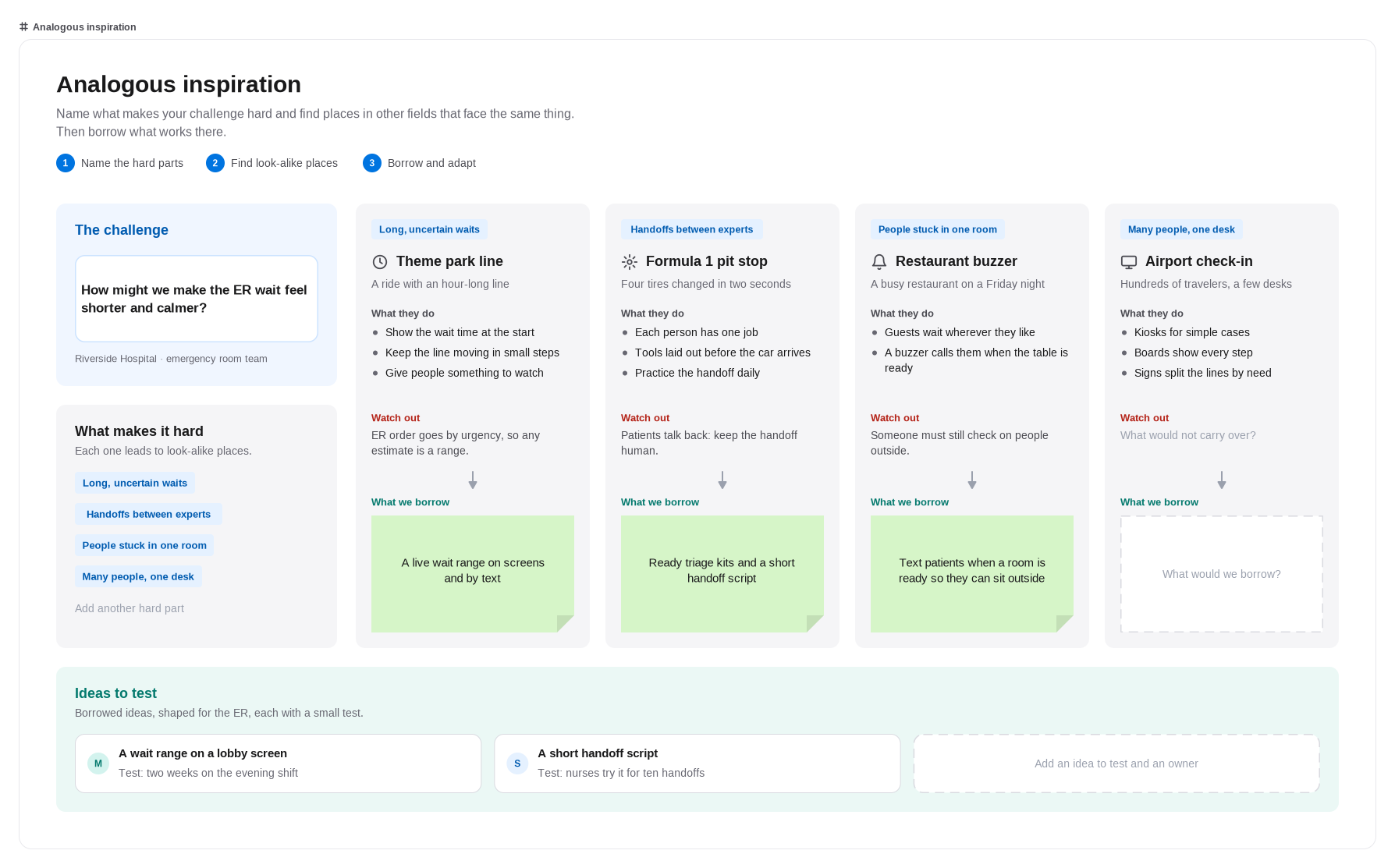
The template turns that into a board. On the left you state the challenge and list what makes it hard. Each hard part then gets a column with a look-alike place: what they do, what to watch out for, and what you will borrow. A strip along the bottom collects the ideas to test. The example comes from the emergency room team at Riverside Hospital.
Name what makes the challenge hard
The challenge card asks: “How might we make the ER wait feel shorter and calmer?” Taken whole, that question only suggests other emergency rooms. So the panel under it, What makes it hard, breaks it into parts that are not about medicine at all:
- Long, uncertain waits
- Handoffs between experts
- People stuck in one room
- Many people, one desk
This is the step that makes the method work. Each line describes a situation, not a hospital. Once the difficulty is stated that plainly, other places that share it come to mind almost on their own. The panel's subtitle says as much: each one leads to look-alike places. A last line invites you to add another hard part.
Find the look-alike places
Each column is headed by one hard part and names a place that lives with it every day.
For long, uncertain waits the team chose a theme park line, “a ride with an hour-long line”. Under What they do are three observations: show the wait time at the start, keep the line moving in small steps, give people something to watch.
For handoffs between experts they looked at a racing pit stop, where four tires are changed in two seconds. Each person has one job, tools are laid out before the car arrives, and the crew practices the handoff daily.
People stuck in one room led to a busy restaurant on a Friday night, where guests wait wherever they like and a buzzer calls them when the table is ready. Many people, one desk led to airport check-in: kiosks for simple cases, boards that show every step, signs that split the lines by need.
The observations are behaviors, not opinions. “They are well organized” would give the team nothing to copy.
Borrow with a warning attached
Copying another field directly usually fails, so every column has a Watch out field before the note that says what to borrow. This is the part of the example most worth imitating.
A theme park can promise a wait time. An ER cannot, and the board says why: ER order goes by urgency, so any estimate is a range. The borrowed idea respects that: a live wait range on screens and by text. The pit stop column warns that patients talk back, so the handoff must stay human, and borrows ready triage kits and a short handoff script. The restaurant column notes that someone must still check on people outside, then borrows a text when a room is ready so patients can sit outside.
The fourth column is left open. Its warning reads “What would not carry over?” and its note “What would we borrow?”, so a new team can finish the airport example before starting its own.
Turn borrowed ideas into small tests
The strip at the bottom, Ideas to test, describes itself as borrowed ideas, shaped for the ER, each with a small test. Two cards are filled. “A wait range on a lobby screen” will run for two weeks on the evening shift. “A short handoff script” will be tried by nurses for ten handoffs. Each card has an initial badge for its owner. The third card asks for an idea to test and an owner.
The tests are sized to be cheap. One shift, ten handoffs. An idea from a racetrack has not earned a hospital-wide rollout, but it has earned two weeks.
How to use the analogous inspiration template
- Open it as a new board and write your challenge as a question in the card at the top left.
- Name the hard parts. List three or four, and strip out the words that belong to your industry. “Triage” becomes “many people, one desk”.
- Find look-alike places. Put one hard part at the head of each column and ask who deals with it all day. Visit, call someone who works there, or watch closely as a customer. Note three things they do.
- Borrow and adapt. Fill Watch out before you fill the borrow note. Then move the best ideas to the bottom strip with an owner and a test.
If no look-alike place comes to mind for a hard part, describe it to FlowDraw AI and ask for fields that share it.
When analogous inspiration helps, and when it does not
It is most useful for service and process problems in a field that mostly learns from itself: health care, banking, public offices, schools. It also helps a team that has run the usual brainstorm and keeps getting the usual answers.
It will not tell you what your own users need. Do that research first, with an interview guide or an empathy map, and bring the pain points here as hard parts. If you want to stretch one existing product instead of looking outside, SCAMPER is the closer fit.
Questions about the Analogous inspiration template
How do I find a good analogous field?
Describe the hard part without any words from your industry, then ask who faces that exact situation every day and survives it. Good analogies are far from your field but close in structure. A restaurant and an ER share almost nothing, except people waiting in one room.
Do we have to visit the look-alike places?
A visit gives the best material, because you notice details nobody would think to mention. When that is not possible, interview someone who works there or go as a customer and take notes. Reading about a field is the weakest source, since articles describe intentions more than behavior.
How is this different from benchmarking competitors?
Benchmarking compares you with others who do the same job, so it tends to produce the solutions your field already has. Analogous inspiration deliberately looks at people doing a different job under the same constraint, which is where unfamiliar solutions come from.
How many look-alike places should one board cover?
One for each hard part, and three or four hard parts in all. The board has four columns. More than that spreads the team thin, and the observations become shallow. It is better to study two places properly than six from memory.