What is a concept fan?
A concept fan is a diagram for the moment a team runs out of ideas. Instead of pushing harder on the same problem, you take a step back and ask what the problem is in the way of. That wider purpose opens several broad directions, each direction suggests general concepts, and each concept leads to specific ideas. Edward de Bono introduced the technique, and the drawing spreads out like a hand fan, which gives it the name.
This template arranges the fan in five columns, Problem, Purpose, Directions, Concepts and Ideas, with lines joining every box to the one it came from. The example was made by the parent council of Lakeside Elementary.
Step back from the problem to the purpose
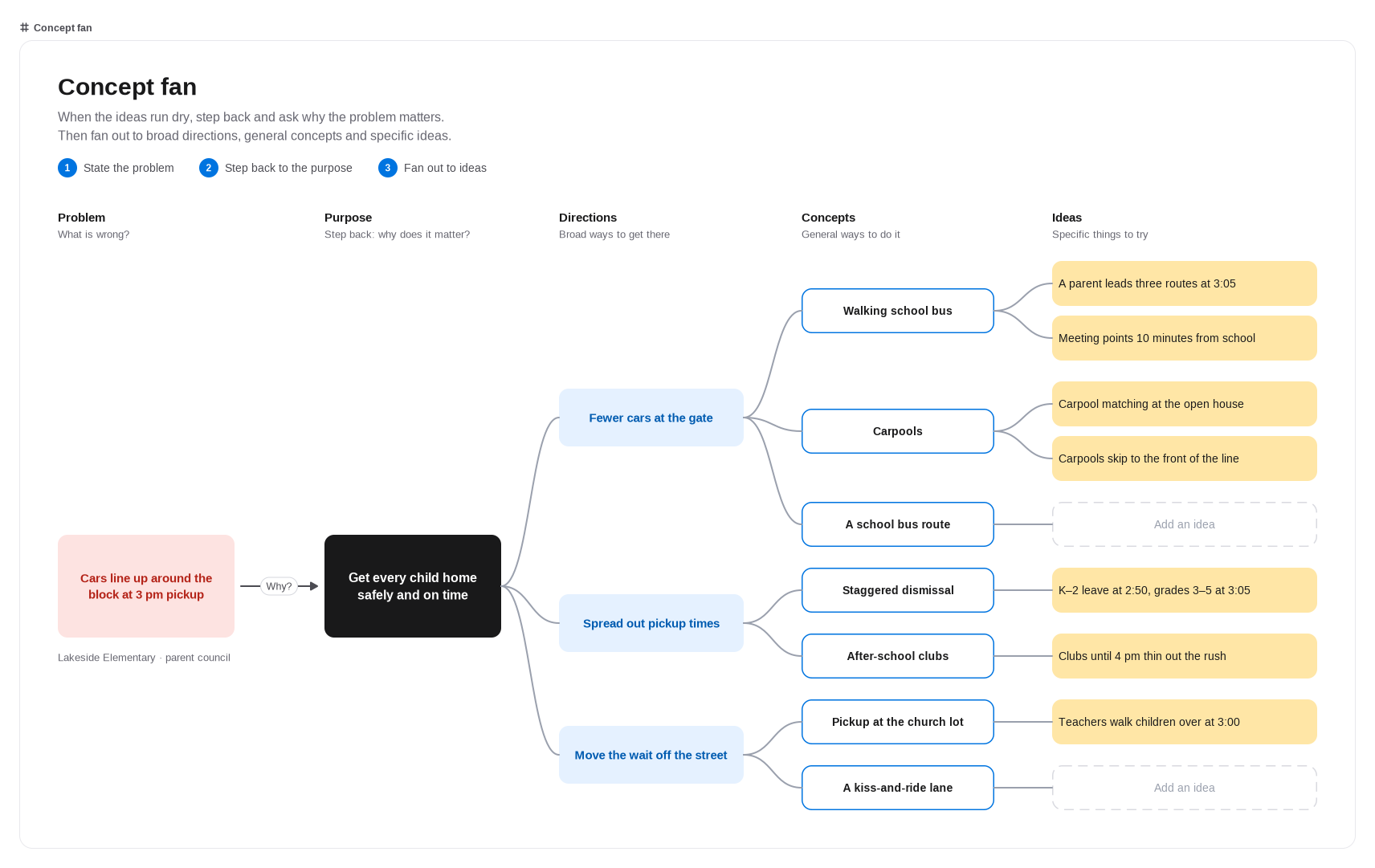
The fan starts with two boxes. The first states the problem in plain words: “Cars line up around the block at 3 pm pickup”. The column asks, “What is wrong?”
The second box is the step back. Its column asks, “Why does it matter?” and the council's answer is “Get every child home safely and on time”. Read the two together and notice what changed. The problem is about cars. The purpose is about children. A group that stays with the cars will argue about traffic cones. A group that starts from the children can ask whether every child needs a car at the gate at all.
If the directions that follow feel cramped, the purpose is still too close to the problem. Ask “why does that matter?” once more and rewrite it.
Directions and concepts: two levels of general
From the purpose, three lines lead to three directions, which the template describes as broad ways to get there:
- Fewer cars at the gate
- Spread out pickup times
- Move the wait off the street
None of these is something you could do on Monday. They are approaches, and each one is different in kind from the others: one reduces the cars, one moves them in time, one moves them in space.
The next column, concepts, holds general ways to follow a direction. Fewer cars at the gate splits into a walking school bus, carpools and a school bus route. Spread out pickup times leads to staggered dismissal and after-school clubs. Move the wait off the street gives pickup at the church lot and a kiss-and-ride lane. That is seven concepts from one purpose.
Ideas you could try next week
The last column is the only one with things to do, and the example shows how specific an idea should be. Under the walking school bus: “A parent leads three routes at 3:05” and “Meeting points 10 minutes from school”. Under carpools: “Carpool matching at the open house” and “Carpools skip to the front of the line”. Each has a time, a place or a rule in it.
Compare that with the level before. “Carpools” is a concept: everyone nods and nothing happens. “Carpools skip to the front of the line” is an idea: the principal can say yes or no to it.
The school bus route has a dashed box that says “Add an idea”. Not every branch fills up in one sitting, and a visible gap tells the next reader where help is wanted.
How to use the concept fan template
- Open it as a new board and overwrite the problem box with the thing your team is stuck on, in one sentence.
- Step back to the purpose. Ask why the problem matters and write the answer in the dark box. Keep it about the people affected, not about the fix.
- Name three directions. Rewrite the three blue boxes. Test them: if two could be carried out by the same action, merge them and find another.
- Fan out to ideas. Give each direction two or three concepts, then give each concept at least one idea with a detail in it.
- Mark what to try. Pick one idea from each direction, so the first round of tests does not all bet on the same approach.
To get a first draft of the branches, describe the problem to FlowDraw AI and edit what it draws.
When a concept fan helps, and when to use another diagram
The fan fits a stubborn, practical problem where the team keeps proposing versions of the same fix. It also works well for one person, since the columns supply the next question to ask.
It looks forward to solutions, not backward to causes. If you do not yet know why the cars pile up, start with a five whys or a fishbone diagram. If the subject has no single problem at its center and you only want to spread a topic out, a mind map is looser. And when the fan has produced more ideas than you can test, an impact effort matrix sorts them.
Questions about the Concept fan template
What is the difference between a direction, a concept and an idea?
They are three levels of detail. A direction is a broad approach, like fewer cars at the gate. A concept is a general way to follow it, like carpools. An idea is specific enough to act on, like carpool matching at the open house.
How is a concept fan different from a mind map?
A mind map branches freely from a topic in any direction. A concept fan has a fixed order: problem, purpose, directions, concepts, ideas. That order forces the step back to the purpose, which is what produces approaches the team had not considered.
What if the purpose only leads to one direction?
Then the purpose is too narrow. Step back again by asking why it matters, and write a wider one. In the example, a purpose like “shorten the car line” would allow one direction. “Get every child home safely and on time” allows three.
Can I add a fourth direction or more concepts?
Yes. Copy a box, place it in the right column and draw a line from its parent. The example board uses 61 elements, so there is plenty of room before a Free board reaches its limit of 150.