What is a hopes and fears exercise?
Hopes and fears is a short exercise for the start of a project or a change. Everyone writes what they hope it brings and what worries them about it, in silence, one thought per note. It surfaces expectations while there is still time to act on them, and it gives quiet doubts a place before they turn into resistance.
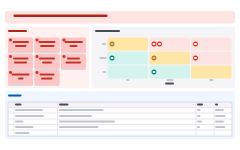
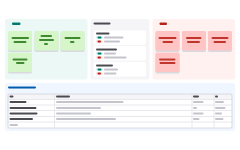
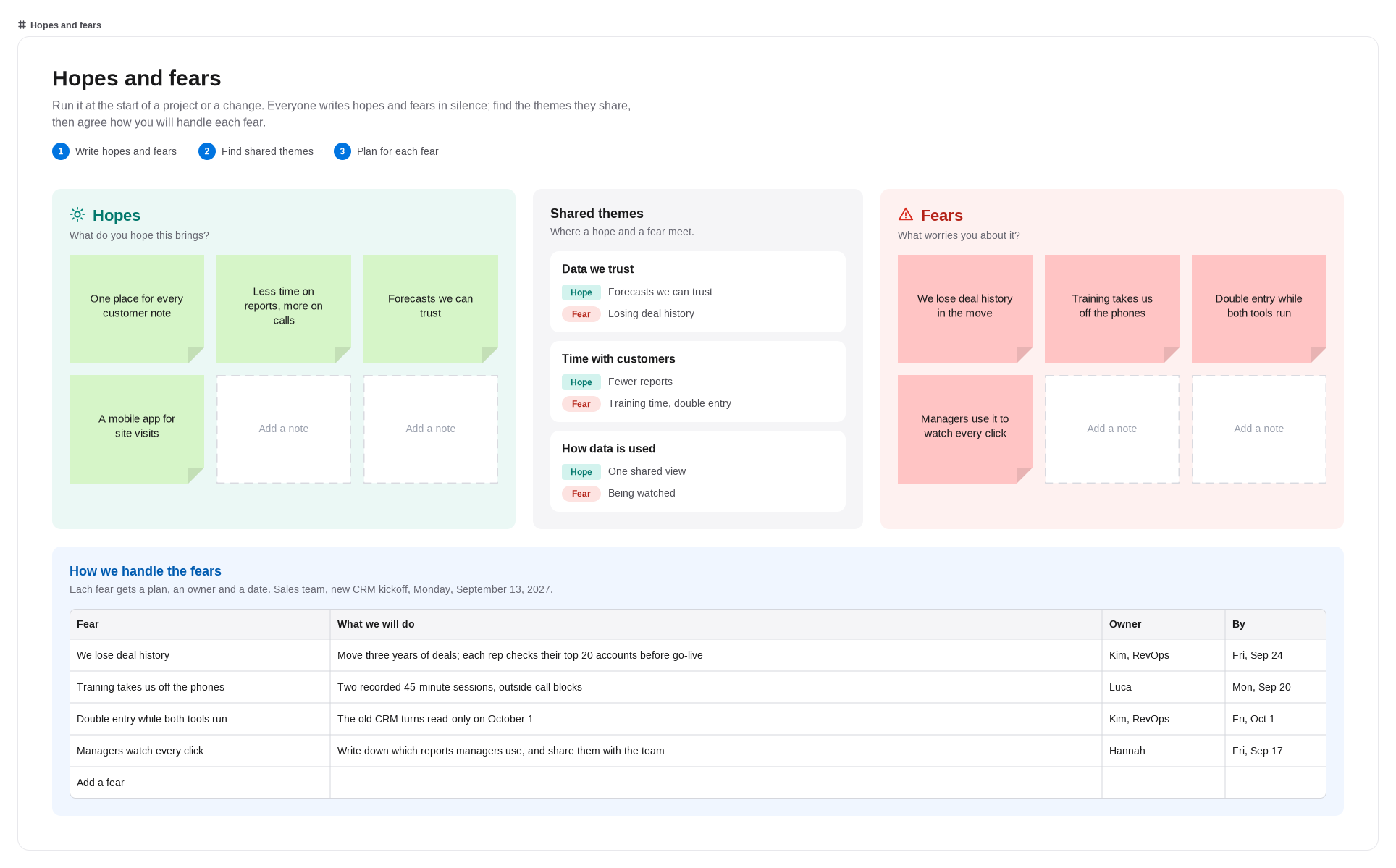
This template has a column for each side, a middle area where the two meet, and a table that turns fears into commitments. The example is a sales team at the kickoff of a new CRM on Monday, September 13, 2027.
The Hopes column
The left column asks one question: “What do you hope this brings?” The sales team answered with four notes:
- One place for every customer note
- Less time on reports, more on calls
- Forecasts we can trust
- A mobile app for site visits
Read them as a list of what success means to the people who will live with the change. Nobody wrote “a modern platform”. They wrote about their own day: calls, reports, visits. Two dashed cards marked “Add a note” show where the next hopes go.
Write fears that someone can answer
The right column asks “What worries you about it?” A vague fear such as “it will be chaos” gives the project lead nothing to work with. The fears on the example board are concrete enough to plan against:
- We lose deal history in the move. A data question with a yes or no answer.
- Training takes us off the phones. A scheduling problem.
- Double entry while both tools run. A question about the cutover date.
- Managers use it to watch every click. A trust issue, and the hardest one to say out loud.
That last note is the reason to write in silence and leave names off. People will type a worry about their manager; few will raise a hand to say it.
Shared themes: where a hope and a fear meet
The middle column is what sets this board apart from two plain lists. Each card names a theme and puts one hope and one fear side by side under it:
- Data we trust. Hope: forecasts we can trust. Fear: losing deal history.
- Time with customers. Hope: fewer reports. Fear: training time, double entry.
- How data is used. Hope: one shared view. Fear: being watched.
Pairing them shows that a hope and a fear are often the same wish seen from two sides. The team wants reliable data and is afraid the move will damage it. Name the theme and you know what the project has to protect.
A plan, an owner and a date for each fear
The table at the bottom is where the exercise pays off. Every fear gets a row with what the team will do, who owns it and by when. The example answers the lost history fear with “Move three years of deals; each rep checks their top 20 accounts before go-live”, owned by Kim in RevOps and due Friday, September 24.
The other rows are just as plain. Training becomes two recorded 45-minute sessions outside call blocks. Double entry ends because the old CRM turns read-only on October 1. For the fear of being watched, Hannah writes down which reports managers use and shares them with the team. A last row, “Add a fear”, waits for the next one.
How to use the hopes and fears template
- Open it as a new board. Change the line under the table title to your own team, project and date.
- Write hopes and fears. Give everyone five quiet minutes. Hopes go on the left, fears on the right, one per note, no names.
- Find shared themes. Read the notes together and look for a hope and a fear about the same subject. Rename the three theme cards to match what you find.
- Plan for each fear. Replace the table rows with your fears. Leave no row without an owner and a date, even when the action is only “find out”.
Come back to the board at the first milestone and check which fears came true.
When hopes and fears helps, and what to use instead
Run it in the first meeting of a project, before a reorganization or a tool change, or when a new team forms. It takes 20 to 30 minutes and works with any group that will be affected by a decision it did not make alone.
It collects feelings and expectations, so it does not rank risks. When the question is what could make the project fail and how likely each cause is, a pre-mortem goes further. For the scope, team and timeline of the same first meeting, pair it with a project kickoff board. Once the work is done, a sailboat retrospective looks back at what helped and what held you up.
Questions about the Hopes and fears template
When should you run a hopes and fears session?
At the very start, before plans harden. The example runs it at the kickoff of a tool change. It also fits the first day of a workshop or the first week of a new team, any time people arrive with expectations nobody has heard yet.
Should the notes be anonymous?
For fears, usually yes. A note like the example’s “Managers use it to watch every click” only appears when nobody has to sign it. Have one person collect the notes, or let people type without adding their name.
What do you do with the hopes?
Use them as the project’s success criteria in the team’s own words. If people hope for less time on reports, measure that after launch. Hopes also pair with fears in the Shared themes column, which shows what the project must protect.
How many people can take part?
Five to fifteen works well on one board. With more, split into groups and merge the themes afterward. On the Team plan everyone adds notes at once; on Free and Pro one person edits while the others view and comment.