What is lean coffee?
Lean coffee is a meeting format with no agenda until it starts. Everyone proposes topics, the group votes, and the topics with the most votes are discussed first, each inside a short timebox. When the time is up, a quick thumb vote decides whether to keep going or move on. The group spends its hour on what most people care about, not on what one person put in the invite.
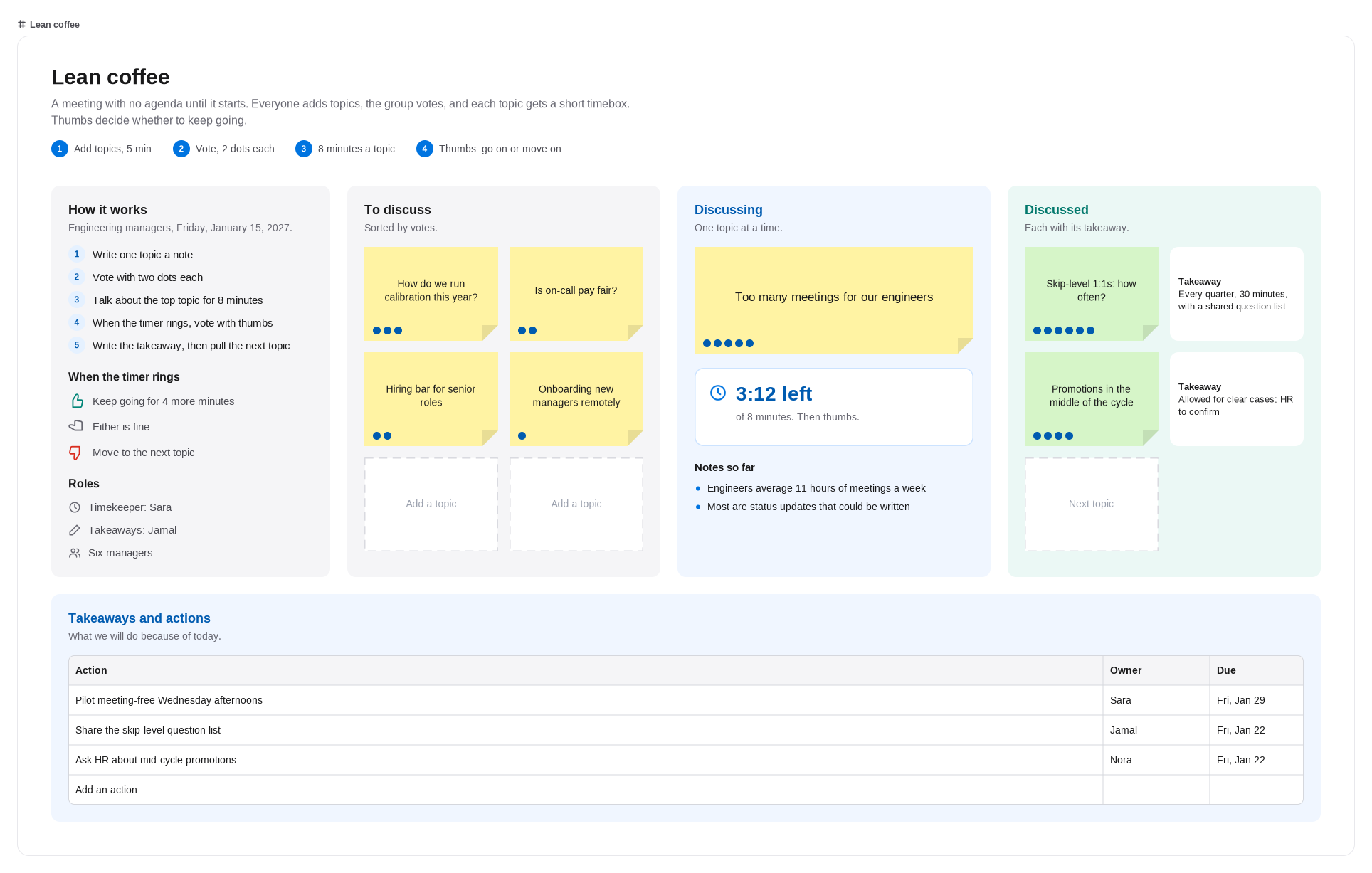
This template is the board for it: a panel with the rules, three columns that topics move through, and a table for takeaways and actions. The example is a session of six engineering managers on Friday, January 15, 2027.
Three columns a topic moves through
The middle of the board works like a small kanban for conversation:
- To discuss. Every proposed topic, sorted by votes. The example holds four, led by “How do we run calibration this year?” with three dots, then “Is on-call pay fair?” and “Hiring bar for senior roles” with two each.
- Discussing. One topic at a time. Right now it is “Too many meetings for our engineers”, which collected five dots.
- Discussed. Finished topics, each with its takeaway beside it.
The dots printed on each note are the votes. Because the first column is sorted by them, nobody has to argue about order: the next topic is always the top note.
The rules, the thumbs and the roles
Lean coffee only works when everyone knows the rules, so the left panel prints them on the board in five steps: write one topic a note, vote with two dots each, talk about the top topic for 8 minutes, vote with thumbs when the timer rings, then write the takeaway and pull the next topic.
Under the steps, a thumb key explains the vote. There are three answers: keep going for 4 more minutes, either is fine, or move to the next topic. The panel also names two roles for the session: Sara keeps time and Jamal writes the takeaways. Giving those two jobs away leaves the rest of the group free to talk.
One topic on the table
The Discussing column shows what a live topic looks like. Under the note a card reads “3:12 left” of 8 minutes, then thumbs: the timekeeper updates it so that everyone can see how long the topic has.
Below that, Notes so far catches the facts as they come up. The managers have written two: engineers average 11 hours of meetings a week, and most are status updates that could be written. Notes like these keep the conversation from circling. When someone repeats a point, the facilitator can point at the board and ask what is new.
End every topic with a takeaway
A topic does not leave the middle column until someone has written what the group concluded. In the Discussed column each note has a takeaway card next to it. “Skip-level 1:1s: how often?” ends with “Every quarter, 30 minutes, with a shared question list”. “Promotions in the middle of the cycle” ends with “Allowed for clear cases; HR to confirm”.
Both takeaways fit in one line and say what was agreed, not what was said. The second one is honest about an open end: a person still has to confirm it. That open end becomes a row in the action table.
How to use the lean coffee template
- Open it as a new board. Clear the example notes and write your group, date, timekeeper and note-taker in the left panel.
- Add topics for 5 minutes. One topic per note, phrased as a question where possible, all placed in To discuss.
- Vote with two dots each. Copy a dot onto the notes you want, then reorder the column so the most dots sit at the top.
- Talk for 8 minutes a topic. Move the top note to Discussing and set a timer on a phone. When it rings, vote with thumbs.
- Record and act. Write the takeaway, move the note to Discussed, and add any follow-up to the table, as the example does with “Pilot meeting-free Wednesday afternoons”, owned by Sara.
When lean coffee fits, and when a set agenda is better
Use it for recurring meetings of peers where nobody owns the agenda: a managers’ circle, a community of practice, an open team forum. It also rescues a standing meeting that has gone stale, since the group votes on what is worth its time.
It is a poor fit when a specific decision must be made or when guests have prepared material. For that, plan a meeting agenda with topics, owners and times, or run a decision meeting with roles and options. Topics the group never reached can wait in a parking lot until next time.
Questions about the Lean coffee template
How long does a lean coffee session take?
Plan 45 to 60 minutes. Five minutes to add topics, two or three to vote, then eight minutes per topic with a possible four-minute extension. That is four to six topics in an hour, which is as many as most groups can discuss well.
Why is it called lean coffee?
The format began as informal morning meetups in a coffee shop for people interested in lean ways of working. The name stuck. It needs no coffee and no lean background, only notes, votes and a timer.
How many votes does each person get?
Two is the usual number and the one printed on this board. You may put both on one topic. With more than ten people or a long list of topics, three votes each spreads the dots a little further.
What happens to topics that are not discussed?
They stay in To discuss. Start the next session with them already on the board and let the group vote again. A topic that collects no dots twice has answered itself and can be deleted.