What is a morphological matrix?
A morphological matrix breaks a design into the decisions it is made of. Each decision, called a parameter, gets a row. The possible answers to it, called options, fill the cells of that row. A concept is then built by picking one option from every row. The method goes back to the astrophysicist Fritz Zwicky, and engineers and product teams use it to make sure they have looked at combinations they would never have thought of in one piece.
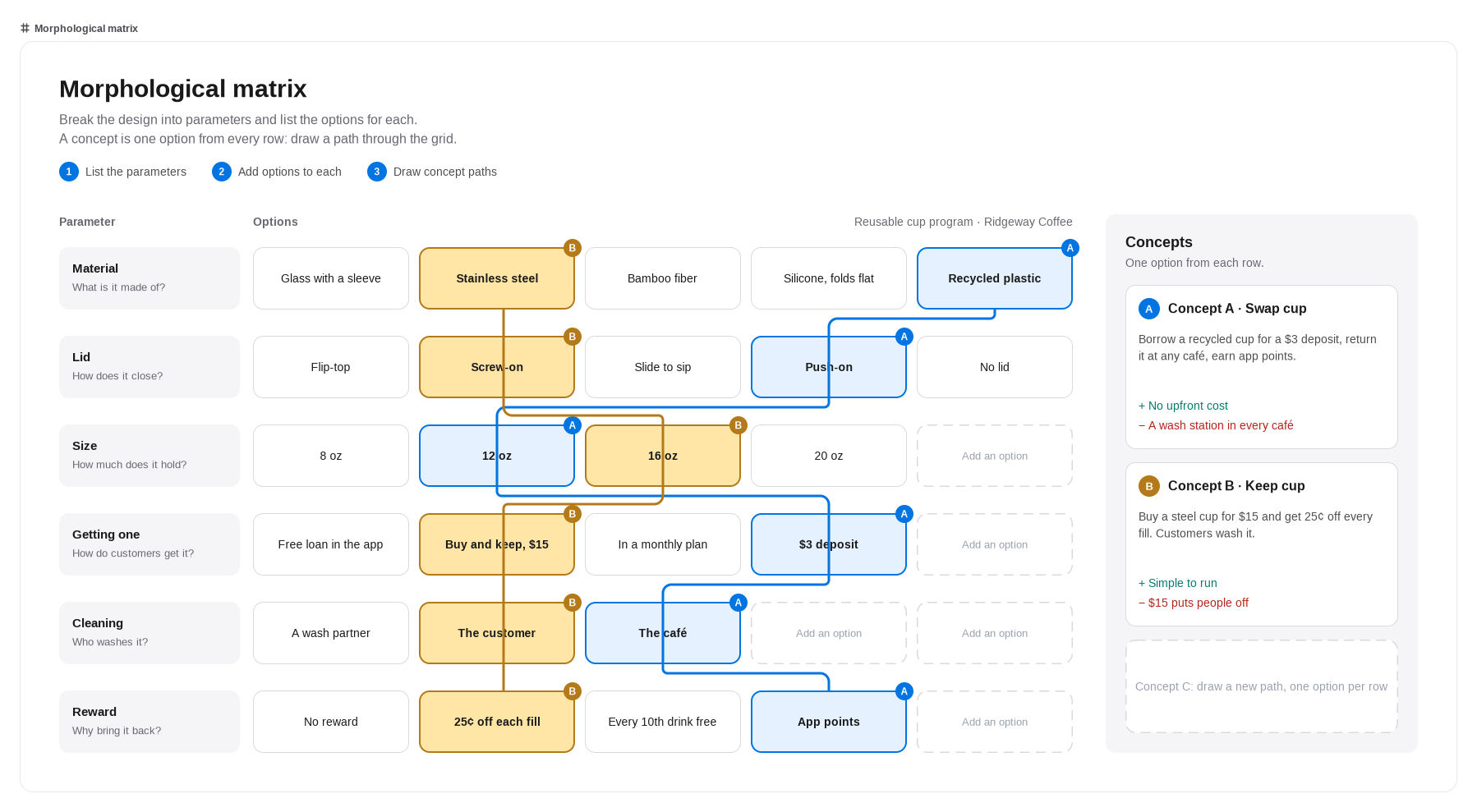
This template has six rows, room for five options in each, and a panel on the right where the chosen combinations are written out as concepts. It is filled in for a coffee shop planning a reusable cup program.
Parameters on the left, options across
Every row starts with a card that names the parameter and asks it as a question. The first three in the example:
- Material. What is it made of? Glass with a sleeve, stainless steel, bamboo fiber, silicone that folds flat, or recycled plastic.
- Lid. How does it close? Flip-top, screw-on, slide to sip, push-on, or no lid.
- Size. How much does it hold? 8 oz, 12 oz, 16 oz or 20 oz.
The question under each name does real work. “Lid” alone invites a debate about lids. “How does it close?” invites a list, and “no lid” becomes a fair answer.
Parameters should be independent. If choosing a material forced the lid, the two rows would be one decision and should be merged.
Fill the rows wide, including the dull options
The lower rows move from the cup to the program around it: Getting one (how do customers get it?), Cleaning (who washes it?) and Reward (why bring it back?). This is where the example is most useful, because it lists options a team would normally skip. “No reward” sits in the Reward row beside “25¢ off each fill” and “Every 10th drink free”. “The customer” is a cleaning option next to “A wash partner”.
Write options as short, concrete answers with the number included when there is one: “Buy and keep, $15” and “$3 deposit” can be compared, “cheap” and “expensive” cannot.
Rows do not need the same length. Cleaning has three options and two dashed cards that say “Add an option”. An empty cell is a prompt, not a gap to hide.
Draw concept paths through the grid
With the rows as they stand, the grid holds 5 × 5 × 4 × 4 × 3 × 4 combinations, which is 4,800 possible cup programs. Nobody reviews them all. You pick a few paths that make sense as a whole and mark them.
The example marks two with lettered badges on the corners of the cells. Path A runs through recycled plastic, a push-on lid, 12 oz, a $3 deposit, washing by the café and app points. The Concepts panel names it Swap cup: borrow a cup, return it at any café, earn points. Path B takes stainless steel, a screw-on lid, 16 oz, buy and keep for $15, washing by the customer and 25¢ off each fill. That is Keep cup.
Each concept card ends with one plus and one minus. Swap cup has no upfront cost but needs a wash station in every café. Keep cup is simple to run, but $15 puts people off. A third card waits for Concept C.
How to use the morphological matrix template
- Open it as a new board and replace the line “Reusable cup program · Ridgeway Coffee” with your own project.
- List the parameters. Rename the six cards on the left. Four to seven rows is workable. Check that each one can be decided without fixing another.
- Add options to each. Work one row at a time and type over the cells. Include the option you use today and at least one that sounds extreme.
- Draw concept paths. Drag the A and B badges onto the cells you pick, one per row. Start one path from the cheapest options and one from the options customers would love.
- Write the concepts down. Give each path a name, two lines of description, a plus and a minus in the panel on the right.
Stuck on a row? FlowDraw AI can propose options for a parameter from a short description of the product.
When a morphological matrix helps, and when it does not
Use it when a product or service can be split into parts that are chosen separately: packaging, pricing models, onboarding flows, event formats, physical products. It is strongest early, when the team has settled on one obvious design and has stopped looking.
It produces concepts, not a winner. To choose between Swap cup and Keep cup, score them on a decision matrix. If your problem will not break into independent rows, a lotus blossom expands one theme outward instead. And to improve a single existing product, SCAMPER is quicker than building a grid.
Questions about the Morphological matrix template
How many parameters and options should the matrix have?
Four to seven parameters with three to five options each is a good range. The example uses six rows and up to five options. Beyond that the number of combinations grows so fast that the grid stops helping people see whole concepts.
What makes a good parameter?
It is a decision the design cannot avoid, it can be phrased as a question, and its answer does not dictate another row. “Who washes it?” is a good one. “Quality” is not, because it is a goal and not a choice.
Do I have to check every combination?
No. The value is in seeing the full space and then choosing a handful of paths that hang together. Start with two or three contrasting ones, such as cheapest to run and most convenient for the customer, and add more only if none of them convinces.
Can a concept use two options from the same row?
Sometimes, when the options do not exclude each other, such as offering two sizes. Mark both cells with the same badge and say so in the concept card. If it happens in most rows, the options are probably too fine and can be merged.