What is name storming?
Name storming is a brainstorm with one output: a name for a product, a company, a feature or a project. It differs from an ordinary brainstorm in two ways. It starts from a written brief, because a name can only be judged against what it has to do. And it ends with a check, because a name the team loves is useless if nobody can spell it or somebody else already owns it.
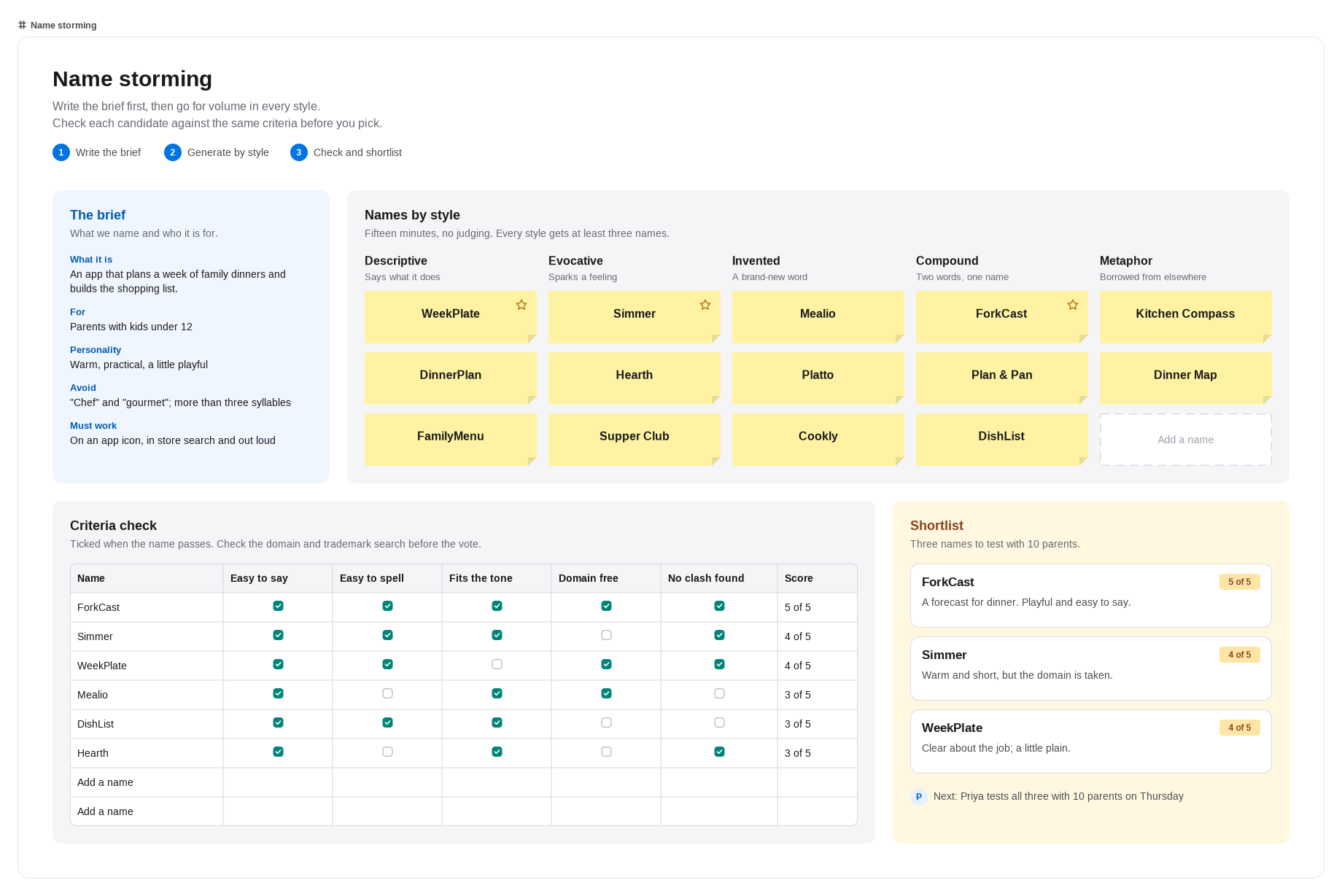
The template follows that order in four panels: The brief, Names by style, Criteria check and Shortlist. In the example a team is naming an app that plans a week of family dinners and builds the shopping list.
Write the brief before the first name
The brief has five fields, and the whole thing fits on a card.
- What it is. An app that plans a week of family dinners and builds the shopping list.
- For. Parents with kids under 12.
- Personality. Warm, practical, a little playful.
- Avoid. “Chef” and “gourmet”; more than three syllables.
- Must work. On an app icon, in store search and out loud.
The last two fields save the most time. “Avoid” rules out a whole family of names before anyone proposes them. “Must work” turns taste into a test: say the name to someone across the room and see if they can type it.
Generate names in five styles
Left alone, a group writes one kind of name. The second panel prevents that with five columns, each a different style with a one-line definition:
- Descriptive says what it does: WeekPlate, DinnerPlan, FamilyMenu.
- Evocative sparks a feeling: Simmer, Hearth, Supper Club.
- Invented is a brand-new word. The example has three coined ones.
- Compound joins two words in one name: ForkCast, Plan & Pan, DishList.
- Metaphor is borrowed from elsewhere: Kitchen Compass, Dinner Map.
The rule under the panel title is “Fifteen minutes, no judging. Every style gets at least three names.” The quota matters. The Metaphor column still has a dashed “Add a name” card, and that visible gap pushes the group to finish the style it finds hardest. Three notes carry a star: the ones that later reach the shortlist.
Check every candidate against the same criteria
The Criteria check is a table. Each row is a name and each column is a question: Easy to say, Easy to spell, Fits the tone, Domain free and No clash found. A cell gets a tick when the name passes and a cross when it does not, and the last column adds up the score.
Six names made it into the table. ForkCast passes all five. Simmer scores 4 of 5: it loses on the domain. WeekPlate also scores 4 of 5, with its cross under tone. Hearth and DishList end on 3 of 5, and both fail the domain check.
The table does something a vote cannot. It shows why a favorite is weak, and whether the weakness can be lived with. A taken domain may be solved with a longer web address. A name people cannot spell stays a problem for good.
The note above the table asks for the domain and trademark search before the vote. Do those searches yourself, outside the board, and record the results here.
A shortlist with reasons
The last panel keeps three names, each with its score and one honest sentence. ForkCast, 5 of 5: “A forecast for dinner. Playful and easy to say.” Simmer, 4 of 5: “Warm and short, but the domain is taken.” WeekPlate, 4 of 5: “Clear about the job; a little plain.”
Notice that two of the three sentences include the drawback. A shortlist that only praises is a sales pitch, and whoever signs off on the name deserves to know what they are accepting.
The panel ends with a next step that puts the decision in front of real users: Priya tests all three with 10 parents on Thursday.
How to use the name storming template
- Open it as a new board and clear the name notes, the table rows and the shortlist cards.
- Write the brief. Fill all five fields with the person who will approve the name. If they will not agree on “Personality”, they will not agree on a name either.
- Generate by style. Give the group fifteen minutes. Work across the five columns and do not stop until each has three notes.
- Check and shortlist. Star the names people keep coming back to and move six of them into the table. Tick the first three columns in the room, then search domains and trademarks for the last two.
- Test the top three. Write a reason for each on the shortlist cards and put a name and a day on the next step.
When a column runs dry, FlowDraw AI can add candidates in that style from your brief. Check them like any other name.
When to use it, and when another board is better
Use it for anything that needs a name people will say out loud: an app, a company, a feature, a newsletter, an event, an internal project. It works with three people and with ten.
It assumes you know what you are naming. If the product's promise is still fuzzy, fill in a value proposition canvas first, and the brief will take five minutes. If the hard part is choosing between finalists on more than five criteria with different weights, move them to a decision matrix. For a quick, quiet round of raw ideas of any kind, brainwriting 6-3-5 is faster.
Questions about the Name storming template
How many names should a naming session produce?
Far more than you need. The board asks for at least three in each of five styles, so fifteen is the floor, and a lively group reaches fifty. Most will fail the checks, which is normal. Only six go into the table and three onto the shortlist.
Does the template check domains or trademarks for me?
No. The table has columns for “Domain free” and “No clash found”, but you run those searches yourself and record the answer with a tick or a cross. For a name you plan to register, have a trademark professional confirm the result.
Why sort names into styles?
Because groups drift toward one style, usually descriptive, and never see the alternatives. Separate columns with a quota force a few evocative, invented, compound and metaphor names onto the board, and the eventual winner often comes from a column the team would have skipped.
Should the team vote on the final name?
Use the vote to build the shortlist, not to pick the winner. The example sends three names to 10 parents, the people the app is for. Their reactions, plus the criteria scores, give the person who decides something better than the team's taste.