What is a question burst?
A question burst is brainstorming turned around. A small group hears a challenge and then, for four minutes, produces nothing but questions about it. No answers, no explanations, no defending how things are done. The method comes from Hal Gregersen, and it rests on a simple observation: when a team is stuck, it is often answering the wrong question.
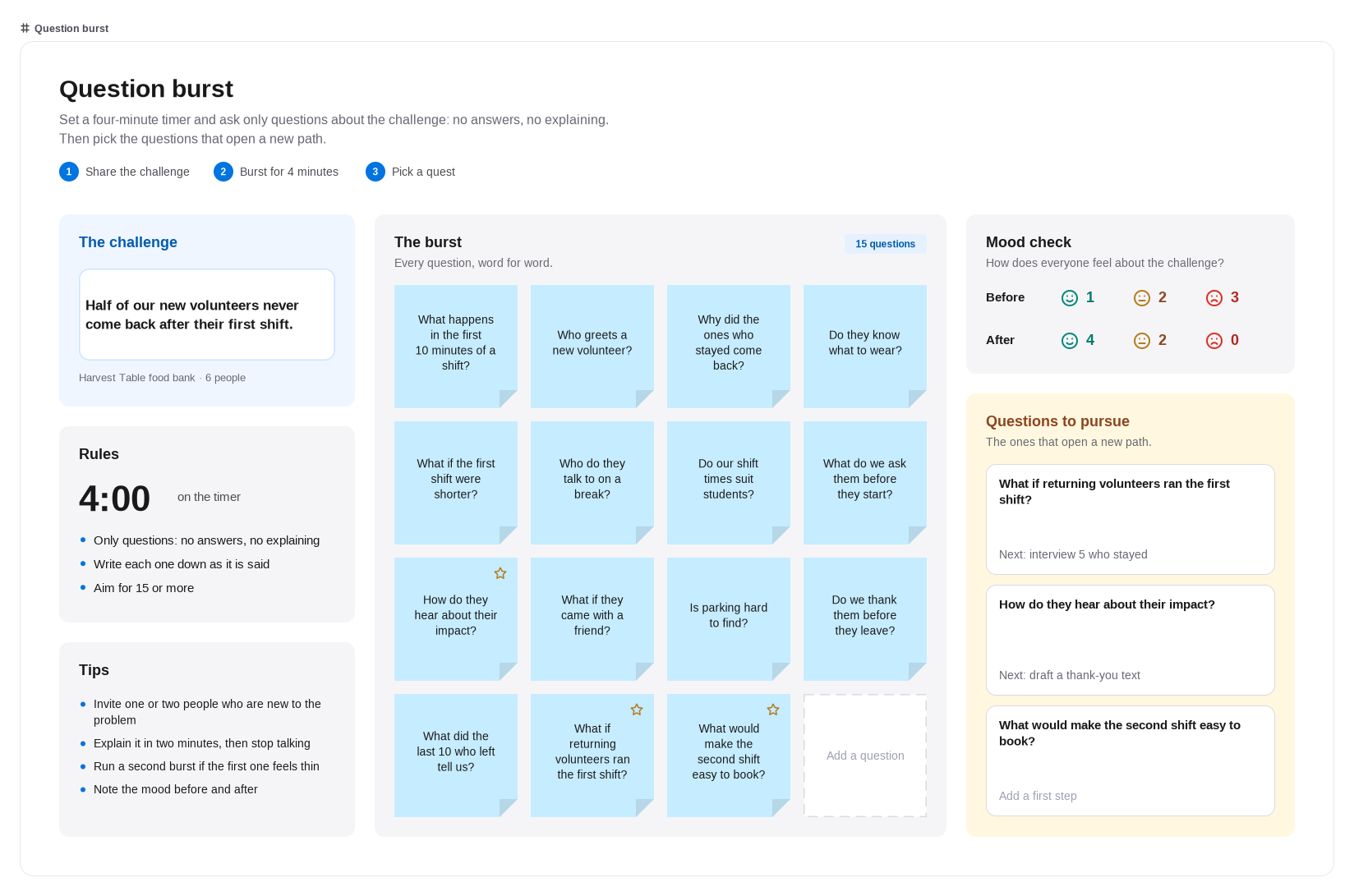
The template gives the exercise a home. The challenge, the rules and some tips sit on the left. The middle is a wall for the questions. On the right are a mood check and a panel for the questions the group decides to pursue. The example was run by six people at Harvest Table food bank.
The challenge and the three rules
The challenge card holds one sentence: “Half of our new volunteers never come back after their first shift.” It states a fact that hurts and stops. It does not say why, and it does not suggest a cure.
Below it the Rules panel shows a large 4:00 with the words “on the timer”, followed by three lines:
- Only questions: no answers, no explaining
- Write each one down as it is said
- Aim for 15 or more
The first rule is the hard one. Someone will start to explain why parking is the way it is. The facilitator's whole job is to say “question, please” and keep the pen moving.
The burst: every question, word for word
The middle panel is headed The burst, and a counter in its corner reads 15 questions. Each one has its own note, and one dashed card is left for the next.
The notes are written exactly as people said them, which keeps the pace up and keeps the scribe from quietly improving things. Read the wall in order and you can watch the group loosen. It starts close to the facts: “What happens in the first 10 minutes of a shift?” and “Who greets a new volunteer?” Later the questions begin to tilt the problem: “What if the first shift were shorter?” and “What if they came with a friend?”
The target of 15 matters because the early questions are the ones everybody already had. The useful ones tend to arrive after the obvious ones are used up.
Which questions are worth the note
The example wall holds three kinds of question, and a good burst needs all of them.
Fact questions show what the team does not know: “Do they know what to wear?”, “What do we ask them before they start?” If nobody can answer, that is a finding.
Reversal questions look at the other side: “Why did the ones who stayed come back?” The challenge is about the half who left. This one asks about the half who did not.
What-if questions change a condition: “What if the first shift were shorter?”
What you will not find is a question with a solution packed inside, such as “Shouldn't we just send a reminder?” That is an answer with a question mark on it. If one slips in, write it down anyway and keep going. Stopping to object costs more than one weak note.
Pick the questions that open a new path
When the timer ends, the group reads the wall and stars a few questions. In the example three notes carry a star, and the same three appear in the panel called Questions to pursue.
“What if returning volunteers ran the first shift?” has the next step “interview 5 who stayed”. “How do they hear about their impact?” leads to “draft a thank-you text”. “What would make the second shift easy to book?” still shows the prompt “Add a first step”.
None of these is “why do volunteers leave?”, the question the team walked in with. Each one points at a specific moment, the first shift, the thank-you, the second booking, and each can be tested within a week.
Check the mood before and after
The small panel at the top right asks how everyone feels about the challenge, twice. A row of three faces is counted before the burst and again after it. With six people, the Before row reads 1, 2 and 3. The After row reads 4, 2 and 0: most of the room has moved to the first face, and the last face is empty.
It takes twenty seconds and it is worth doing. A burst rarely solves the problem in the room. What it changes is whether people feel the problem can be worked on, and the two rows make that shift visible. One of the tips on the board adds: run a second burst if the first one feels thin.
How to use the question burst template
- Open it as a new board and replace the challenge with one sentence about yours. Invite one or two people who are new to the problem, as the Tips panel suggests.
- Share the challenge. Explain it in two minutes, then stop talking. Count the faces for the Before row.
- Burst for 4 minutes. Start a timer. One person types each question onto a note as it is said, and everyone else asks.
- Choose and commit. Count the After row, star up to three questions, copy them to the right and write a first step under each.
Afterwards, FlowDraw AI can turn a chosen question into a first diagram of ideas to react to.
When a question burst helps, and when to use another board
Run one when a team keeps circling the same answers, or before a brainstorm to make sure it aims at the right thing. Three to six people is enough.
If you want questions in a fixed order around a new product or plan, starbursting sorts them into who, what, where, when, why and how. To dig into the cause of one known failure, five whys goes deeper. To turn a chosen question into a brief for ideas, rewrite it on the How might we board.
Questions about the Question burst template
Why only four minutes?
Short enough that nobody can settle into a speech, long enough to get past the questions everyone arrived with. The pressure of the clock is part of the method. If the wall looks thin afterwards, run a second four-minute burst instead of extending the first.
What if someone starts answering a question?
Interrupt kindly and ask them to turn the answer into a question. “We tried shorter shifts in 2023” becomes “What happened when we tried shorter shifts?” Agree on this before the timer starts, so the reminder does not feel personal.
Who should be in the room?
The person who owns the challenge and a few others, ideally including one or two who do not know the problem well. Outsiders ask the basic questions that insiders stopped asking years ago, and those are often the ones that get starred.
What do we do with the questions we did not pick?
Leave them on the board. They are a record of what the team was unsure about, and several will turn out to be quick to answer. Come back after the first steps are done and see which ones have become relevant.