What is a workshop agenda?
A workshop agenda is the plan for a working session in which a group has to produce something together: a map, a list of priorities, a set of ideas. A meeting agenda lists topics to talk about. A workshop agenda lists sessions, and each one needs a method, a time limit and a result that the next session builds on. If one session ends without its result, the rest of the day has nothing to stand on.
This template lays the day out as two timelines, morning and afternoon, with panels for materials, roles and the work that follows. The example plans a customer journey workshop from 9:00 AM to 4:00 PM.
Set the outcome before the sessions
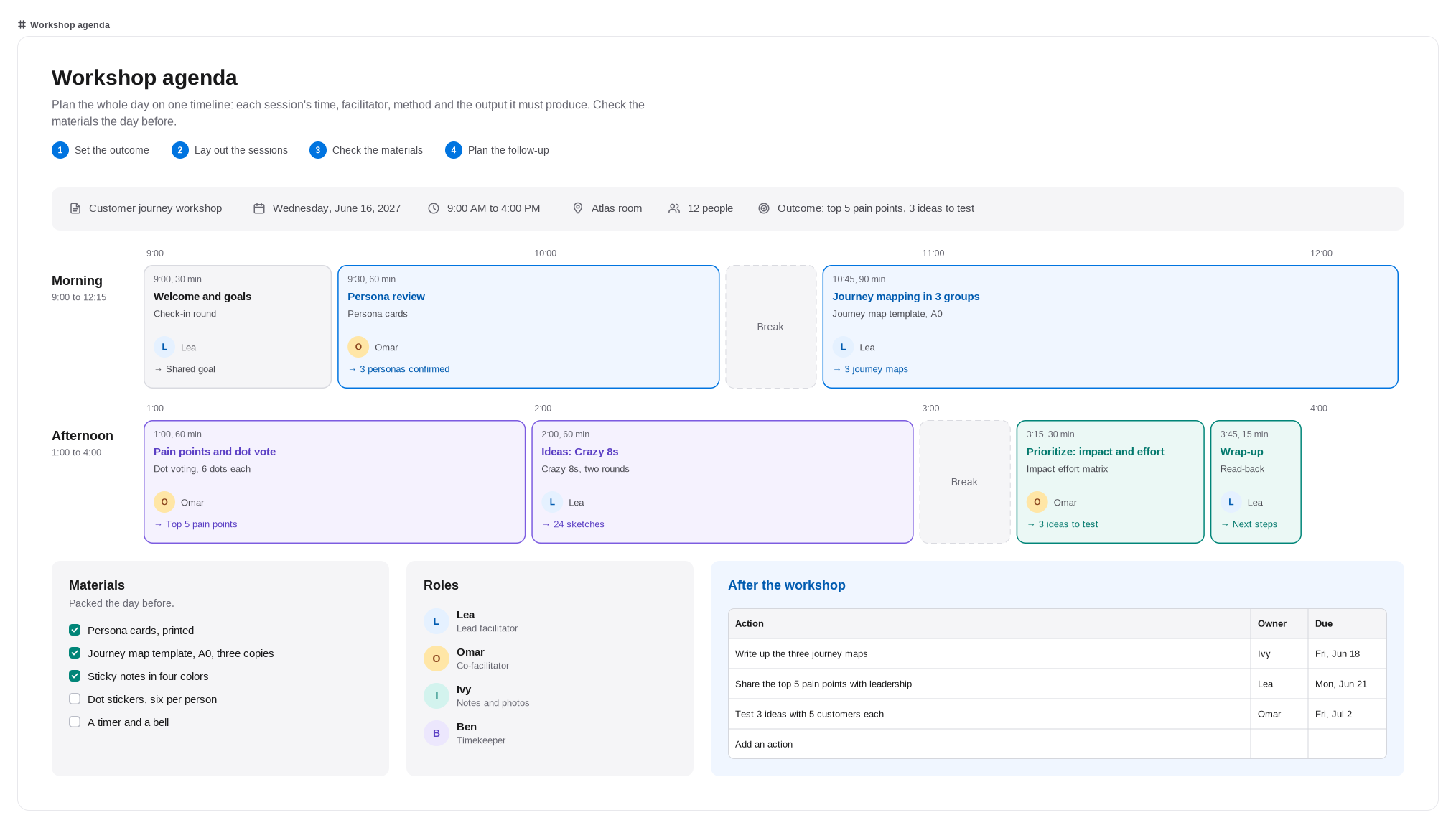
The bar under the title holds the facts everyone needs: the workshop’s name, Wednesday, June 16, 2027, 9:00 AM to 4:00 PM, the Atlas room, 12 people. The last item on the bar is the one to write first: “Outcome: top 5 pain points, 3 ideas to test”.
That outcome is countable. At 4:00 PM anyone can check whether the room has five pain points and three ideas. An outcome such as “align on the customer experience” cannot be checked, and a day planned around it tends to end in a pleasant conversation. Step 1 on the board says it in three words: set the outcome.
The morning: build a shared picture
Each row is a time scale with hour marks, and each session is a block whose width matches its length. The morning runs from 9:00 to 12:15 and has three sessions and a break:
- 9:00, 30 min. Welcome and goals, with a check-in round. Lea.
- 9:30, 60 min. Persona review, using persona cards. Omar.
- Break. A narrow block of its own before 10:45.
- 10:45, 90 min. Journey mapping in 3 groups. Lea.
The longest block of the day goes to the hardest work, and it sits in the morning when people are fresh. Breaks are drawn as blocks of their own, so they cannot be planned away.
What every session block holds
Look closely at one block. “Journey mapping in 3 groups” carries five pieces of information: the start time and length (10:45, 90 min), the session’s name, the method or material (Journey map template, A0), the facilitator (Lea) and, on the last line after an arrow, the output: 3 journey maps.
The arrow line is what separates a workshop plan from a schedule. Read only those lines down the day and you get the chain of results: shared goal, 3 personas confirmed, 3 journey maps, top 5 pain points, 24 sketches, 3 ideas to test, next steps. Each one feeds the session after it. If you cannot write an output for a block, cut the block.
The afternoon: narrow down
The afternoon row, 1:00 to 4:00, turns the morning’s maps into choices. It opens with “Pain points and dot vote”, six dots each, which produces the top 5 pain points. Then comes an hour of Crazy 8s in two rounds, a break, 30 minutes on an impact effort matrix that leaves 3 ideas to test, and a 15-minute wrap-up with a read-back.
Notice the shape: the sessions get shorter as the day goes on. Generating ideas takes an hour, choosing takes half of that, and the wrap-up is a quarter. Two of the afternoon’s outputs, the top 5 pain points and the 3 ideas to test, are exactly the outcome promised on the info bar.
Materials and roles
Two panels at the bottom left cover what sinks workshops more often than a bad plan: a missing template or nobody watching the clock. Materials is a checklist packed the day before: persona cards, printed; the journey map template in A0, three copies; sticky notes in four colors; dot stickers, six per person; a timer and a bell. Every item matches a method named in a session block.
Roles names four people. Lea is lead facilitator, Omar is co-facilitator, Ivy takes notes and photos, and Ben keeps time. The two facilitators alternate sessions on the timeline, which gives each of them a rest and the room a change of voice.
How to use the workshop agenda template
- Open it as a new board. Fill the info bar, and write the outcome as things you can count.
- Lay out the sessions. Work backward from the outcome. Resize each block to its length against the hour marks, and write its output on the arrow line.
- Check the materials. Go through the blocks and list what each method needs. Tick the list the day before.
- Plan the follow-up. Fill the last table before the day, not after: who writes up the results, who shares them and by when. The example has Ivy writing up the three journey maps two days later.
When this agenda fits, and when to pick another
Use it for half-day and full-day sessions with a facilitator and a concrete result: discovery workshops, planning days, offsites, training.
A one-hour meeting does not need a timeline; a plain meeting agenda will do. For a workshop that spans a whole week with a fixed method for each day, start from the design sprint board. And if the group is new and you want to hear expectations before the first session, open with hopes and fears.
Questions about the Workshop agenda template
How do you structure a full-day workshop?
Open with goals, spend the morning building a shared understanding, break for lunch, then use the afternoon to generate options and choose among them. Close with a read-back of results and next steps. The example follows exactly this arc in seven sessions.
How long should each workshop session be?
Between 30 and 90 minutes. The example’s longest block is 90 minutes of group mapping and its shortest is a 15-minute wrap-up. Anything over 90 minutes needs a break inside it, and anything under 15 is an announcement.
How many breaks does a workshop need?
One every 90 minutes or so, plus lunch. The example has a short break in the morning, 45 minutes at midday and another short break at 3:00. Draw them on the timeline so the sessions around them stay honest.
What is the difference between a facilitator and a timekeeper?
The facilitator leads the method and the conversation. The timekeeper watches the clock and signals when a block is ending, so the facilitator can stay with the group. On the example board these are different people: Lea and Omar facilitate, Ben keeps time.