What is the Disney method?
The Disney method is a way to develop one idea by looking at it in three separate roles, one after the other. The dreamer imagines without limits. The realist works out how it could be done. The critic hunts for weak spots. Robert Dilts described the technique, and its rule is simple: never play two roles at once. Most ideas die because someone criticizes them while they are still being dreamed.
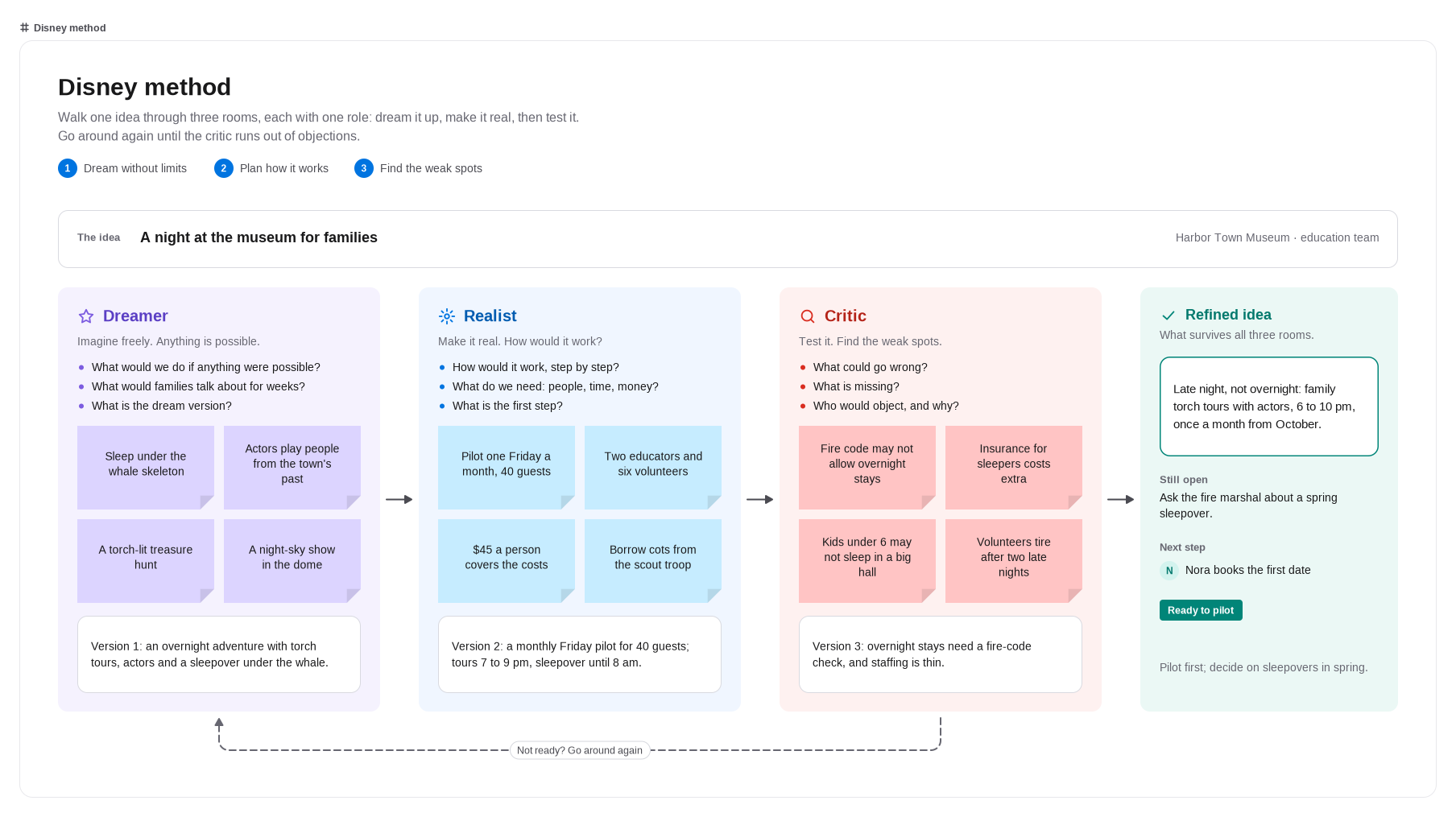
This template draws the roles as three rooms side by side and adds a fourth column for the refined idea. The example comes from the education team at Harbor Town Museum, working on “A night at the museum for families”.
Three rooms, three sets of questions
The bar across the top holds the idea and who is working on it. Under it, each room opens with a one-line brief and three prompts, so the group knows which voice it is using.
- Dreamer. Imagine freely. What would we do if anything were possible? What would families talk about for weeks? What is the dream version?
- Realist. Make it real. How would it work, step by step? What do we need: people, time, money? What is the first step?
- Critic. Test it. What could go wrong? What is missing? Who would object, and why?
The prompts keep people honest about the room they are in. A sentence that starts “but the insurance” does not answer any dreamer question, so it waits.
One idea, rewritten in every room
Each room in the example holds four notes and ends with a summary box, and the summaries are numbered as versions. That is the habit worth copying: the idea is written out again after each role has spoken.
The dreamer's notes are bold on purpose: sleep under the whale skeleton, a torch-lit treasure hunt, actors who play people from the town's past, a night-sky show in the dome. Version 1 is an overnight adventure with all of it.
The realist does not shrink the dream. It gives it numbers: a pilot one Friday a month for 40 guests, two educators and six volunteers, $45 a person to cover the costs, cots borrowed from the scout troop. Version 2 has hours, tours from 7 to 9 pm and a sleepover until 8 am.
Only then does the critic speak, and its notes are specific enough to check: fire code may not allow overnight stays, and volunteers tire after two late nights.
What survives: the refined idea
The last column is headed Refined idea, with the line “What survives all three rooms.” The critic's fire-code and staffing objections did not kill the museum night. They changed it: late night, not overnight. Family torch tours with actors, 6 to 10 pm, once a month from October. The torches and the actors come straight from the dreamer. The monthly rhythm comes from the realist.
Three smaller fields keep the result from drifting. Still open parks the question nobody could answer in the room: ask the fire marshal about a spring sleepover. Next step names a person, Nora, who books the first date. A status tag reads Ready to pilot, and the bottom line records the decision: pilot first, decide on sleepovers in spring.
How to use the Disney method template
- Open it as a new board and type your own idea and team into the bar at the top.
- Dream without limits. Spend ten minutes in the Dreamer room only. Replace the museum notes, answer the three prompts, then write Version 1 in the box below.
- Plan how it works. Move to the Realist room and put a number on every note you can: guests, staff, price, dates. Write Version 2.
- Find the weak spots. In the Critic room, write objections as facts someone could verify. Summarize them as Version 3.
- Go around again. Take the objections back to the dreamer and ask for a way past them. Stop when the critic has nothing new, then fill in the Refined idea column.
Working alone? FlowDraw AI can add first notes to a room from a description of the idea, which gives you something to react to.
When this method helps, and when another fits better
Reach for it when a team has one promising idea and a habit of shooting ideas down early, or the opposite habit of falling in love with a plan nobody has costed. It handles one idea per board. Copy the board to test a second one.
It does not generate a list of options. If you need many ideas first, start with a brainstorm session. If the group needs more than three viewpoints, including facts and feelings, six thinking hats gives it six. And when the plan is settled and you only want the critic's room, a pre-mortem goes deeper on what could fail.
Questions about the Disney method template
Why are the three roles kept in separate rooms?
Because the roles cancel each other when they speak together. A critic in the dreamer's room stops people from saying anything unusual, and a dreamer in the critic's room waves away real risks. Moving from column to column makes it obvious which kind of thinking is allowed right now.
How many times should we go around the three rooms?
Usually two or three. The first pass produces a rough plan and a list of objections. The second pass answers them. Stop when the critic repeats itself or when the remaining objections can only be settled outside the room, like the fire-code question in the example.
Can one person use the Disney method alone?
Yes. Work through the columns in order and give each a fixed time, such as ten minutes, so you do not slide into criticizing while you dream. Writing a numbered version after each room helps a single person see how the idea has moved.
What is the difference between the realist and the critic?
The realist is on the idea's side and asks how to make it happen with real people, time and money. The critic stands back and asks what would stop it or who would object. In the example the realist sets a $45 price, and the critic raises the fire code.