What is a stage gate process?
A stage gate process splits a new product project into stages, with a checkpoint, a gate, before each new one. At a gate a small group looks at the evidence and decides whether the project gets the money for the next stage. The method is known from Robert G. Cooper’s work on new product development. Its point is simple: each stage costs more than the last, so weak ideas should be stopped while they are cheap.
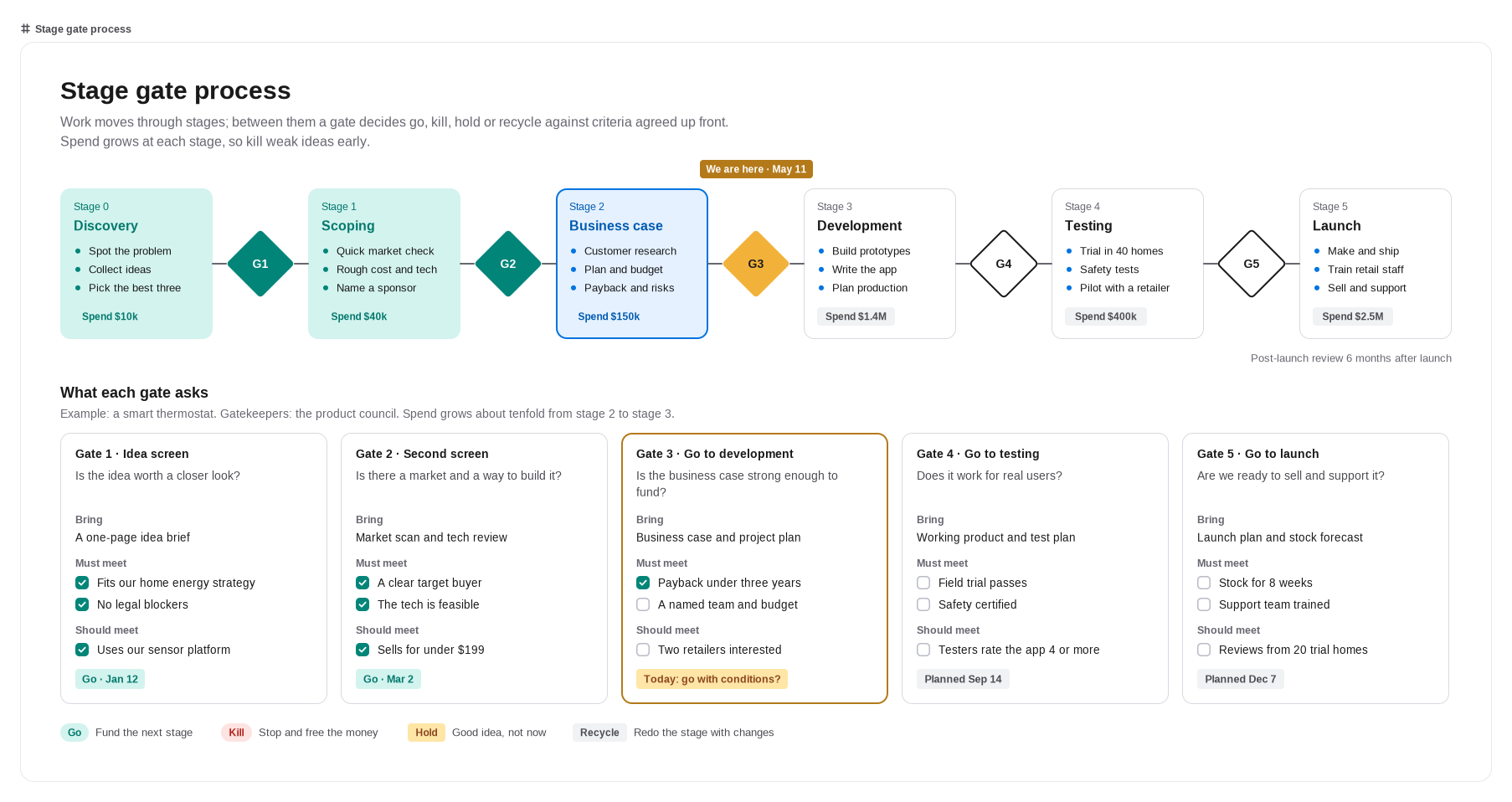
This template draws the process as a row of six stages and five diamonds, with a card under the row for every gate. The example is a smart thermostat, judged by a product council. The board has 160 elements, more than a Free board holds, so opening it needs the Pro or Team plan.
Six stages, and the spend grows
The row across the top runs from Stage 0 to Stage 5. Each box lists three activities and the money the stage will use.
- Discovery. Spot the problem, collect ideas, pick the best three. Spend $10k.
- Scoping. Quick market check, rough cost and tech, name a sponsor. Spend $40k.
- Business case. Customer research, plan and budget, payback and risks. Spend $150k.
- Development. Build prototypes, write the app, plan production. Spend $1.4M.
- Testing. Trial in 40 homes, safety tests, pilot with a retailer. Spend $400k.
- Launch. Make and ship, train retail staff, sell and support. Spend $2.5M.
The spend line is the reason the gates exist. Up to the business case the project has used $200k. Development alone costs about ten times the stage before it. A note after the last box adds one more checkpoint: a post-launch review 6 months after launch.
What each gate asks
Every gate has a card with the same five parts: a name, one question, what the team must bring, the criteria it must meet and the ones it should meet.
Gate 1, the idea screen, asks “Is the idea worth a closer look?” The team brings a one-page idea brief. It must fit the home energy strategy and have no legal blockers, and it should use the company’s sensor platform. Gate 2 asks whether there is a market and a way to build it: a clear target buyer and feasible tech are musts, a price under $199 is a should. Gate 3 asks for a business case with payback under three years and a named team and budget.
The split matters. A miss on a must-meet line ends the discussion. Should-meet lines are for ranking projects that all pass. Because the criteria are written down before the work is done, the gate meeting is about evidence. Enthusiasm does not carry a project through.
Four possible decisions
The key at the bottom left names what a gate can decide, and “go” is only one of four:
- Go. Fund the next stage.
- Kill. Stop and free the money.
- Hold. Good idea, not now.
- Recycle. Redo the stage with changes.
The last line of each card records the outcome. The thermostat got “Go · Jan 12” at gate 1 and “Go · Mar 2” at gate 2. A process in which every project always gets a go is not doing its job. If your gates never kill or hold anything, look at whether the must-meet lines are real.
We are here: the gate before the big spend
A marker above the third diamond reads “We are here · May 11”. Gate 3 is the most expensive decision on the board. Behind it lies $150k of business case work, and ahead of it $1.4M of development.
The card for this gate ends with an open question where the others have a date: “Today: go with conditions?” That is a realistic outcome. A council may fund development while asking for something it has not yet seen, such as the second interested retailer on the should-meet line. Write the condition on the card, with a date, so it is checked and not forgotten.
How to use the stage gate process template
- Open it as a new board. Use this template copies the thermostat example into your workspace. It needs a Pro or Team plan.
- Rename the stages. Keep five or six. Write three activities and a budget into each box, so the growth in spend can be seen.
- Write the gate cards before you start. For each gate set the question, what to bring, and two or three must-meet and should-meet lines. Agree them with the people who will decide.
- Plan the gate dates. Future gates carry a planned date, as gates 4 and 5 do in the example: Sep 14 and Dec 7.
- Record each decision. After a gate meeting, replace the planned date with the outcome and its date, and move the “We are here” marker.
When gates help, and when they slow you down
The process fits projects where a late failure is expensive: hardware, regulated products, anything with tooling, stock or certification. It also suits a company that runs many projects and has to choose which ones to fund.
For software that can be released and changed weekly, five formal gates are usually too heavy, and a software development lifecycle or a sprint rhythm fits better. Earlier in the funnel, when you are still choosing among raw ideas, an idea funnel does the sorting. The business case that gate 3 asks for can start from a cost-benefit analysis.
Questions about the Stage gate process template
What is the difference between a stage and a gate?
A stage is a period of work with a budget, such as scoping or testing. A gate is a meeting between two stages where the decision is made to fund the next one or not. Work happens in stages. Decisions happen at gates.
Who are the gatekeepers?
The people who control the money and resources for the next stage, usually senior managers from product, engineering, finance and sales. In the example it is a product council. The project team presents and does not vote.
Can I open this template on the Free plan?
No. The board has 160 elements and a Free board holds up to 150, so this template needs the Pro or Team plan. Once it is in your workspace, every stage, gate and card can be edited or deleted.
Does a stage gate process work with agile teams?
Yes, many companies combine them. The gates decide funding and direction a few times a year, and inside each stage the team works in sprints. The gate criteria stay fixed while the way of working within a stage is up to the team.